
CRM for Coaches How to Organize Clients and Grow
You finish a coaching session, open Excel, and realize three clients still need follow-up. One prospect is buried in an old email thread, a package renewal sits in your calendar notes, and the discovery call you thought you rescheduled is still marked as tentative. None of these tasks is difficult on its own. Together, they create a quiet revenue leak between sessions.
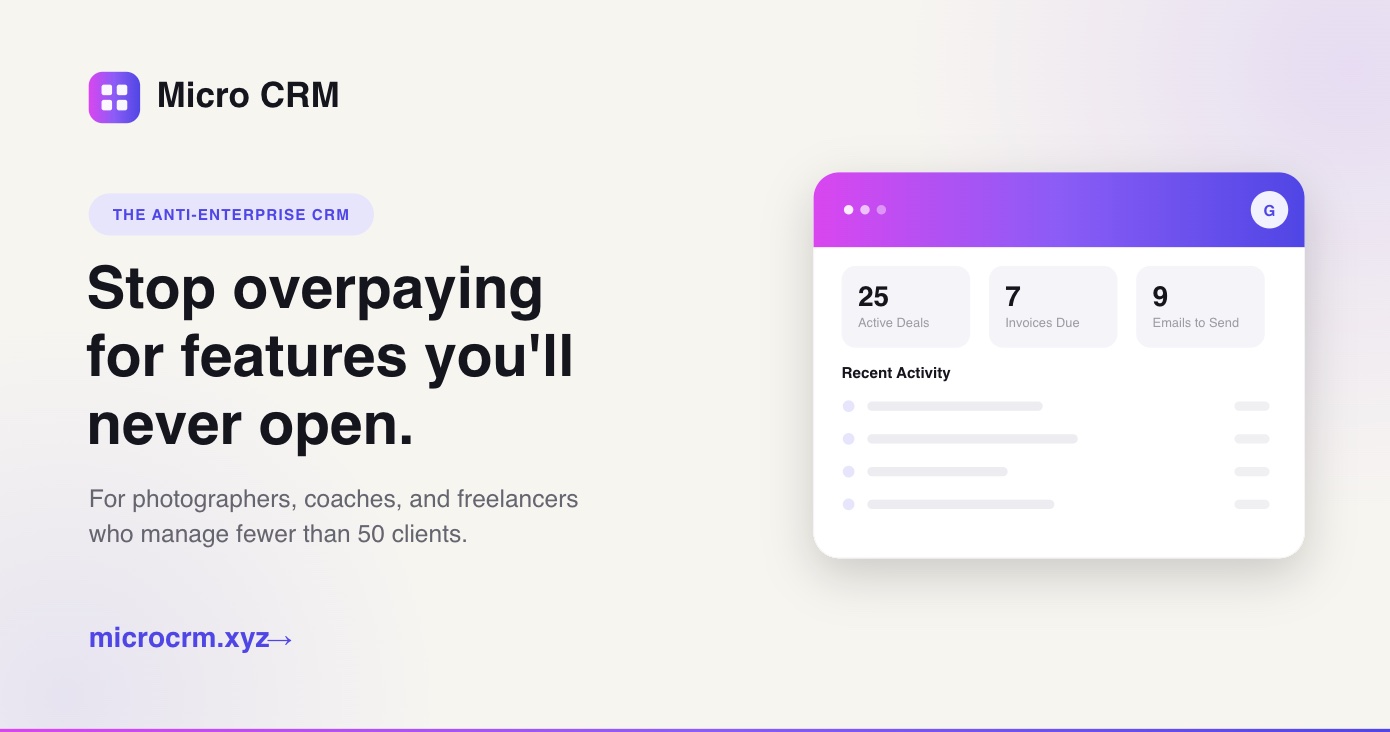
A CRM for coaches can bring contacts, deals, invoices, appointments, and follow-ups into one working view. The right system shouldn't turn a solo practice into an enterprise operation. It should help you remember the next useful action, recover missed opportunities, and keep client administration from competing with coaching.
Table of Contents
- Why Coaches Outgrow Spreadsheets and Sticky Notes
- What a CRM Really Does for a Coaching Practice
- Essential CRM Features Every Coach Actually Needs
- Spreadsheets vs Complex CRMs vs a Lean Coaching CRM
- How to Evaluate and Set Up Your Coaching CRM Without Overwhelm
- Automate the Follow Up Keep the Coaching Human
- Start Simple and Keep Clients Moving Forward
Why Coaches Outgrow Spreadsheets and Sticky Notes
A spreadsheet works well when your practice is small, your memory is reliable, and every client conversation happens in one place. Coaching rarely stays that tidy. A lead may arrive through a referral, book through a calendar link, receive a proposal by email, and then disappear until you remember to check in.
Suppose a prospect has completed a discovery call and is considering a package. In Excel, you might update a status cell, add a reminder to a separate calendar, and leave a note in your inbox. If you don't connect those actions, the record tells you only that the person exists. It doesn't reliably tell you what happened, what you promised, or what should happen next.
Practical rule: If you need to search three apps before contacting a client, your client record isn't centralized enough.
The problem becomes more visible after a booking changes. A client reschedules, but the original reminder remains active. Another client misses a session, and you make a mental note to reach out later. A package nears its end, yet the renewal conversation starts only after the final session. These aren't dramatic failures. They're ordinary interruptions that gradually reduce consistency.
The hidden cost of scattered context
Spreadsheets require manual data entry, while email and calendar actions often happen in separate applications. A CRM can connect calendar activity with a chronological interaction record, reducing the chance that an appointment or planned follow-up slips through the cracks, as explained in this comparison of spreadsheets and CRM systems.
The operational cost isn't just typing. It's the repeated effort of reconstructing context before every message. You remember the client, but you don't immediately remember whether they asked for a proposal, paused their package, or wanted to continue next month.
For practical guidance on creating a cleaner contact system, use this guide to organizing contacts. The goal is simple: every person should have one dependable record, one current status, and one visible next step.

A lightweight tool such as MicroCRM can provide that central workspace without requiring you to rebuild your entire business around software. You can keep the system focused on the work a coach repeats: managing contacts, moving opportunities forward, sending invoices, scheduling appointments, and following up.
What a CRM Really Does for a Coaching Practice
Think of your coaching CRM as the front desk of a well-run studio. The front desk doesn't coach the client, interpret their goals, or replace your judgment. It makes sure the right file, appointment, payment detail, and next action are available when you need them.
The first job is the client hub. Each contact should hold basic details, tags, notes, and a history of interactions. When a former client returns, you shouldn't need to search old messages to remember the last conversation. The record should give you enough context to respond personally and accurately.
The second job is the workflow engine. This part of the CRM handles repeatable movement, such as a booking confirmation, an appointment reminder, a rescheduling action, or a follow-up after a missed meeting. Salesforce describes CRM automation as a way to save time, reduce errors, improve productivity, and support timely follow-ups by reducing routine administrative work. You can read its explanation of CRM automation and follow-up workflows for the broader operating principle.
From installed software to the browser
Modern coaching CRMs inherit the SaaS model that reshaped the wider CRM category. Salesforce.com was founded in 1999, went public in 2004, launched AppExchange in 2005, and introduced Force.com in 2007, helping move CRM from a standalone application toward a broader web-based platform, according to this history of CRM development.
That history matters for a solo coach because you don't need a server, a local installation, or a large technical project to begin. A browser-based system fits the way coaching work already happens. You can open it before a session, after a discovery call, or while preparing an invoice.
The third job is the pipeline view. A pipeline turns vague business activity into visible stages, such as new inquiry, discovery call, proposal sent, active client, renewal due, and reactivated. You can then see which conversations are moving and which ones have stopped.

A useful CRM doesn't decide whom you should coach or what message you should send. It gives you a reliable operating picture, so your attention goes toward the relationship rather than hunting for information.
Essential CRM Features Every Coach Actually Needs
A coaching CRM earns its place by handling a small set of recurring jobs. Feature count matters less than whether the system prevents a specific interruption, delay, or missed touch.

1. Contact management that preserves context
A contact record should include searchable details, tags, notes, and interaction history. Tags might distinguish executive coaching, career coaching, past client, referral partner, or renewal opportunity. The label matters less than the ability to find the right group and understand each person's history.
A client who paused coaching shouldn't look identical to a brand-new inquiry. The record should show the relationship, not just the name.
2. A visual pipeline for movement
A Kanban pipeline gives you a simple answer to a daily question: where does each opportunity stand? Dragging a prospect from discovery call to proposal sent makes progress visible without forcing you to read every note.
Use stages that match your real process. A solo coach might use:
- New inquiry: The person has expressed interest.
- Discovery booked: A conversation is scheduled.
- Proposal sent: The offer is awaiting a decision.
- Active client: The engagement has started.
- Renewal due: The current package is nearing completion.
- Reactivation: A past client may be ready to return.
3. Scheduling with reminders
An appointment calendar should show availability, bookings, confirmations, rescheduling, and reminders in one flow. Independent scheduling guidance recommends reminders before every appointment, one-tap confirmation and rescheduling links, and a reminder sequence that restarts after a reschedule. That setup makes booking rate, show rate, and reschedule recovery rate useful operating KPIs rather than guesses, as described in this appointment reminder workflow guide.
4. Notes and journaling
Session notes should stay connected to the client record. Keep coaching judgment and sensitive details appropriately protected, but don't scatter routine goals, agreed actions, and next-session prompts across notebooks and private documents.
The CRM shouldn't replace your coaching methodology. It should make the administrative facts easy to retrieve.
5. Invoicing and simple reporting
A practical system should create a professional invoice, produce a PDF, and send it by email. It should also show clear activity, deal, and revenue indicators without requiring a reporting specialist.
Email integration supports the same principle. This CRM email integration guide is useful when you want messages, templates, and follow-up activity tied to the client record instead of isolated in your inbox.
Evaluation question: Can the system help you identify the next client action in less time than opening your spreadsheet?
For coaches with fewer than 50 clients, these essentials usually matter more than course hosting, complex AI assistants, or elaborate enterprise permissions. The best feature is the one you'll use consistently.
Spreadsheets vs Complex CRMs vs a Lean Coaching CRM
Choosing a CRM for coaches isn't a contest between “simple” and “powerful.” It's a question of operational fit. A spreadsheet may be enough for a short list of contacts. An enterprise CRM may be appropriate for a large sales department. A lean CRM sits between those extremes, with enough structure to prevent missed actions without turning setup into a project.
| Criteria | Spreadsheets | Enterprise CRM | Lean Micro CRM |
|---|---|---|---|
| Setup | Familiar, but requires manual structure | Often configuration-heavy | Designed for quick onboarding |
| Daily work | Manual updates across separate tools | Many options and screens | Focused contact, pipeline, calendar, email, and invoice workflow |
| Follow-up | Personal reminders and separate calendar tasks | Advanced sequences and rules | Practical templates and follow-up sequences |
| Visibility | Rows and filters | Detailed dashboards | Kanban stages and clear KPIs |
| Billing | Often handled elsewhere | May require modules or integrations | Integrated invoice creation, PDF generation, and email delivery |
| Best fit | Very small or temporary tracking needs | Larger teams with complex processes | Freelancers, coaches, consultants, and small businesses |
The spreadsheet trade-off
Spreadsheets feel inexpensive because many people already have access to them. The trade-off appears in maintenance. You enter information manually, create your own status conventions, and switch to other apps for email, appointments, and invoicing.
Paid small-business CRM plans commonly fall around $15 to $30 per user per month, according to this small-business CRM and spreadsheet comparison. For a three-person team, that range works out to roughly $540 to $1,080 per year, based on the same source. A solo coach should still compare the cost against the time and missed follow-ups the system is meant to address.
The enterprise trade-off
Complex CRMs can offer automation builders, advanced reporting, permissions, and integrations that a coach may never use. More capability can create more decisions, more configuration, and more opportunities to stop using the system.
A lean MicroCRM approach keeps the workspace centered on contacts, deals, invoices, emails, appointments, and reporting. That makes sense when your practice needs reliable movement and clear records, not a software administration role.
How to Evaluate and Set Up Your Coaching CRM Without Overwhelm
Don't begin by importing every contact you've ever stored. Start with the workflow you need this week and test whether the CRM supports it without explanation from a consultant.

Test the complete client journey
Use a free plan or trial to run one realistic example. Add a test contact, write a note, create a deal, move it through the pipeline, schedule an appointment, and generate an invoice. You're not testing isolated features. You're checking whether the entire path feels natural.
Look for these signals:
- You can add a contact quickly. The record should make sense without a training session.
- You can see the next action. A deal shouldn't disappear inside a contact list.
- You can schedule and reschedule. The calendar should support real client changes.
- You can bill without another manual system. Invoice creation and delivery should be straightforward.
- You can find history immediately. Notes and messages should remain connected to the person.
MicroCRM offers a free plan with no credit card required, so a coach can test the basic workflow before committing. The broader product is designed around minimal setup, centralized contact and deal management, Kanban stages, invoicing, automated emails, and an appointment calendar.
Migrate only what you can maintain
Clean your Excel file before importing it. Remove duplicates, standardize names, and decide which fields you will use. A small, accurate working list is more valuable than a large database you never review.
Create pipeline stages that reflect your coaching business rather than copying a sales team's terminology. For example, separate “discovery booked” from “discovery completed,” because the distinction helps you identify conversations that need a follow-up.
Start with one live workflow: inquiry, discovery, proposal, active client, renewal, and reactivation.
Set a specific go-live day. From that point forward, enter every new inquiry and appointment in the CRM, even if you still keep historical records elsewhere. Consistency matters more than a perfect configuration.
Automate the Follow Up Keep the Coaching Human
Automation should handle timing and repetition. You should handle interpretation, empathy, coaching judgment, and meaningful personal outreach.
A minimum viable workflow can look like this:
- At booking: Send confirmation with the appointment details and a clear reschedule option.
- Before the session: Send a reminder sequence that supports confirmation and changes.
- After a reschedule: Restart the reminder sequence so the new appointment doesn't rely on memory.
- After a no-show: Send a same-day or within-24-hours recovery message, then create a clear next action.
- Before package completion: Trigger a renewal prompt while the client's progress and goals are still current.
- After a quiet period: Flag warm past clients for personal reactivation.
Appointment guidance identifies automated email and SMS reminders as effective no-show reduction tactics, and notes that payment or deposits at booking can create financial commitment and reduce missed appointments. For a micro CRM, that translates into booking records, event-driven follow-up logic, reminder templates, and tracking for no-show and recovery activity, as outlined in this CRM no-show recovery workflow.
What should remain manual
Don't automate the parts that make the relationship feel generic. Your session notes, personal progress observations, renewal conversation, and response to a vulnerable client message should remain yours.
Automation can remind you that a package is ending. It can't decide whether the client needs a challenge, a pause, a different offer, or a thoughtful conversation. Use the system to surface the moment, then bring your coaching presence to it.
For guidance on building practical email sequences, see this email follow-up automation resource. The sequence should support your process, not create a new maintenance burden.
Measure the leaks, not vanity metrics
Track the points where clients and prospects tend to disappear:
- Booking rate: How often an interested person schedules.
- Show rate: How often booked appointments happen.
- Reschedule recovery rate: How often changed appointments become attended sessions.
- No-show rate: How often a scheduled session is missed.
- Renewal activity: Whether package completion leads to a timely conversation.
- Reactivation activity: Whether past clients receive an intentional invitation to return.
These indicators help you improve the path from inquiry to attended session, then from active engagement to renewal. You don't need a complicated dashboard. You need enough visibility to see which follow-up is being missed.
Start Simple and Keep Clients Moving Forward
A useful CRM for coaches should make your practice feel calmer, not more technical. The decision becomes clearer when you focus on three principles.
First, centralize the record. Put contact details, notes, appointments, deal stages, and invoices where you can find them together. This reduces the repeated task of rebuilding context before every conversation.
Second, protect the moments between sessions. No-show recovery, package renewal, and past-client reactivation deserve the same operational attention as new bookings. Those moments often depend on a timely touch, and a CRM can make that touch visible before it becomes a forgotten intention.
Third, keep automation proportional. Confirmations, reminders, rescheduling, invoice delivery, and simple follow-up sequences are sensible candidates. Personal coaching communication should still sound like you.
Small-business CRM adoption has moved well beyond a niche practice. One 2024 industry summary reported 71% adoption among small businesses with 500 or fewer employees, while an earlier benchmark cited by the same source placed SMB adoption at 26%, showing how quickly CRM use has spread across smaller organizations, as reported in this CRM statistics overview. For coaches, that shift reflects a practical reality: consistent client tracking is becoming part of normal business operations.
You don't need to start with a complex platform. Test one client journey, move your active opportunities into a visible pipeline, and automate only the reminders that repeatedly escape your attention.
Manage clients, deals, and invoices in one platform with MicroCRM, a lightweight workspace built for practical coaching operations. Visit Micro CRM to start for free, with no credit card required, and begin replacing scattered spreadsheets and missed follow-ups with one clear client workflow.