
CRM for Freelancers: How to Choose the Right One
You've got a messy spreadsheet open, three client tabs fighting for attention, and one invoice still sitting in your notes app because you meant to send it yesterday. That's the freelancer problem. The work itself isn't the bottleneck, the admin stack is.
A CRM for freelancers should fix that without turning your business into an enterprise software project. MicroCRM is one example of the lean approach, a single place for clients, deals, invoices, follow-ups, and calendar work, with a low learning curve and no extra layers you'll never use. MicroCRM
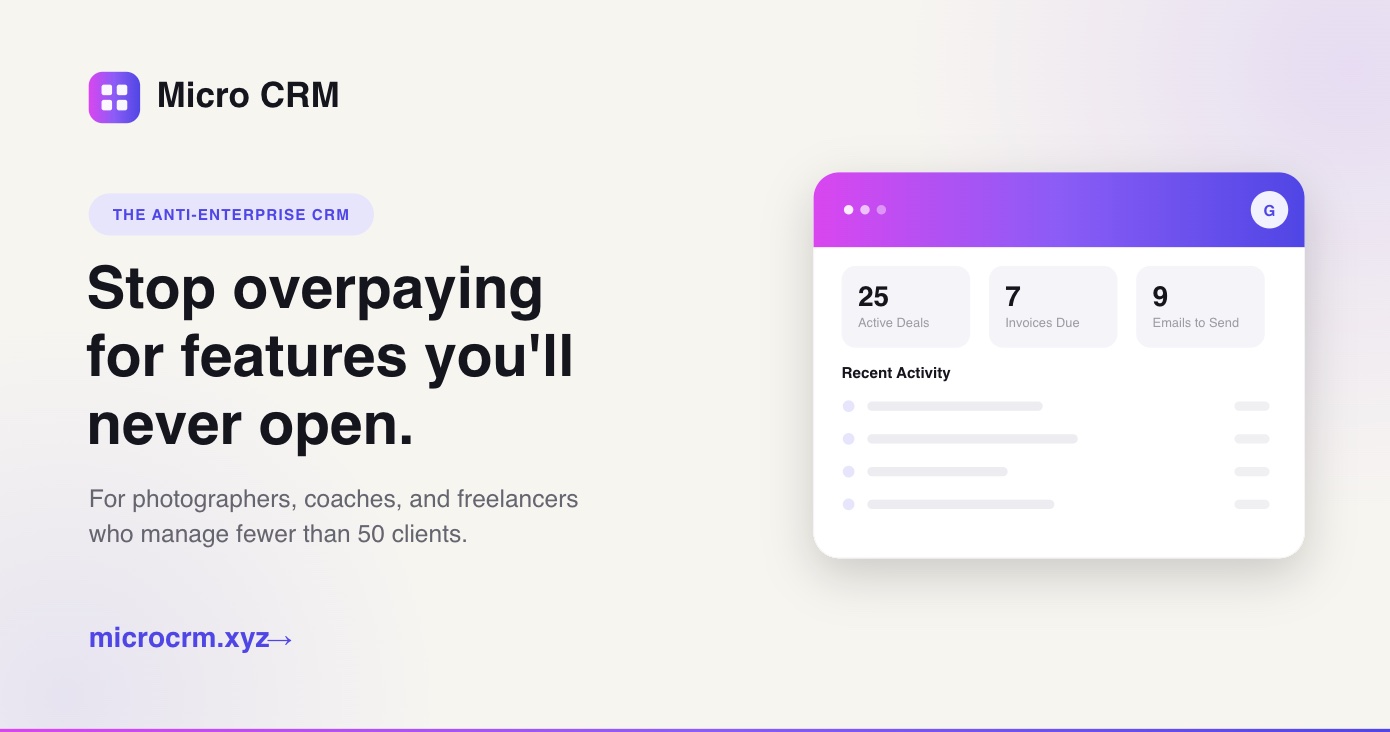
Table of Contents
- The Freelancer Workflow Problem Most Tools Ignore
- What a Freelancer CRM Actually Does
- Core Features Worth Paying Attention To
- How MicroCRM Stacks Up Against Enterprise CRMs
- Setting Up Your CRM in a Single Afternoon
- Pricing, Plans, and Total Cost of Ownership
- When a Lighter CRM Is the Right Choice
- Bringing Clients, Deals, and Invoices Into One Place
The Freelancer Workflow Problem Most Tools Ignore
A lot of freelancers don't have a “sales process,” they have a pile of conversations. A proposal lives in email, a payment reminder sits in a spreadsheet, and the client's preferences are buried in a notes app. That fragmentation is exactly where follow-ups get missed and repeat work slips away.
The real cost of scattered tools
Freelancer-focused CRM guidance keeps pointing to the same workflow, keep client details, notes, proposals, and payment history together, use a visual pipeline, and handle reminders, scheduling, and billing in one system. That isn't enterprise software thinking, it's solo-operator survival. A neutral market-research source defines this segment as cloud-based client relationship management solutions for individual service providers, which is the right way to think about it: a small, practical system for people who need speed more than deep customization. HTF Market Insights
The reason spreadsheets fail here is simple. They store data, but they don't help you act on it. You can track a contact list in Excel, but you can't see where a deal stalls, when to send the next message, or whether an invoice has been sent without bouncing between apps.
Practical rule: if you're re-opening old tabs just to remember what a client asked for, your workflow is already too fragmented.
Why a focused CRM beats patchwork admin
A lightweight CRM replaces that patchwork with one searchable client record. For freelancers, that record should hold conversations, project status, billing history, and follow-up tasks in the same place. When a client re-engages after a few weeks or months, you shouldn't have to rebuild the context from scratch.
That's where a focused tool like MicroCRM makes sense. It doesn't try to be a giant operating system. It just centralizes the client work that matters, so you can stop managing memory and start managing relationships.
What a Freelancer CRM Actually Does

A freelancer CRM is a digital front desk. Instead of scattering client details across inboxes, docs, and payment tools, it keeps the conversation, the deal, and the invoice tied to the same record. That matters because solo operators usually don't need layers of territory management, team permissions, or giant reporting trees.
Think in one client record, not five separate apps
The most useful structure is a single searchable client record. That record should hold contact details, message history, project notes, pipeline stage, and billing information together. Independent freelancer CRM guides keep circling back to the same idea because repeated lookup is where time disappears.
That's the point of this category. It exists because solo service providers need a compact workspace, not a sprawling database. You can tell your current setup is failing if you're still jumping from inbox to spreadsheet to calendar just to answer one client question.
The difference from enterprise CRM software
Enterprise CRMs assume teams, handoffs, permissions, and detailed reporting. Freelancer CRM software assumes one person wearing all the hats. The workflow is lighter, the setup is faster, and the data model stays simple enough to use every day.
A useful way to judge any tool is to ask whether it helps you answer three questions fast. Who is this client, what stage is the work in, and what happens next? If the software makes those answers harder to find, it's not a freelancer CRM, it's overhead.
A good freelancer CRM feels boring in the best possible way. You open it, see what needs attention, and move on.

Core Features Worth Paying Attention To
Unified records and a visual pipeline
The first thing to demand is a unified contact record. A designer shouldn't have to check one place for the brief, another for the last email, and a third for payment status. The value is context on demand, especially when a client comes back after going quiet.
The second critical feature is a visual Kanban pipeline. For freelancers, that board turns vague momentum into clear stages. A coach can move someone from inquiry to discovery call to proposal to paid, and a writer can see exactly which pitches are waiting for a reply.
Best use case: if you can glance at the board and know who needs a nudge today, the pipeline is doing its job.
Invoicing, templates, calendar, and reporting
The next three features are where the admin savings show up. Integrated invoicing keeps billing attached to the same client record, which means you're not rebuilding the same details every time. Email templates and follow-up sequences cut down the repetitive writing that eats solo hours, and a shared appointment calendar reduces back-and-forth when someone wants to book time.
A simple reporting dashboard matters too, but only if it stays readable. You don't need a wall of charts, you need a quick view of what's open, what's overdue, and where the money is likely to land. That's consistent with freelancer guidance that emphasizes reminders, scheduling, and billing from one system rather than app hopping. For a deeper look at connected messaging workflows, see CRM with email integration.
Features that look impressive in marketing, like heavy AI layers, elaborate approval paths, or custom enterprise objects, usually don't earn their keep for a freelancer with a modest client book. The right system is the one that helps you respond faster and forget less.
How MicroCRM Stacks Up Against Enterprise CRMs
Fit matters more than prestige
If you're under 50 active clients, enterprise CRMs are usually overkill. They're built for complex sales organizations, not solo operators who need to keep a small number of relationships moving. That gap shows up immediately in setup time, learning curve, and the number of settings you'll never touch.
Here's the comparison that matters.
| Dimension | MicroCRM | Enterprise CRM |
|---|---|---|
| Setup | Fast, minimal configuration | Longer onboarding, more setup decisions |
| Learning curve | Low, built for solo use | Steeper, more moving parts |
| Core workflow | Contacts, deals, invoicing, email, calendar | Broader sales operations and team features |
| Fit for under-50-client rosters | Tight fit | Often too much software for the job |
| Feature load | Essentials only | AI add-ons, custom objects, multi-team permissions |
| Admin overhead | Low | High |
What freelancers usually don't need
Most freelancers don't need custom objects, multi-team permissions, or advanced AI add-ons to stay on top of clients. They need fast access to relationship history, a visible next step, and billing that doesn't require another system. That's why the smaller tool wins.
MicroCRM's value is that it keeps the workflow compact. Contacts, deals, invoicing, email sequences, and calendar work live in one interface, so you don't pay in time every time you need to update a record. Enterprise tools can be excellent for big teams, but for a solo business they often slow adoption because you spend more time configuring than using.
If you want the simplest test, ask whether the software helps you run the next week better. If the answer is yes, you're looking at the right class of tool. If the answer is “eventually, after setup,” you're paying for prestige.
Setting Up Your CRM in a Single Afternoon

A clean setup sequence
A freelancer doesn't need a migration project. The workable version is plain and fast.
- Create the account immediately. Don't overthink structure before you've seen the interface.
- Import contacts from a spreadsheet or address book. That gets your real client list into one place.
- Define four to six pipeline stages. Match them to how work moves, not how a software demo looks.
- Connect inbox and invoice templates. Then turn on the follow-up pieces you'll use.
What usually slows people down
Duplicate contacts and stale tags are the usual mess. That's normal when you're pulling in years of scattered admin. Clean it once, then stop feeding the chaos back into the system.
For freelancers who slow down seasonally, the pause-and-preserve option is useful because it lets you keep the account intact without forcing a full rebuild later. That matters more than it sounds, because many solo operators don't want to pay for software during quiet months, but they also don't want to lose the structure they already created. If you want a practical walkthrough of day-to-day use, how to use a CRM system is the right companion read.
Start with the smallest version of the workflow you'll use every week. Anything bigger becomes a maintenance hobby.
A setup that earns its keep
A clean onboarding flow should end with one active pipeline, one inbox connection, and one invoice template. That gives you a working system before you add anything else. Once that's running, you'll know whether the CRM fits your habits instead of guessing from a feature list.
Pricing, Plans, and Total Cost of Ownership
Start with the free plan, then earn your upgrade
The right price is the one that matches your current client load. MicroCRM offers Free, Starter, Pro, and a limited-time Lifetime Deal, so a freelancer can start small and only move up when the workflow needs it. The free plan is built for testing the process before you commit money or attention.
That's the value of a free plan with no credit card required. It lowers the barrier to replacing spreadsheets with a proper client system. If the tool saves even a few round trips per client, the economics start to make sense fast.
Match the tier to the business stage
- Free: good for testing the workflow and getting organized with a small client list.
- Starter: better once you want a bit more room for ongoing client work.
- Pro: useful for a more established solo business handling recurring relationships.
- Lifetime Deal: makes sense if you want to commit to the system long term without a subscription mindset.
The important part isn't the badge, it's the total cost of ownership. A cheap tool that you never use is still expensive. A simple tool that keeps you from missing follow-ups or invoices pays for itself in time saved and cleaner client management.
For billing-specific thinking, invoicing as a freelancer is where the money side gets more concrete.
If you can see the client, the deal, and the invoice together, you're already ahead of the spreadsheet crowd.
When a Lighter CRM Is the Right Choice
Freelancers often think they need more software than they do. They don't. If your client book is still modest, the smartest move is to avoid AI-heavy deal scoring, automation builders you won't maintain, and client portals you don't need.
CRM should protect repeat work, not create a second job
The strategic value of a CRM for freelancers is retention. That matters because recurring work, re-engagement, and missed follow-ups are a significant money leak for solo operators. A CRM helps you notice who needs a check-in, who's waiting on a proposal, and who might buy again, which is more valuable than chasing shiny lead-gen features.
There's also a practical threshold for when organization tools become necessary. Coherence points to 20+ clients or losing track of follow-ups as the point where a CRM starts to make sense, which is a useful line in the sand for a solo business. Above that point, a spreadsheet usually becomes a memory test. Coherence
Security and simplicity are enough for most solo books of business
A lighter tool can still be serious about security. MicroCRM's published product details say it uses AWS storage, encryption at rest and in transit, and Amazon Cognito authentication. For most freelancers, that's plenty when the alternative is stuffing client work into half a dozen consumer apps.
The bigger question is simpler. What would you use in the next ninety days? If the answer is contacts, follow-ups, invoices, and a calendar, then you do not need a heavyweight platform. You need something lean enough to become routine.
Bringing Clients, Deals, and Invoices Into One Place
A freelancer CRM should do three things well. It should keep client history searchable, make deal progress visible, and tie billing to the same place where the relationship lives. If it doesn't do those three things cleanly, it's not reducing admin, it's adding it.
The comparison with enterprise tools is straightforward. Big CRMs bring layers you probably won't use, while a lean system like MicroCRM keeps the essentials in one interface and cuts setup friction. That's the whole decision framework for freelancers under 50 active clients, fit beats complexity every time.
The free plan changes the risk equation too. You can try a dedicated workflow, see whether it fits your habits, and keep the admin stack tight without committing to a steep rollout. The result is simple, manage clients, deals, and invoices without wasting time on complex CRMs.
Start with the smallest system that helps you follow up on time, send invoices faster, and stop losing track of client history. If that sounds like the gap in your business right now, try MicroCRM and start for free. No credit card required.
A CTA for Micro CRM.