
CRM for Photographers That Saves Shoot Days
The first time I lost a shoot confirmation in a spreadsheet, it wasn't because I was disorganized. It was because the work was split across too many places, one tab for inquiries, one inbox for email, one invoice tool, one calendar, and a folder full of notes I meant to clean up later. By the time I found the client's editing preferences, I'd already burned part of a shooting day on admin that should've taken minutes.
That's the reason photographers start looking for a CRM for photographers. Not because they want another app, but because they need one client record that follows the job from inquiry to delivery without forcing them to copy the same details five times. A lightweight system like Micro CRM can fit that gap when the business needs contacts, pipeline tracking, invoicing, email follow-ups, and calendar scheduling in one place, without the overhead of a huge studio suite.
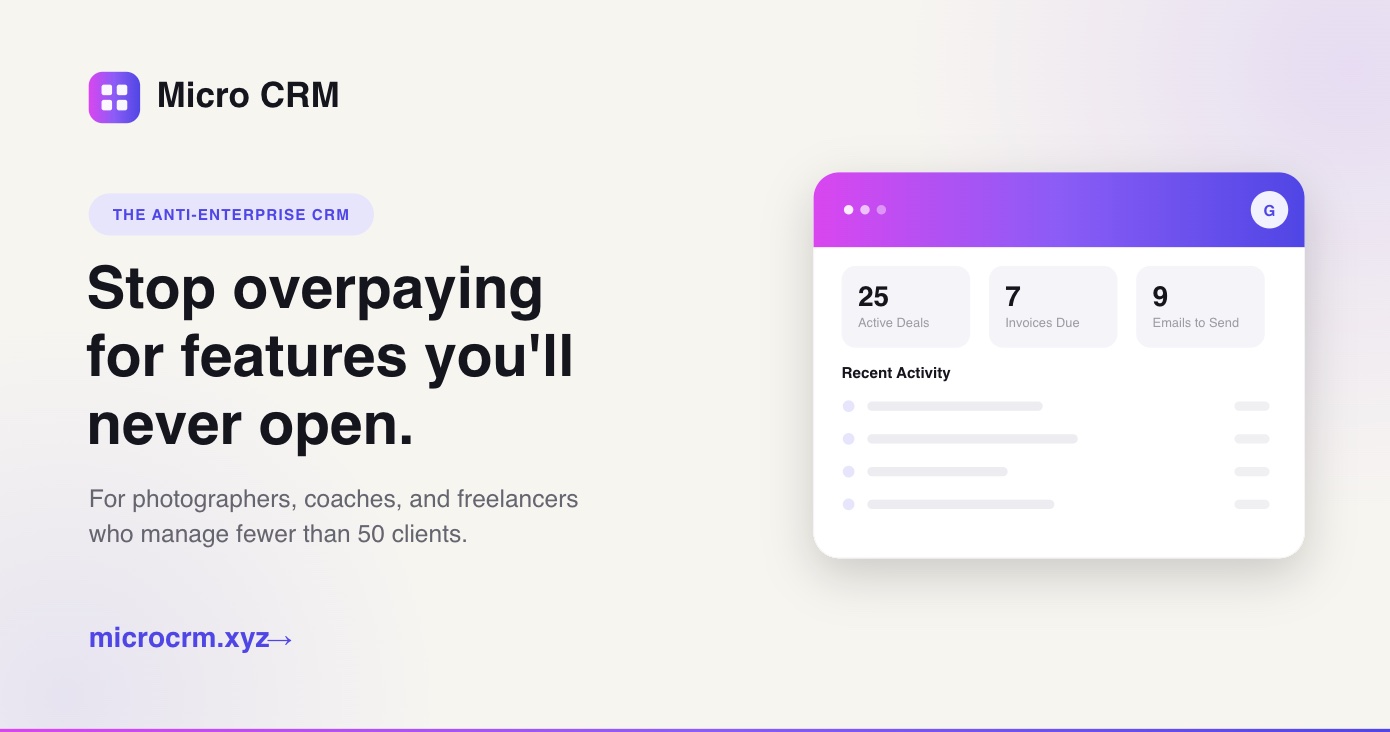
Table of Contents
- The Spreadsheet Problem Every Photographer Recognizes
- What a Photography CRM Actually Needs to Do
- Building Your Photographer Pipeline
- Spreadsheets vs a Dedicated CRM in Real Hours
- Migrating Your Clients Without Losing a Booking
- Turning Past Clients into Repeat Bookings and Referrals
- A Simple Plan to Get Started This Week
The Spreadsheet Problem Every Photographer Recognizes
The week that usually breaks the spreadsheet system starts small. A wedding inquiry comes in on Monday, the deposit reminder gets buried by Thursday, and by Saturday you're at a venue trying to remember whether the bride asked for black-and-white edits, extra family formals, or both. The invoice is in one tool, the contract is in another, and the note you wrote on your phone isn't where you need it.
That's the moment a single client record starts to matter more than another template. A photographer doesn't just manage names and email addresses, they manage inquiry status, shoot date, contract state, payment history, shot preferences, delivery milestones, and the little details that keep a client calm. The workflow is repetitive, but the details aren't.
Practical rule: if you have to retype the same client facts twice, the system is already leaking time.
A photographer-specific CRM works because it follows the actual business cycle, not a generic sales cycle borrowed from another industry. The market is clearly moving in that direction too. One industry report valued the CRM for photographers market at US$935.9 million in 2024 and projected US$2.5 billion by 2035 at a 9.3% CAGR from 2025 to 2035, while a second independent report estimated US$150 million in 2024 and US$262 million by 2030 at a 9.8% CAGR (wiseguyreports.com).
Those numbers don't tell you how to run a shoot, but they do confirm something practical. Photographers are spending money on tools that reduce admin around booking, communication, and billing because the old mix of spreadsheets and inbox searches keeps failing at the exact points that matter most.
What a Photography CRM Actually Needs to Do
A real crm for photographers has to handle the work where the calendar gets messy. That means it's not enough to store a contact card. It needs to hold the inquiry, the booking stage, the shoot logistics, the editing notes, and the delivery status in one place so the whole timeline stays visible.
The clearest way to judge any platform is by the jobs it takes off your plate.
The five jobs the system has to handle
- Inquiry capture: New leads come in through website forms, DMs, referrals, and repeat clients. The CRM should catch them without making you rebuild the lead by hand.
- Booking progression: Once a client is interested, the system has to track proposals, deposits, contracts, and the point where the session is officially locked.
- Shoot logistics: Locations, timing, shot lists, and special requests need to sit on the same record as the client, not in a separate note somewhere else.
- Post-production and delivery: Editing preferences, gallery status, and delivery deadlines belong in the workflow, because that's where mistakes cost trust.
- Repeat-business tracking: Anniversary shoots, seasonal campaigns, referrals, and rebooking reminders should live on the same client history, not in a forgotten “follow-up someday” list.
Wedding work is the clearest test. One industry guidance page notes that wedding clients often generate 50 to 100 shoot requests or preferences that should be attached to a single client profile, which is exactly why structured fields beat free-form notes (Plutio). A messy paragraph in a notes app doesn't help when you're standing on-site and need the exact family grouping or timeline detail.

If a tool can't keep those five jobs together, it's not solving the photographer's real problem. It's just moving the clutter into a prettier interface.
A sensible shortlist should include contacts, a visual pipeline, invoicing, email templates, and a calendar in one workspace. That's the baseline, whether the platform is a dedicated studio app or a lightweight tool like Micro CRM. For a simple setup, this internal guide on email integration for CRMs is a useful companion because email is where most booking friction shows up first.
Building Your Photographer Pipeline
The fastest way to make a CRM useful is to stop treating it like a contact database and start treating it like a production board. A photographer's pipeline should mirror the job as it moves through the calendar, from inquiry to gallery delivery and beyond. That means every stage needs a clear action, not just a label.
A pipeline that fits the shoot calendar
The most practical stages are New Inquiry, Quote Sent, Booked With Deposit, Shoot Scheduled, Editing in Progress, Gallery Delivered, and Review Request. Each one should tell you what's done, what's waiting, and what email needs to go next. In a Kanban view, that keeps the week legible at a glance instead of forcing you to hunt through tasks.
A few tags make the board far more searchable. Mark by session type, like wedding, portrait, branding, or family. Add tags for venue, referral source, season, and whether the client needs a reminder about a contract, a deposit, or final delivery.
Templates that save the most time
The template library should cover the same repetitive moments every week.
- Inquiry response: confirm the date is open, ask for the session type, and point to the next step.
- Contract and deposit request: make the booking action obvious and keep the wording consistent.
- One-week-before reminder: send session details, arrival timing, and any final prep notes.
- Post-delivery review ask: request a review while the gallery is still fresh in the client's mind.
The best follow-up email is the one you don't have to remember to write twice.
Micro CRM's visual Kanban board, invoice tools, email sequences, and appointment calendar fit this kind of setup well if you want one place to manage the full client path. The platform is built for a simple workflow, so the board stays usable without the setup drag that comes with heavier systems. For a deeper look at pipeline structure, this page on sales pipeline management maps neatly to the same logic.

The point isn't to automate everything. It's to make the next action obvious so the work doesn't stall between inquiry and booked date.
Spreadsheets vs a Dedicated CRM in Real Hours
A spreadsheet stack looks cheap until you count the time. Copying client details between tabs, searching for the latest email thread, checking whether the invoice went out, and manually reminding yourself about a follow-up all chip away at the day. The cost shows up in interrupted editing blocks and missed confirmations.
| Workflow Step | Spreadsheet + Email Stack | Dedicated CRM |
|---|---|---|
| New inquiry logging | Copy details from form or DM into a sheet, then open email separately | Create the lead once and keep the message thread with the contact |
| Deposit chasing | Check the invoice tool, then write a reminder email manually | Trigger a follow-up from the booking stage |
| Editing notes | Re-enter preferences from messages into a separate note | Store preferences on the same client record |
| Shoot reminders | Search the calendar, then draft reminder text or email | Use a saved template tied to the session date |
| Gallery delivery | Update the sheet, send the link, and note the delivery status elsewhere | Move the job to delivered and keep the record intact |
| Late payment follow-up | Cross-check the invoice tool and the spreadsheet before sending | Track billing alongside the client pipeline |
The point of a dedicated CRM is not fancy dashboards. It's fewer places to touch for the same booking. That's why tools built for small businesses matter, because the person doing the admin is often also the person shooting, editing, and handling client communication.
A focused platform also lowers the learning burden. Micro CRM is set up for contact management, pipeline tracking, invoicing, email sequences, and calendar scheduling in one workspace, and its free plan doesn't require a credit card. That matters if you want to test a new system without a long setup project.
If you're still using Excel plus a separate invoice app, you're probably doing more manual handoffs than you realize. Those handoffs are where follow-ups get missed, and for a photographer, a missed follow-up usually means a lost booking or a slower payment.
Migrating Your Clients Without Losing a Booking
Moving into a new system is where a lot of photographers hesitate, and for good reason. Active bookings can't disappear in a bad import, and nobody wants to rebuild six months of client history by hand. The move needs to be orderly, not dramatic.
Start with the fields that actually protect the booking
Export your contacts from the spreadsheet or old CRM, then clean the file before you import anything. Keep the fields that matter on shoot day and after it, like shoot date, package, deposit status, gallery link, and delivery deadline. Prune the rest if it's just clutter you never use.
Tagging during import saves you later. Separate active weddings, portraits, past clients, and referral partners so you can filter the list without guessing. Deduping matters too, because one client with three records is the fastest way to send the same reminder twice.
Keep the old system alive for a short overlap
Run the new CRM and the old spreadsheet in parallel for two weeks. That gives you a backup while you confirm that upcoming shoots, invoices, and contract statuses transferred correctly. Once the active calendar is stable, the spreadsheet can stop being the place you trust most.
Don't delete the backup until you've opened the next real booking from start to finish in the new system.
Data hygiene matters here because the CRM should reduce anxiety, not create it. If the vendor stores data on AWS with encryption at rest and in transit, that's a sensible baseline to look for when you're comparing options, especially if you keep contracts, payment history, and client notes in the same tool.
For a practical migration walkthrough, this guide on how to organize contacts is a good fit before you import anything. It helps you decide which records are worth preserving and which ones should be cleaned up first.
A one-page checklist works best in practice. Export contacts, clean duplicates, import active bookings, confirm invoice statuses, test one pipeline move, and only then start sending new reminders from the system.
Turning Past Clients into Repeat Bookings and Referrals
Most photographer CRMs stop at the booking. That leaves money on the table, because the same client record can drive the next session, the referral, and the seasonal offer if you build for it on purpose. Past work is not just archive material, it's a contact list with context.
The overlooked revenue layer
Set up segmented lists for anniversary shoots, family updates, seasonal mini-sessions, and past-wedding follow-ups. A client who already trusts your process is easier to rebook than a cold lead, and the CRM gives you a clean way to keep those campaigns separate from active inquiries. That keeps client messaging relevant instead of noisy.
Referral partners deserve their own category too. Wedding planners, venues, stylists, and agencies shouldn't be mixed into the same list as clients, because they need different communication rhythms. A quarterly check-in works better when the relationship is tagged correctly from day one.
The strongest move is simple automation. Send a thank-you after delivery, then a review request a little later, then a rebooking prompt around the moments that make sense for your niche. That keeps the relationship warm without making you manually remember every touchpoint.

A client record becomes a revenue tool when it stores more than a delivery status. It needs enough history to make the next outreach timely, personal, and easy to send.
A Simple Plan to Get Started This Week
The cleanest start is not a giant system rebuild. Import your contacts, build the seven-stage pipeline, and set up the four core email templates first. That alone gets the biggest admin chores out of your head and into a repeatable process.
Then send the first review request through the system, not from your personal inbox. That small change is where the habit starts, because the CRM begins doing the remembering for you instead of asking you to remember later.
If you want a simple setup without a steep learning curve, a lightweight tool like Micro CRM is worth a look. It combines contacts, a Kanban pipeline, invoicing, email sequences, and calendar scheduling in one workspace, and it offers a free plan with no credit card required. For freelancers and small studios that don't need a heavy feature stack, that's often enough.
Start with one shoot category, not your whole business. Once the workflow feels natural, expand the templates and tags to the rest of your calendar.
Micro CRM gives photographers one place to manage clients, deals, invoices, and follow-ups without juggling spreadsheets and scattered inbox threads. If you want to keep your bookings, payments, and delivery notes tied to the same client record, visit Micro CRM and start for free.