
How to Follow Up with Clients Without Sounding Pushy
You finish a project, send the files, and expect the client to reply with approval, a question, or payment. Instead, the inbox goes quiet. A few days become a week, the next project takes over, and eventually you send a vague “just checking in” message without a clear reason for contacting them.
That problem usually isn't a writing problem. It's an operations problem. Effective client follow-up depends on knowing who needs attention, what happened last, which action comes next, and when outreach should stop. A lightweight CRM can replace scattered spreadsheets, inbox searches, and memory with a repeatable workflow. The MicroCRM image represents that simpler approach, keeping client activity, deals, invoices, and reminders together instead of distributing them across several tools.
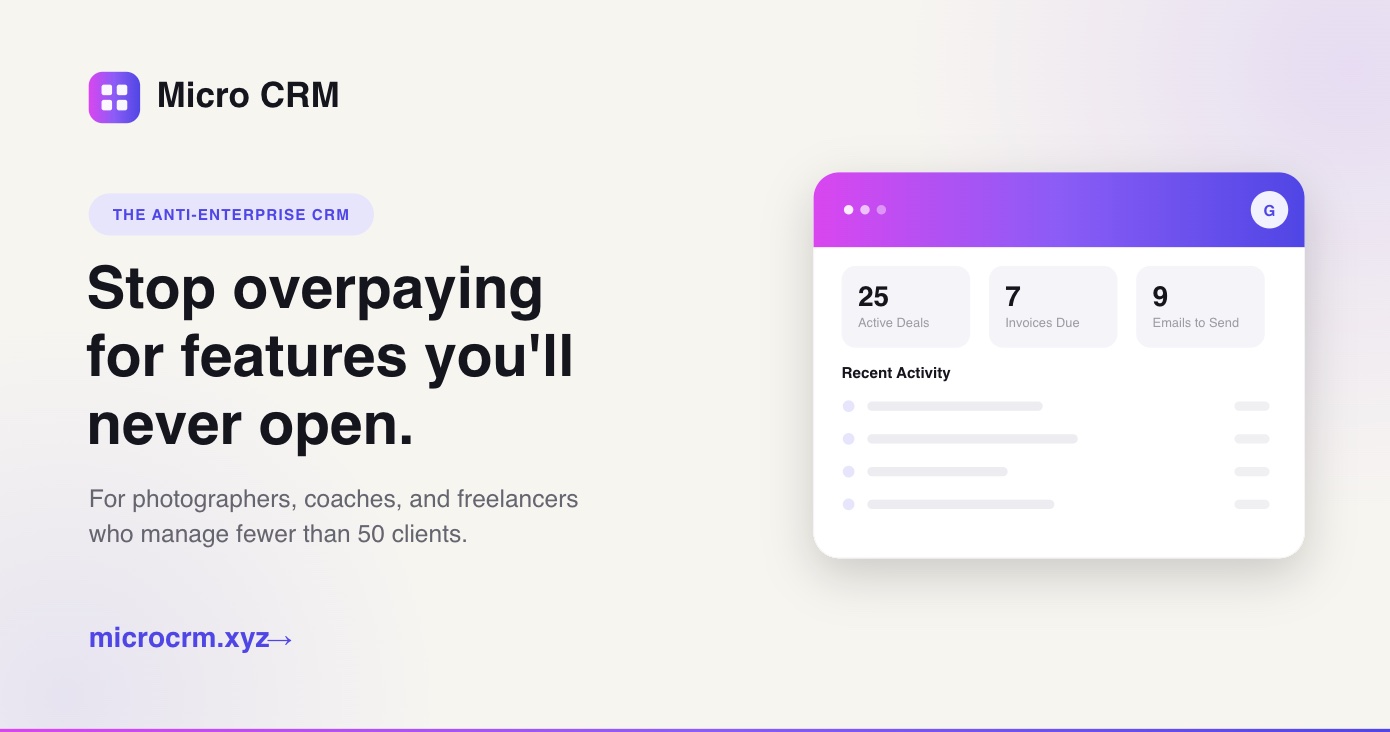
Table of Contents
- Why Most Client Follow-Ups Fail Before You Hit Send
- Prioritizing Clients Before You Write a Single Message
- Choosing the Right Channel and Timing for Each Touch
- Building a Multi-Touch Follow-Up Cadence That Stays on Track
- Subject Lines and Message Templates That Earn Replies
- Running the Whole Workflow Inside MicroCRM
- Measuring Results and Turning Follow-Ups Into a Weekly Habit
Why Most Client Follow-Ups Fail Before You Hit Send
A follow-up becomes awkward before you write it when the previous conversation has no recorded outcome. You may remember discussing a proposal, but not whether the client needed internal approval, wanted revised pricing, or just promised to respond after a meeting. Without that context, the message sounds generic because you're reconstructing the situation from memory.
The same issue appears after delivery. A designer sends final assets but doesn't record whether the client must approve them, whether the invoice is unpaid, or whether a launch date is approaching. When the client remains silent, the freelancer has no defined next step and no reasoned stopping point. Every reminder then feels like a fresh decision.
The four gaps behind weak outreach
- No next step: “Let me know what you think” leaves the client without a specific action.
- No context: An empty spreadsheet row doesn't show what was discussed, promised, or blocked.
- No owner: If several people touch a client account, nobody knows who should follow up.
- No stop condition: A sequence can drift into repetitive reminders that feel more like pressure than service.
A stronger workflow records one objective for every touch. The objective might be confirming receipt, requesting approval, answering an invoice question, or offering a scheduling option. It also records a due date and the condition that ends the sequence, such as a reply, a booked call, a declined proposal, or a final pause.
Practical rule: Never ask a client to “check in” with you. Give them one clear decision or action that makes replying easy.
This is why a tagged contact list matters more than a polished template. Before sending anything, you should be able to see the client's current stage, priority, last interaction, outstanding task, and next scheduled action. Once those fields are reliable, the message becomes a short expression of an organized process rather than a rescue attempt.
Prioritizing Clients Before You Write a Single Message
Start with the client list, not your inbox. A freelancer who follows up in send-date order can spend the morning chasing low-impact tasks while a valuable proposal or overdue invoice sits untouched. Prioritization makes outreach deliberate.
Use two simple dimensions: response likelihood and business priority. Response likelihood describes the client's current engagement. Business priority reflects revenue impact, deadline pressure, or the importance of the relationship.
Build a practical tagging system
Apply a stage tag to every active contact:
- Hot: The client has a live decision, recent conversation, or immediate project need.
- Warm: The client has shown interest but hasn't committed to a date or next action.
- Dormant: The relationship matters, but there's no current conversation or active deadline.
- Closed: The opportunity is won, lost, completed, or intentionally paused.
Then add a priority tier from A to D. Tier A might include a proposal awaiting signature, a critical delivery approval, or an invoice that affects near-term cash flow. Tier D can hold low-pressure nurture contacts and tasks that can wait.

Sort by tier first, then by the date of the next action. Don't sort only by the age of the last email. A dormant, high-value account may deserve a carefully planned reactivation message, while a recent low-priority note may not.
Update records after every interaction
After a call or reply, change the stage, add a short note, and schedule the next action. Use tags that describe decisions, not personality. “Needs approval,” “awaiting assets,” “invoice sent,” and “renewal opportunity” are more useful than subjective labels such as “difficult client.”
Review the list weekly and remove stale tasks. A useful qualification framework can help you decide whether a contact belongs in an active pipeline, as explained in this guide to qualifying leads in a CRM.
No outbound follow-up should go out until the contact has both a stage tag and a priority tier.
Choosing the Right Channel and Timing for Each Touch
The right channel depends on the client's decision, not your personal habit. Email works well when the client needs to review a proposal, approve a deliverable, answer an invoice question, or forward information internally. It creates a record and gives the recipient time to respond asynchronously.
Phone calls are more useful when the decision is blocked by uncertainty, urgency, or a question that would take several emails to resolve. After an unanswered email, a call should add clarity, not deliver another vague status request. Direct messages suit warm relationships and quick clarifications, but they're a poor default for cold prospects because the context is thinner and the interruption is more noticeable.
Match the ask to the channel
| Channel | Best Send Window | Ideal Use Case |
|---|---|---|
| During the client's normal working hours, with timing adjusted for their time zone | Proposals, approvals, documents, invoices, and detailed next steps | |
| Phone | After written context exists or when a specific question is blocking progress | Clarifying objections, confirming urgency, or resolving a complex decision |
| Direct message | When the relationship already supports informal communication | Quick questions, meeting coordination, and short clarifications |
Timing should follow the agreed project rhythm whenever possible. If a client says they'll review a proposal after a team meeting, schedule the reminder for after that meeting rather than applying a generic delay. For new outreach, follow-up data supports early, structured persistence. One benchmark reports that 80% of sales require at least five follow-up contacts, while another reports about eight touchpoints on average before a first meeting or comparable conversion with a new prospect. These figures are summarized in ZoomInfo's sales follow-up statistics.
The same source describes diminishing response rates across one sequence, with a first follow-up after 2 to 3 days producing a 21% response rate, compared with 17% for the second and 13% for the third. Treat those figures as directional benchmarks, not a license to keep contacting someone indefinitely.
Log the selected channel and the reason in the contact record. “Phone because approval is blocked” is useful future context. “Phone because email didn't work” isn't enough.
Building a Multi-Touch Follow-Up Cadence That Stays on Track
A cadence gives every message a job. Consider a freelancer waiting for a signed proposal. The mistake is sending four versions of the same reminder. The better approach is to use four touches that progressively reduce friction and then provide a respectful exit.
Use a clear day-by-day sequence
- Day 1: Confirm that the proposal arrived and ask whether the client has questions about scope, timing, or terms.
- Day 3: Use a polite call or short message to identify the specific blocker.
- Day 7: Share something useful, such as a revised scope note, implementation detail, or answer to a concern raised earlier.
- Day 14: Send a final proposal reminder and offer to close or pause the opportunity if the timing isn't right.

This four-touch example is intentionally bounded. Other benchmarks support a broader sequence of roughly six touches over about three weeks, spaced 3 to 4 days apart, while a separate guide recommends gaps that expand from 2 to 3 days to 4 to 5 days, then 7 days, 10 to 14 days, and 14 to 21 days. You can compare those timing approaches in this email follow-up sequence guide.
The practical choice depends on the segment. A warm lead with a stated decision date can receive a tighter sequence. A dormant client may need one useful reactivation message, not a full sales cadence. Enterprise contacts may require more restraint, while small-business audiences can tolerate modest persistence according to the segmented guidance in this follow-up statistics analysis.
Record the decision at every step
At each touch, record:
- Last contact: What you sent or discussed.
- Client signal: Replied, opened a discussion, declined, deferred, or stayed silent.
- Next action: The exact step you'll take.
- Stop condition: The event that pauses or ends outreach.
- New value: The information or option added this time.
MicroCRM can automate email sequences, schedule reminders when a client goes silent, and keep each touch in the contact timeline. That removes the need to remember which version you sent or search multiple inbox threads. It also prevents automation from becoming a spam loop because you can define the sequence and its stopping point before activating it.
Subject Lines and Message Templates That Earn Replies
A follow-up earns attention when it helps the recipient decide what to do next. “Just checking in” gives no context and creates no reason to reply. A specific subject line should identify the item, decision, or useful update without pretending the client has already agreed.
The message should also change at each stage. The first touch confirms context, the second removes friction, and the final touch offers a clear choice.
First follow-up after a deliverable
Subject: Feedback on the homepage concepts
Hi Maya,
I've attached the homepage concepts we discussed for the spring launch. Could you reply with A, B, or needs revision by Thursday? If another stakeholder needs to review them, I can send a short summary for that discussion.
Best,
Alex
This works because it points to a specific deliverable and gives the client an easy response format.
Second follow-up with a useful detail
Subject: One note on the proposal timeline
Hi Maya,
I reviewed the launch schedule and added a simple approval checkpoint to the proposal. It should make the handoff easier if your content team needs more time. Would you like me to hold the current start date, or should I move the project to the next available slot?
Best,
Alex
The second message doesn't repeat the first. It adds operational information and presents two realistic choices.
Final follow-up with an exit
Subject: Close or keep the project open
Hi Maya,
I haven't heard back, so I'm going to pause this proposal after Friday. Reply keep open if the project is still active, or pause if the timing has changed. Either answer is fine, and I can reopen the conversation later.
Best,
Alex
A clear exit protects the relationship and your time. The client doesn't have to invent a polite rejection, and you don't have to keep a silent task active forever. For more adaptable examples, see these email follow-up templates.
Running the Whole Workflow Inside MicroCRM
A spreadsheet can store names and dates, but it separates contact history, deal status, invoices, and reminders. That forces you to search for the last email, open the proposal elsewhere, and check the calendar before writing. Each interruption makes follow-up less consistent.
MicroCRM keeps those records in one workspace. Create the contact, add stage and priority tags, attach notes to the relevant deal, and set the next action before leaving the record. The Kanban pipeline shows which opportunities need attention, while contact history preserves the reason behind each status change.

Connect outreach to scheduling and billing
For a proposal, record the decision date, current stage, and next follow-up. If the client wants to talk, use the appointment calendar to offer available slots instead of starting another scheduling thread. Once the client is ready, move the deal forward and create the invoice in the same workspace.
Invoices need a separate follow-up rule. Tag an unpaid invoice, record when it was sent, and schedule a reminder that names the invoice number, due date, and payment method. The message should make payment easier, not just announce that you are still waiting.
Templates need judgment too. Use variables for names, project titles, and invoice details, then edit the central sentence to match the client's situation. Automation can manage timing and record-keeping. You still decide whether the message is relevant and whether the contact should receive it.
Watch the workflow overview before configuring your own process. This guide explains how CRM and workflow integrate.
A practical setup can begin with these actions:
- Import active contacts: Bring in current clients, prospects, and unpaid accounts.
- Create tags: Add stages, priority tiers, blockers, and invoice status.
- Build one cadence: Start with a short proposal or approval sequence.
- Add calendar options: Make booking the next conversation straightforward.
- Review the pipeline: Move deals as replies, approvals, pauses, and payments arrive.
The goal is a workable follow-up system, not an enterprise CRM replica. Contact-management software can reduce wasted time, improve engagement, support sales productivity, and strengthen retention by keeping client history available for personalized interactions, as described in this contact management guide. For freelancers and small businesses, judge the tool by whether it reduces context switching without creating another administrative job. MicroCRM brings contacts, deals, invoicing, email follow-ups, and calendar scheduling into one interface, with a free plan that does not require a credit card.
Measuring Results and Turning Follow-Ups Into a Weekly Habit
A follow-up system should produce better decisions, not just more activity. Track four measures each week: reply rate, time to reply, revenue recovered from follow-ups, and overdue invoice days. The first two show whether outreach is reaching people. The latter two show whether that activity affects cash flow and completed work.
Don't treat every benchmark as a universal target. One historical analysis found that follow-up emails generated 42% of all replies, while another review of 16.5 million emails reported a peak reply rate of 6.94% on the third email, compared with 4.1% when no follow-up was sent and 3.01% for sequences with five or more emails. Those figures, collected in this follow-up research summary, illustrate why sequence design matters, but your own segment and offer should guide final decisions.
Reserve 20 minutes every Friday for the operational review:
- Review unanswered touches and check whether the next action still makes sense.
- Mark stalled deals with a reason, such as budget, timing, or missing information.
- Queue the following week's sequences and calls.
- Archive dead contacts or pause them until there's a legitimate reason to reconnect.
MicroCRM can supply pipeline notes, reminder history, and invoice timestamps without requiring a separate analytics tool. If replies remain weak, change one variable at a time, such as the channel, subject line, value offered, or gap between touches. A useful cadence is a feedback loop: review what happened, adjust the workflow, and run it again.
Manage clients, deals, and invoices in one platform with a simple workspace that keeps follow-up history, pipeline stages, reminders, email sequences, calendar appointments, and invoicing connected. Visit Micro CRM to try the free plan, organize your next client cadence, and start for free with no credit card required.