
Online CRM for Freelancers and Small Businesses
You're probably juggling a spreadsheet with 40 client rows, an inbox full of “just checking in” drafts, and at least one invoice you meant to resend yesterday. That setup feels manageable until it isn't. The moment a client asks, “What's the latest on this?” and you have to search three apps and your browser history, you've already lost time.
An online CRM fixes that by putting contacts, deals, invoices, follow-ups, and scheduling in one place instead of forcing you to stitch them together by hand. For freelancers and small businesses, that matters more than flashy automation. If you want a simple browser-first option, MicroCRM is built for exactly that kind of work, with a free plan and no credit card required.
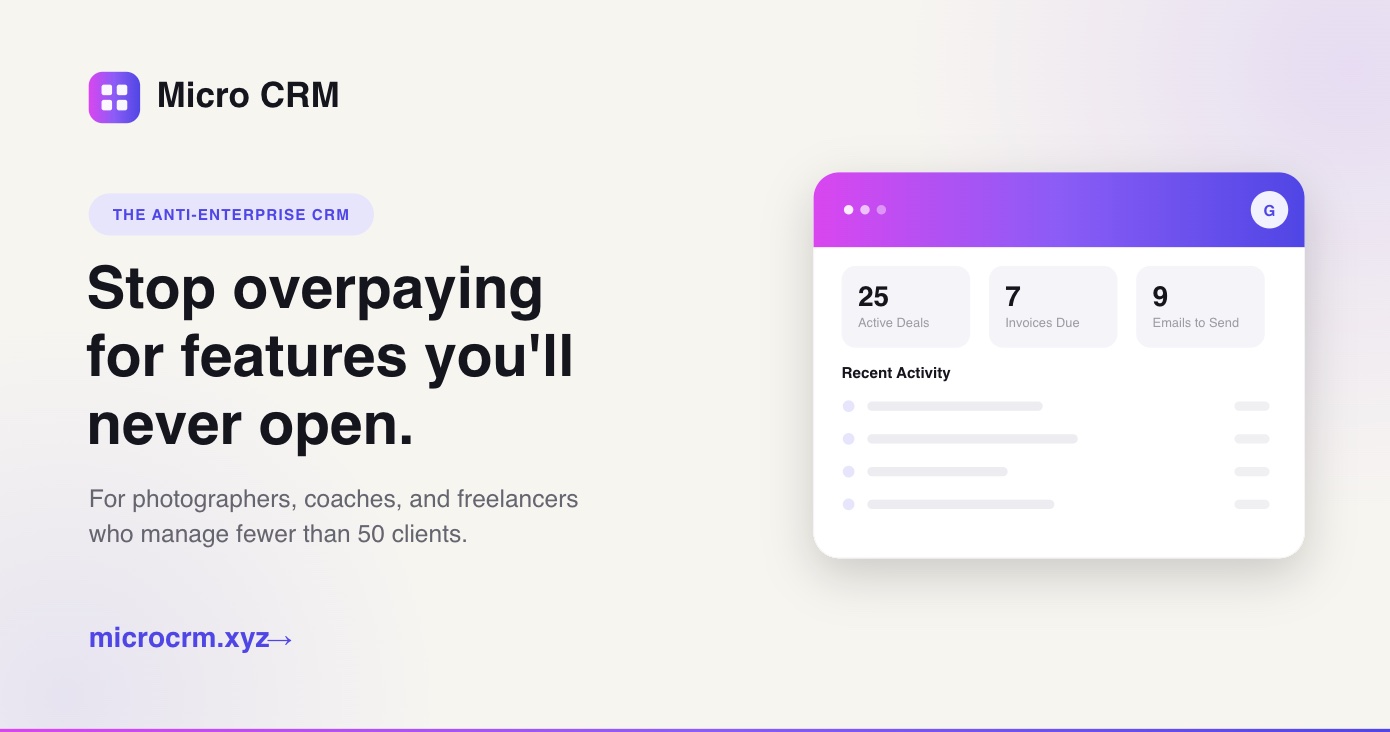
Table of Contents
- The Spreadsheet Trap Most Freelancers Fall Into
- What an Online CRM Actually Is
- The Core Modules a Small Operator Actually Needs
- Lightweight CRMs Versus Enterprise Platforms
- A Buying Checklist That Filters Out the Noise
- Migrating From Spreadsheets Without Losing Your Mind
- How MicroCRM Fits This Picture
- A Simpler Way to Run Your Client Work
The Spreadsheet Trap Most Freelancers Fall Into
Monday starts with a new lead in your inbox. You add the name to a sheet, paste the email into a notes app, and promise yourself you'll follow up on Thursday. By Friday, you've done the work, sent the proposal, and created a separate invoice, but the context lives in three different places.
That's the trap. The spreadsheet doesn't fail all at once, it fails in tiny ways, and those tiny failures pile up into missed follow-ups, duplicate invoices, and awkward calls where you can't remember what the client already approved. Admin starts eating the time you should spend delivering actual client work.
Where the friction shows up first
The first problem is context. A spreadsheet stores a name, maybe a status, maybe a number, but it doesn't tell you what was said on the last call or which email thread mattered most.
The second problem is repetition. You enter the same client details into a sheet, then an invoicing app, then your calendar, then a mail draft. Every extra copy creates another place for errors.
The third problem is follow-up fatigue. If you have to remember every next step manually, one busy day is enough to let a deal go cold.
Practical rule: If you have to search before every client call, your system is already too fragmented.
An online CRM is the cleaner path for operators with fewer than 50 clients because it replaces that patchwork with one workspace. You don't need enterprise complexity to stop losing track of deals. You need a central place where the next action is obvious.
What an Online CRM Actually Is
An online CRM is a browser-based system that keeps your customer information, deal status, communication history, and billing in one place. You log in from any device, open the client record, and see what's happening without installing desktop software or managing servers.
That browser-first setup matters because the dominant CRM pattern today is web-based deployment with REST APIs, plus browser and mobile access and cloud hosting on platforms like AWS, Azure, or Google Cloud, which reduces install overhead and makes integrations easier to run. The technical point is simple, the system lives online, so your records travel with you instead of staying trapped on one machine. For a freelancer, that's the difference between a tool you use and a tool you keep meaning to adopt.
Desktop CRM versus enterprise suite
A desktop CRM usually makes you think in terms of local files, manual sync, and device-specific access. That's awkward for a solo operator who works from a laptop, a phone, and a second screen at the office.
An enterprise suite goes the other direction. It adds layers, approvals, admin controls, and integrations that make sense for bigger teams, but often feel heavy when you're trying to log a deal, send an invoice, and schedule a call. If you manage a modest client list, the value of the system comes from speed and clarity, not from a long feature menu.

A useful mental model is this. An online CRM should give you contacts, pipeline, and invoicing as its core spine. If a product can't make those three parts easy, it's not solving the problem.
Later in the process, you'll see why a focused tool like MicroCRM fits this browser-first model. For now, keep the definition tight, if it lives in the cloud, works in a browser, and connects client data to action, it's an online CRM.
The Core Modules a Small Operator Actually Needs
A small operator doesn't need a massive feature catalog. You need a short list of modules that remove admin and keep client work moving. Anything beyond that should earn its keep.
Start with contacts, then attach history
The first essential feature is centralized contacts with a complete interaction trail. When you open a client record, you should see emails, calls, notes, and next steps in one timeline.
That means you're not digging through old inbox threads before every meeting. It also means anyone helping you, even if that helper is just future you, can understand the relationship fast.
Make the pipeline visual
A Kanban pipeline is the next piece because it turns deal tracking into a visual flow instead of a status field buried in a sheet. You drag an opportunity from one stage to the next and immediately know where it stands.
That matters when a quote turns into a win. The pipeline should make that movement obvious, so you're not manually cross-checking whether the client approved, whether the invoice went out, or whether the follow-up is overdue.
Keep billing tied to the deal
Integrated invoicing earns its place because billing is part of the same client story. Create the invoice from the deal, generate the PDF, and send it without leaving the record.
Simple test: If invoicing lives in a separate app, you're paying an admin penalty every time you close a deal.
Email automation and follow-ups belong here too. Personalized CRM-based email campaigns have a 14% higher click-through rate than non-personalized campaigns, which is a good reason to prefer built-in email tools over a messy bolt-on setup, according to a CRM statistics roundup on personalized CRM email performance. Calendar scheduling and clear KPI reporting round out the essentials, because a small team needs to see appointments and deal progress without building its own dashboards.

What you should skip is just as important. Ignore AI add-ons, complex automation builders, and marketing suites if your real job is to keep a small client base organized. Those extras usually add setup time before they add value.
The productivity case is straightforward. One CRM statistics report says 32% of sales reps spend more than 1 hour per day on manual data entry in CRM workflows, which is exactly the kind of waste a compact system should eliminate, not reproduce, from manual CRM data entry burden.
Lightweight CRMs Versus Enterprise Platforms
The wrong comparison is “which CRM has more features.” The right comparison is “which CRM wastes less of my time when I manage under 50 clients.” That's where lightweight tools win.
CRM adoption is already mainstream. 67.9% of organizations are already using CRM, and another 12.0% plan to start by the end of 2025, according to Metrigy's market research on CRM adoption and market size. In other words, the category is no longer the question. The question is which type of CRM fits your size.
| Dimension | Lightweight CRM, MicroCRM-style | Enterprise CRM, Salesforce/HubSpot-style |
|---|---|---|
| Setup | Fast start, minimal configuration | Longer setup, more admin work |
| Learning curve | Simple enough to use right away | More training and onboarding |
| Core workflow | Contacts, pipeline, invoicing, email, calendar | Broad sales, service, and marketing stack |
| Pricing | Transparent and easier to understand | More layers, more add-ons, more complexity |
| Billing fit | Built for client work and invoices | Usually not centered on invoicing |
| Best for | Freelancers and small teams | Larger teams with layered processes |
That table is the whole decision. If you're a solo founder or a micro-agency, you should optimize for speed to value. A heavier platform only makes sense when you need multi-team permissions, deeper governance, or complex cross-department workflows that you don't have today.
There's also a practical adoption signal in the U.S. market. One industry roundup says 74% of businesses in the United States have implemented a CRM system, and 91% of companies with more than 11 employees use CRM software, from CRM adoption statistics. That tells you the market has normalized CRM, but it doesn't mean every business needs enterprise software.
If your team is tiny, the safest tool is usually the one that gets out of your way.
A simple rule works well. If you can manage your client work with a single pipeline, a few inbox sequences, and straightforward invoicing, stay lightweight. Move up only when your process breaks under scale, not because a vendor made bigger software sound more serious.
A Buying Checklist That Filters Out the Noise
Most CRM shopping goes wrong because people chase demos instead of testing daily use. Don't do that. Run every candidate through a short checklist and reject anything that adds friction where you need speed.
Use pass or fail rules
- Time to first deal: If you can't log a real deal quickly, pass. A CRM that needs a long setup loses the battle before it starts.
- Invoicing included: If invoicing costs extra, downgrade the tool. Billing is core work, not a premium add-on.
- Email sequences built in: If follow-ups live behind another integration, that's friction you'll feel every week.
- Pricing clarity: If the pricing page hides the actual cost, skip it.
- Free tier quality: If the free version is too stripped down to test the workflow, it's not a real trial.
- Data safety if you pause: If you can't pause without losing records, that's a red flag.
- Language and currency support: If you work with international clients, this needs to be obvious up front.
- Reporting clarity: If you can't see deal status and activity at a glance, the CRM isn't doing enough.
The logic is simple. A built-in email composer matters because CRM-driven personalized emails already outperform generic ones, so making follow-ups native is smarter than bolting them on later. If a vendor sells you a “starter” plan that still makes you buy the basics separately, you're not buying simplicity, you're buying a longer bill.
This CRM selection guide is worth reading if you want a tighter way to compare candidates before you sign up. Use it only as a filter, though. The ultimate test is whether you can open the tool and run your client work without a training session.
Migrating From Spreadsheets Without Losing Your Mind
Move the active work first. Leave the old sheet alone until the new process is steady. That keeps the switch controlled, which is what solo founders need when they are trying to replace a spreadsheet without breaking their week.
Set aside one clean Saturday or Sunday and do the transfer in one pass. Export contacts from your spreadsheet and inbox, clear out obvious duplicates before anything goes into the CRM, then rebuild your live pipeline with the stages you already use, such as New Lead, Proposal Sent, Waiting on Reply, and Won.
After that, move open invoices and the next 30 days of follow-ups. Continuity matters more than perfect cleanup. If you start Monday with one current client list and one current pipeline, the move has already done its job. You can follow a structured migration process outlined in our guide on how to use a CRM system to make the transition smoother.
What to move first
A designer or photographer can usually handle this in a couple of focused hours. The mistake is rebuilding the old mess inside the new tool.
Start with contacts. Get the active client list into the CRM so every record has one owner and one history. Then rebuild pipeline stages only where they matter. Skip the decorative fields and the extra columns you never check. Move billing next so open invoices stay visible while you switch systems. Put follow-ups last, including the next reminders and email sequences, so nothing drops out of sight.
Keep the old spreadsheet as an archive, but stop treating it as the working system. That is the point where the change starts paying off. One sheet becomes history. One CRM becomes the place where you run client work.
How MicroCRM Fits This Picture
MicroCRM is built around the exact setup most freelancers need, contacts, a Kanban pipeline, invoicing, email sequences, calendar scheduling, and simple reporting in one browser-based place. It also keeps the plan structure straightforward with Free, Starter, Pro, and a limited-time Lifetime Deal, so you're not guessing at whether the basics are hidden behind layers of packaging.
The part that matters most for small operators is what it leaves out. MicroCRM is positioned for users managing fewer than 50 clients, with a zero-learning-curve approach and no unnecessary features, which is the right tradeoff if your real goal is to move faster, not to build an internal ops project.
The details that matter in daily use
The product also leans into practical operating details that small businesses care about. It supports multi-currency invoicing, data storage on AWS, and encryption at rest and in transit, and it's available in English and Italian. That combination is useful if you work across markets or need to keep billing and client records tidy without bolting on extra tools.
There's also a useful flexibility feature here, the account can be paused without losing data or reconfiguring everything. That matters more than most vendors admit, because freelancers don't always need a CRM every month, but they do need their records intact when work picks back up.
Want to better organize your clients and business opportunities?
👉 Try MicroCRM for free: https://microcrm.xyz
A Simpler Way to Run Your Client Work
An online CRM should cut admin, not create a new job. If you're under 50 clients, the right choice is the one that keeps contacts, deals, invoices, and follow-ups in one place without forcing you into enterprise overhead.
That's the core case for an essentials-only tool. A free plan with no credit card, integrated invoicing and email, and pause-anytime flexibility solve the everyday mess that spreadsheets leave behind. If you want less context switching and fewer missed follow-ups, start there.
Manage clients, deals, and invoices in one platform.
Start for free. No credit card required.