
Simple CRM System Guide for Freelancers and Small Teams
You open a spreadsheet to check one prospect, then spend several minutes searching across tabs, email threads, calendar entries, and an invoice folder. Somewhere in that process, a follow-up gets missed, a client record stays outdated, and the system you created to save time starts taking time instead.
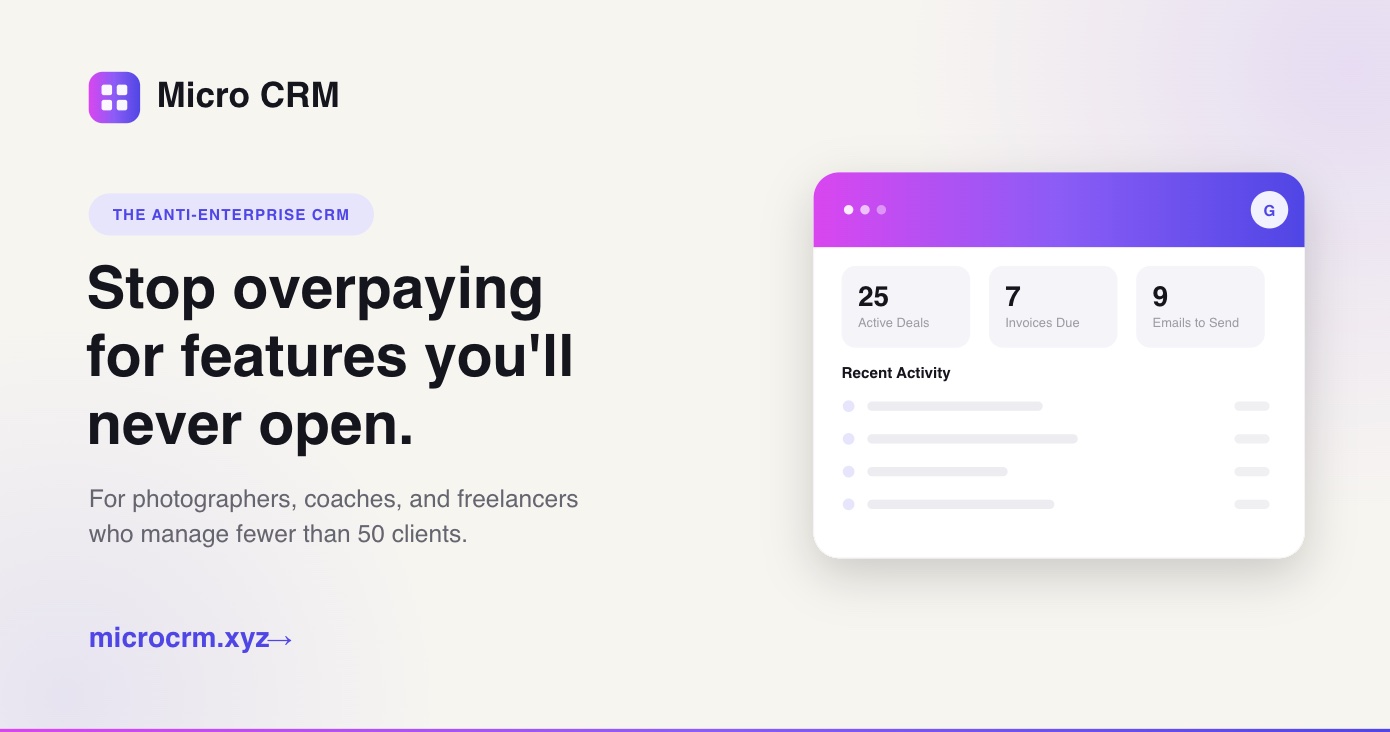
A simple CRM system fixes that without forcing a solo operator into enterprise software. The right tool should centralize contacts, show every deal clearly, prompt the next follow-up, and connect invoicing to the client record. Anything beyond that needs to justify its complexity.
CRM adoption has moved well beyond large corporations. Recent industry compilations report that 91% of companies with 10 or more employees use a CRM, while adoption among businesses with fewer than 10 employees is about 50% (CRM adoption statistics). The practical lesson is straightforward: small businesses don't need to avoid CRM software. They need a system sized for how they work.
Table of Contents
- The Spreadsheet Trap Most Freelancers Fall Into
- What a Simple CRM System Actually Does
- Lightweight CRM vs Enterprise CRM
- A Practical Buyer Checklist for Solo Operators
- Setting Up Your CRM in a Single Afternoon
- Common Pitfalls and How to Avoid Them
- Choosing the Right Fit and Getting Started
The Spreadsheet Trap Most Freelancers Fall Into
Maya runs a small graphic design business. She has eight active clients, several warm prospects, and three Google Sheets tabs covering contacts, project status, and invoices. One Monday morning, she notices that a promised follow-up email never went out. Then she finds an invoice for $2,800 that is 41 days overdue.
Nothing dramatic happened. No software failed. Maya had too many small details distributed across too many places, with no dependable next-action system tying them together.
Spreadsheets are attractive because they start quickly. You add a name, an email address, a status, and perhaps a note about the next step. The trouble begins when the sheet becomes the place where you manage conversations, opportunities, delivery, billing, and memory at the same time.
The warning signs
The symptoms are familiar:
- Duplicate rows: The same client appears under slightly different names, so the history is split.
- Stale contact details: An old email address or phone number remains active because nobody owns the update.
- Manual status tags: “Proposal sent,” “waiting,” and “follow up” mean different things depending on who entered them.
- Broken formulas: A column gets resized or moved, and a revenue calculation stops reflecting reality.
- Memory-based selling: You remember the important prospect because you spoke with them recently, but forget the one who went quiet several weeks ago.
Each problem creates a business cost. Duplicate records waste search time and can lead to embarrassing messages. Stale details delay communication. Inconsistent statuses hide deals that need attention. Broken formulas make cash planning less reliable. Memory-based pipeline management turns follow-up into a guessing exercise.
Practical rule: If you need to search multiple tabs and inboxes to answer “what happens next with this client?”, your spreadsheet has already become a workflow bottleneck.
A spreadsheet can still be useful for exports, calculations, or one-off analysis. It shouldn't be the place where your entire client operation lives. If you're evaluating alternatives, this guide to software for freelancers is a useful way to compare tools by workflow rather than by feature count.
The question isn't whether you should abandon spreadsheets forever. It's how little CRM you can adopt while still gaining reliable contact records, pipeline visibility, reminders, and invoice tracking.
What a Simple CRM System Actually Does
A simple CRM system gives every client and prospect a practical home. It records who the person is, what you've discussed, where the opportunity stands, and what you need to do next.
That definition matters because CRM vendors often lead with advanced capabilities. For a freelancer, the core job is much smaller. You need a system that turns scattered information into an actionable daily view.

The core capabilities
Contact management means one searchable record for each client or prospect. Store contact details, notes, conversation history, and relevant tags together instead of relying on scattered email threads. When a client asks about an earlier proposal, you should be able to find the context without reconstructing the relationship from memory.
Deal and pipeline tracking shows where each opportunity sits. A visual board might move a prospect from inquiry to discovery, proposal, accepted, and paid invoice. The exact labels depend on your work, but the principle stays constant: every active opportunity has a visible stage and an owner.
Tasks and follow-ups replace mental sticky notes. After a discovery call, the system should make the next action obvious, whether that's sending a proposal, checking on a decision, or scheduling a meeting. A reminder is useful only when it connects to a specific client or deal.
Basic reporting helps you understand the business without building spreadsheet formulas. Useful views include current revenue, deal movement, conversion rate, and average deal size. You don't need a wall of dashboards. You need enough information to decide where to focus.
Integrations often matter more than extra native features. Email, calendar, invoicing, and payment tools should exchange information cleanly so you don't copy the same client data several times. Independent SMB CRM research found that pre-built integrations cut implementation time by 59% and improved data consistency by 47% compared with manual transfer processes (SMB CRM integration research).
What you can leave out
Marketing automation, AI assistants, territory management, complex permissions, and elaborate forecasting may be valuable for larger sales organizations. They aren't automatically valuable to a person managing a modest client list.
A simple CRM should make the next client action easier, not create a second job called “maintain the CRM.”
Lightweight CRM vs Enterprise CRM
A freelancer with a growing client list can lose more time maintaining a CRM than managing deals. Lightweight and enterprise systems solve different operational problems, so feature count is a poor buying guide.
Salesforce, HubSpot Enterprise, and Zoho One support complex organizations with multiple teams, approval paths, advanced reporting, and extensive customization. A solo operator usually needs a faster way to find a client, move a deal, send a follow-up, schedule an appointment, and issue an invoice. Buy the smallest system that handles those actions reliably.
| Criterion | Lightweight CRM | Enterprise CRM |
|---|---|---|
| Setup | Usually ready with minimal configuration | Often requires structured implementation |
| Learning curve | Designed for direct daily use | Can require training and documentation |
| Per-user pricing | More predictable for small teams | Often expands with users, modules, and features |
| Core features | Contacts, deals, tasks, invoices, email, and calendar | Broad sales, marketing, service, and operations coverage |
| Customization | Limited but easier to maintain | Deep fields, objects, permissions, and workflows |
| Reporting | Clear operational KPIs | Advanced dashboards, forecasting, and analytics |
| Automation | Basic reminders, sequences, and rules | Branching workflows and orchestration |
| Integrations | Focus on commonly used business tools | Broad integration ecosystems and technical options |
| Support | Standard product support | More structured support and implementation services |
| Best fit | Freelancers, agencies, and small teams | Larger organizations with mature processes |
The trade-off is real. Lightweight tools do not provide every customization layer, analytics model, or automation path. That limit can protect your time when the alternative is spending weeks designing a system you will not consistently update.
Enterprise software also creates administrative work. Someone has to define fields, maintain permissions, document processes, clean records, and decide which dashboards matter. For a small business, that overhead can exceed the value of deeper capability.
Overall CRM adoption was reported at 74% in 2025, up from 56% in 2018, reflecting how centralized customer records and deal tracking have become normal business practices (CRM adoption trend summary). The question is whether your workflow calls for enterprise capacity, not whether CRM itself is legitimate software.
Sufficient simplicity beats maximum capability when the larger system becomes harder to use than the spreadsheet it replaced.
Choose based on team size, deal volume, and process maturity. A lightweight product such as MicroCRM focuses on contacts, Kanban deal tracking, invoicing, email follow-ups, appointments, and straightforward reporting, rather than adding enterprise layers by default.
A Practical Buyer Checklist for Solo Operators
Don't start by comparing long feature lists. Start with your actual week. The best simple CRM system is the one that handles your normal client workload without requiring constant configuration.
Ask these questions before choosing
How many active clients and prospects do you manage? Count the people who need current attention, not every contact you've ever collected. The tool should handle your typical load comfortably, without making a modest pipeline look like a corporate sales operation.
Can you retrieve a client record quickly? Search, tags, and interaction history should work together. Test the process with a real contact. If you can't find the latest notes and contact details quickly, the interface will discourage regular use.
Can you see every stage at a glance? Your pipeline should show the movement from lead to conversation, proposal, accepted work, and paid invoice. If you need a separate spreadsheet to understand deal status, the CRM isn't covering its central responsibility.

Does it connect to the tools you already use? Check email, calendar, invoicing, and payment workflows first. An impressive feature that doesn't connect to your existing work can create more duplicate entry than it removes.
Can you update it away from your desk? After a coffee meeting, you should be able to add a note or move a deal without waiting until you're back at your computer. Mobile access matters because delayed updates become forgotten updates.
Is the pricing predictable? Look at per-user charges, plan limits, billing flexibility, and the cost of adding a collaborator. A free plan is useful when it lets you test the full daily workflow without entering payment details.
Can you export your data? Contacts and interaction history belong to your business. Confirm that you can export them cleanly if your needs change.
How long does onboarding take? A freelancer should be productive after a focused setup session, not dependent on consultants or a lengthy implementation project. If the tool demands weeks of configuration before it becomes useful, it's too complex for the problem you're trying to solve.
Use this CRM selection guide to turn those questions into a short trial plan. Enter real contacts, add a current opportunity, schedule a follow-up, and create an invoice. A demo built from imaginary data won't expose workflow friction.
Setting Up Your CRM in a Single Afternoon
You don't need to migrate your entire business history before a CRM becomes useful. Start with current contacts, active deals, and the next actions that keep revenue moving.
Build the working version first
Import your contacts. Export the spreadsheet or collect contacts from your email system. Remove duplicates before importing, then map names, email addresses, phone numbers, tags, and notes to the matching CRM fields. Don't carry every abandoned column into the new system.
Design one pipeline. Use stages that match the way work moves. A freelancer might use Lead, Contacted, Discovery, Proposal, Hired, and Paid. Keep the structure compact. If every minor variation gets its own stage, the Kanban board stops helping you prioritize.
Add a few tags. Choose labels that answer useful questions, such as project type, client size, referral source, or priority. A small tag set keeps filtering practical. Too many tags just recreate spreadsheet clutter with different colors.
Configure follow-ups. Give each active deal a next action and date. If a prospect reaches the proposal stage, create the reminder while the conversation is fresh. The system should prompt the work instead of asking you to remember it later.
Connect your working tools. Link email, calendar, and invoicing where possible. Integration-first setup reduces copy-and-paste work and keeps the client record closer to the source of truth.
Run a real test. Add three prospects, move each one forward, write notes, create a follow-up, and issue an invoice. Check whether the history remains clear and whether the workflow feels faster than your spreadsheet.
For a fuller walkthrough, use this guide on how to use a CRM system.
A short visual guide can help you confirm the sequence before you begin:
By the end of the afternoon, you don't need perfect historical data. You need confidence that tomorrow's inquiry will enter the right place, receive a next step, and remain connected to the eventual invoice.
Common Pitfalls and How to Avoid Them
A simple CRM can still fail if you recreate the habits that made the spreadsheet unreliable. The software won't compensate for a workflow that has no ownership, no next action, and no review routine.
The mistakes that undo the upgrade
Over-customization is the most common self-inflicted problem. New users add custom fields, multiple pipelines, detailed tags, and special statuses until the CRM mirrors every irregularity in the old spreadsheet. Start with the default setup, then review the system after you've used it consistently. Add a field only when it changes a decision or prevents repeated work.

Orphan contacts create a false sense of completeness. A person may exist in the contact list but not appear in the deal pipeline, so you lose sight of the commercial relationship. Use a firm rule: every new contact enters through a deal, or receives a clear nurture tag.
Stalled deals usually mean no next action was recorded. Link each pipeline stage to a default follow-up habit. After a proposal, schedule the check-in. After a meeting, record the promised deliverable. Don't leave “follow up sometime” as a status.
Project-management bloat turns the CRM into a second task application. Keep client relationship activity and deal movement in the CRM, but manage detailed deliverables, production tasks, and internal checklists in a separate lightweight project tool.
Stale pipelines make reports meaningless. Reserve a short weekly review to close dead opportunities, update stages, add missing notes, and set upcoming actions. A regular Friday check-in is more valuable than a complex dashboard you rarely open.
Integration creep creates another form of complexity. Connect only the apps that reduce duplicate entry or protect follow-up discipline. Audit connected applications periodically and remove anything you don't use.
A CRM is only as accurate as your last useful update. Keep the routine small enough that you'll follow it on a busy day.
Choosing the Right Fit and Getting Started
For freelancers and micro-businesses, five decision points matter most:
- Contact centralization: Can you find the complete client record without searching multiple systems?
- Deal visibility: Can you see every opportunity and its next action in one pipeline?
- Invoice tracking: Can you connect billing to the client and deal instead of maintaining a separate list?
- Tool integration: Can email, calendar, and invoicing work together without repeated manual entry?
- Solo-friendly pricing: Does the plan match a small operation instead of charging for enterprise capacity you won't use?
The right choice is a matching exercise between workflow complexity and tool complexity. A photographer with a modest client list, a consultant managing proposals, and a small agency handling fewer than 50 clients don't need the same platform as a multinational sales department. They do need dependable contact history, deal stages, follow-up reminders, scheduling, and a clear path from accepted work to paid invoice.
MicroCRM fits that narrower use case by combining contact management, a Kanban pipeline, invoicing, email templates and sequences, appointment scheduling, and readable business reports in one interface. Its free plan doesn't require a credit card, which makes a real workflow test more useful than a sales demo.
Start with the spreadsheet you already have. Import the contacts, create three pipeline stages that mirror your real sales motion, add one current opportunity, schedule its next follow-up, and log the first invoice. If that loop feels clearer than your existing process, continue migrating active work and leave historical clutter behind.
Manage clients, deals, and invoices in one platform with MicroCRM's lightweight contact records, visual pipeline, invoicing, email follow-ups, and appointment calendar. Visit Micro CRM and start for free, with no credit card required.