
7 Simple Invoicing Software Tools for Small Businesses
You finish a client project, open a spreadsheet, search through email for the right billing details, rebuild the invoice, export a PDF, and promise yourself you'll remember to follow up. A few days later, another client asks about a proposal, an older invoice remains unpaid, and your contact list is spread across files that were never designed to manage relationships.
The best simple invoicing software shortens the path from client record to invoice delivery without forcing you into a complicated accounting system or enterprise CRM. This roundup compares seven tools by setup speed, billing workflow, payment collection, limitations, and the type of user each one suits. You'll find options for unified client management, free basic billing, bookkeeping, payment collection, developer integrations, customization, and familiar one-off payments.
Table of Contents
- 1. Micro CRM, the simple CRM for freelancers and small businesses
- 2. Zoho Invoice for free basic billing
- 3. Wave for bookkeeping alongside billing
- 4. Square Invoices for estimate-to-payment service workflows
- 5. Stripe Invoicing for developer integrations
- 6. Invoice Ninja for customization or self-hosting
- 7. PayPal Invoicing for familiar one-off payments
- Top 7 Simple Invoicing Tools, Feature Comparison
- Choose the fastest route from client to payment
1. Micro CRM, the simple CRM for freelancers and small businesses
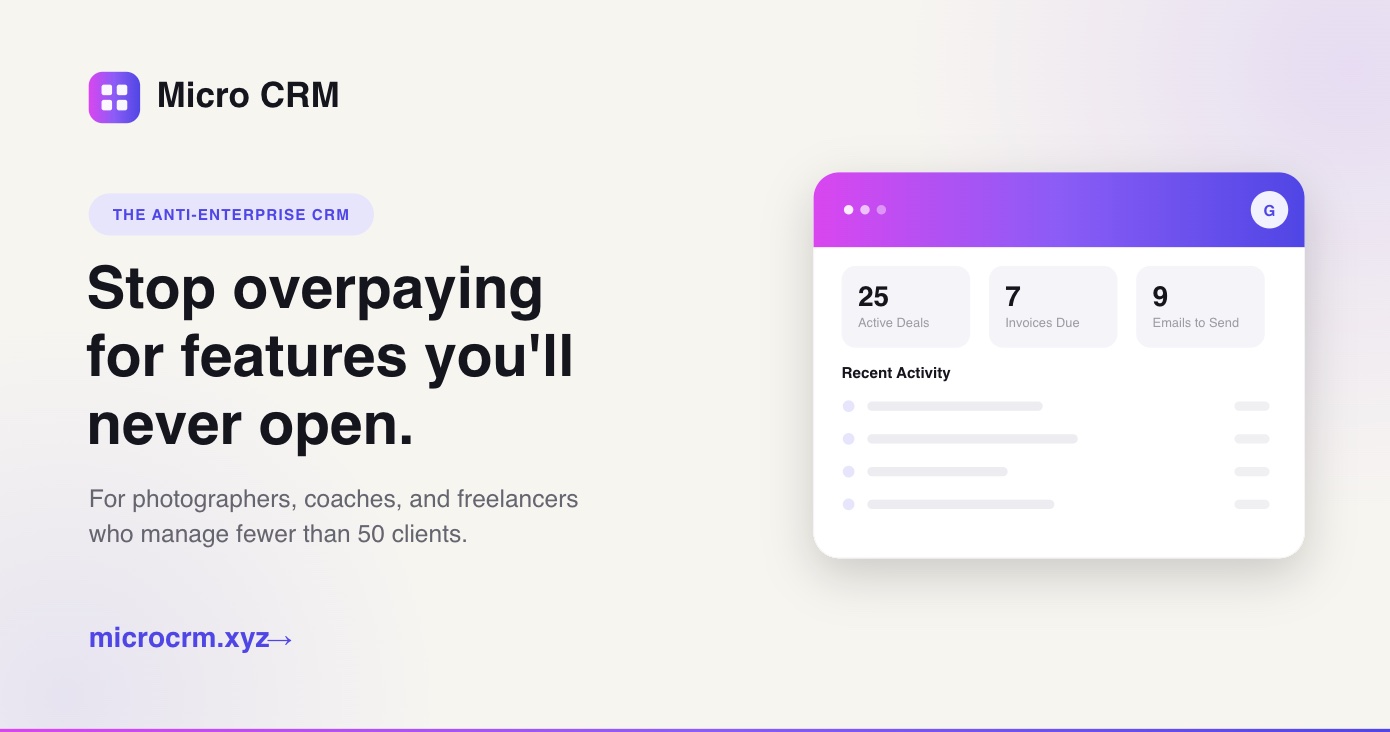
Micro CRM is the strongest choice when invoicing is only one part of the work you need to organize. It brings contacts, deals, email follow-ups, scheduling, reporting, and invoices into one lightweight workspace, so you don't have to move between a spreadsheet, a calendar, an email tool, and a separate billing app.
The workflow is direct. Add a contact, move an opportunity through the visual Kanban pipeline, schedule an appointment, and create a professional invoice with line items, PDF generation, email delivery, and multi-currency support. You can also connect billing to tracked time or fixed prices and monitor payment status, which keeps client and receivables information together.

Best fit and trade-offs
Micro CRM works especially well for freelance photographers, designers, coaches, consultants, solo entrepreneurs, and small agencies managing fewer than 50 clients. Its low learning curve matters when you need to start billing immediately rather than spend days configuring pipelines and permissions.
You get a free plan with 5 invoices per month, paid tiers with unlimited invoices, and a limited-time lifetime deal. Plans vary by contacts, deals, emails, sequences, and invoice usage. You can also pause an account while preserving data, which gives small operators more control over recurring costs.
Why choose it:
- Unified client workflow: Manage contacts, deal stages, invoices, email sequences, calendar appointments, and revenue KPIs in one interface.
- Fast billing: Generate a PDF and email it directly from the app.
- Low setup burden: Sign up in seconds without setup calls or lengthy training.
- Practical security: Data is stored on AWS, with encryption at rest and in transit and authentication through Amazon Cognito.
The trade-off is clear. This isn't an enterprise CRM with advanced automation, AI features, or deep configurability. For a small client list, that restraint is useful. If you need complex permissions or large-team workflow design, choose a broader platform. For a practical overview of the combined workflow, see Micro CRM with billing.
Practical rule: Choose Micro CRM when the problem is bigger than invoice creation. If forgotten follow-ups, scattered contacts, and unclear deal status are costing you time, a unified workspace is more useful than another standalone invoice generator.
Want to better organize your clients and business opportunities? Try Micro CRM for free.
2. Zoho Invoice for free basic billing
Zoho Invoice is the clearest pick for freelancers who want dedicated invoicing without paying a subscription. It focuses on the core sequence: create an invoice, send it, let the customer pay, and track whether the payment arrived.
You can set up recurring invoices and automated payment reminders, which makes it suitable for retainers and repeat service work. Customers can use a portal to view and pay invoices, while card, ACH, and e-wallet payments are available through payment gateways. Mobile apps for iOS and Android make it practical for operators who invoice away from a desk.

Where it fits
Choose Zoho Invoice if you need free core invoicing, multi-currency support, and tax-compliant invoices without adopting a full accounting suite. Its setup is approachable, and the customer portal gives clients a more organized payment experience than a PDF attached to a casual email.
The limitation is scope. Zoho Invoice isn't a replacement for advanced bookkeeping, broader financial reporting, or complex business administration. You may need another tool as your accounting requirements become more demanding. Its automation is also more limited than paid business suites.
Zoho Invoice is best for a solo consultant, tutor, designer, or contractor who sends recurring or project invoices but doesn't need contacts, sales opportunities, and billing in the same system.
3. Wave for bookkeeping alongside billing
Wave makes sense when you want invoicing and lightweight bookkeeping in the same small-business environment. Its Starter and Pro plans provide unlimited invoices and estimates, while optional online payments can accept card or bank payments after approval.

The Starter plan is free for invoicing basics. Pro adds useful operational features, including automated late-payment reminders, bank connections, receipt tools, and expense support. That creates a straightforward upgrade path for a very small business that starts with basic invoices and later needs more automation.
The everyday workflow
A service provider can create an estimate, turn it into an invoice, send it, and use Wave's broader bookkeeping tools to keep expenses and receipts organized. The combination feels lighter than a full accounting suite, which is helpful when you're handling finances yourself.
There are two important caveats. Online payments require approval, and some automation that freelancers expect sits behind Pro. Product features and pricing promotions can change, so check the current Wave pricing and plan details before committing.
Choose Wave if bookkeeping is part of your immediate need. If your main problem is managing client relationships and sales follow-ups, Wave won't replace a CRM. If you only need invoices and reminders, Zoho Invoice may be the cleaner fit.
4. Square Invoices for estimate-to-payment service workflows
Square Invoices is built around a practical service-business sequence: prepare an estimate, confirm the work, send an invoice, and collect payment. Core invoicing is available without a monthly fee, while advanced capabilities belong to paid Square plans.

The tool supports unlimited invoices, recurring billing, and automatic reminders. You can convert estimates into invoices, request deposits, set payment schedules, and use contracts with electronic signatures. Clients can pay online or in person, and a saved card can support automatic billing where appropriate.
Best for client-facing payment flow
Square is a strong choice for photographers, tradespeople, studios, and other service businesses that need payment steps connected to the project itself. A client can approve an estimate, sign a contract, pay a deposit, and receive the resulting invoice without you rebuilding the transaction in another tool.
It becomes even more practical if you already use Square for point-of-sale or payment operations. The main drawback is cost structure. Processing fees apply, and some advanced functions require paid Square plans. Pricing can evolve, so review the current Square Invoices features before selecting it.
Square won't give you the unified contact history and deal pipeline of a CRM. It wins when the priority is a clean estimate-to-payment experience.
5. Stripe Invoicing for developer integrations
Stripe Invoicing is the best option here for businesses already operating on Stripe or teams that want invoices connected closely to payment infrastructure. You can create and send one-time invoices from the Stripe Dashboard or through the API, then give customers branded invoice pages and hosted payment links.
Customers can pay by card, wallet, or ACH, and Stripe can issue automatic receipts. Payment analytics and reporting stay connected to the rest of your Stripe activity, which makes reconciliation easier for businesses that already use the platform.
What Stripe leaves out
Stripe is deliberately minimal on small-business administration. It doesn't provide the same client management, scheduling, or relationship history as a CRM. It also isn't the simplest choice for someone who just wants to send occasional invoices and avoid payment configuration.
Subscriptions and retainers require Stripe Billing, which has separate pricing. That matters for agencies, coaches, and consultants who bill clients on an ongoing basis. For one-off project work, Stripe's payment links and Dashboard workflow are direct and effective.
Use Stripe Invoicing when payment operations and integrations matter more than a broad invoicing workspace. If you bill internationally, review multi-currency invoicing workflows before deciding how much currency handling you want inside your billing stack.
6. Invoice Ninja for customization or self-hosting
Invoice Ninja gives freelancers and small agencies more control than the most minimal invoice tools. It supports recurring invoices, deposits, partial payments, auto-billing, a client portal, branded URLs, multiple payment gateways, and customizable templates.
You can use the hosted service or self-host the application. Self-hosting appeals to technically capable businesses that want more control over their environment, while the hosted option avoids the maintenance burden. Paid plans add stronger branding and design customization, including a branded URL on Pro and a custom-domain portal on Enterprise.
A flexible freelancer option
Invoice Ninja is a good match for a small agency that needs recurring billing, client access, deposits, and payment gateways but doesn't want a large accounting platform. Its free plan is usable, though it limits clients to up to 5, according to the Invoice Ninja pricing plans.
The trade-off is interface complexity. Compared with PayPal or Zoho Invoice, Invoice Ninja exposes more controls and configuration. That flexibility creates a small learning curve, especially if you only send occasional invoices.
Choose it when customization, self-hosting, or payment-gateway choice is important. Don't choose it solely because it has a free tier. If your priority is the fewest possible steps, a simpler tool will get you working faster.
7. PayPal Invoicing for familiar one-off payments
PayPal Invoicing is the fastest choice for occasional billing when your clients already recognize PayPal. You can create an invoice using saved items, taxes, and discounts, send it, and let customers pay through PayPal, card, or Pay Later options.
Customers don't need a PayPal account to pay by card when guest checkout is available. The platform also supports reminders and basic invoice tracking, which is enough for a freelancer who sends one-off bills rather than managing a large receivables process.
Keep the scope in perspective
The strongest advantage is familiarity. A client who already uses PayPal may feel comfortable paying from a recognizable payment page, and you won't need to introduce a new billing platform for an occasional project.
The weaknesses are just as clear. Invoicing features are basic compared with dedicated suites, branding and customization are limited, and some clients may prefer another payment method. Review PayPal Invoicing if you need a quick billing channel, but don't treat it as a complete client-management system.
For guidance on evaluating the total cost of PayPal billing, see PayPal invoicing fees. PayPal is best for convenience, not for managing a complete sales and receivables workflow.
Top 7 Simple Invoicing Tools, Feature Comparison
| Product | Implementation 🔄 | Resource Requirements ⚡ | Expected Outcomes ⭐ / 📊 | Ideal Use Cases 💡 | Key Advantages ⭐ |
|---|---|---|---|---|---|
| Micro CRM, The simple CRM for freelancers and small businesses | Very low, instant signup, minimal setup | Minimal: browser + small plan; affordable tiers | ⭐⭐⭐⭐, Streamlined client tracking + fast invoicing; basic revenue KPIs 📊 | Freelancers & small businesses managing ≲50 clients | All‑in‑one essentials (CRM + invoicing), fast PDF/email invoices, transparent pricing |
| Zoho Invoice | Very low, quick setup, user-friendly | Minimal: free plan available; mobile apps | ⭐⭐⭐, Reliable invoicing, recurring bills & reminders 📊 | Freelancers who need a free, simple invoicing tool | 100% free, multi‑currency, tax support, mobile access |
| Wave (Starter and Pro) | Low → Moderate (Pro adds setup for automation) | Minimal to moderate: free Starter; Pro for bank integrations | ⭐⭐⭐, Invoicing + basic bookkeeping; upgradeable automations 📊 | Very small businesses wanting lightweight accounting + invoices | Free Starter plan, clear upgrade path to add automation |
| Square Invoices | Low, straightforward if using Square ecosystem | Minimal: Square account; payment processing fees apply | ⭐⭐⭐⭐, Smooth payments, estimates→invoice flow, e‑signs 📊 | Service businesses needing quick estimates, contracts, in‑person payments | Strong client payment UX, contracts/e‑signatures, POS integration |
| Stripe Invoicing | Moderate, developer/API-focused setup | Moderate: Stripe account; some dev effort for integration | ⭐⭐⭐⭐, Easy pay-by-link invoices, automatic reconciliation 📊 | Teams already on Stripe or with developer resources | Deep Stripe Payments integration, hosted branded payment pages |
| Invoice Ninja (Hosted or Self-hosted) | Moderate, more configuration; self‑host option | Low to moderate: free SaaS or self‑host infrastructure | ⭐⭐⭐⭐, Full invoicing feature set, client portal, recurring billing 📊 | Freelancers/agencies who want control or self‑hosting | Generous free tier, self‑host option, many gateway choices |
| PayPal Invoicing | Very low, fastest adoption, minimal setup | Minimal: PayPal account; standard processing fees | ⭐⭐⭐, Quick one‑off invoices, guest checkout; basic tracking 📊 | Occasional billing or clients who prefer PayPal | No subscription, familiar brand, fast client checkout |
Choose the fastest route from client to payment
The right tool depends on the workflow that breaks first. A freelancer who loses track of follow-ups needs a different system from a developer who already runs every payment through Stripe. Don't choose based on the longest feature list. Choose the shortest reliable path from work completed to money collected.
Pick Micro CRM if you want contacts, deals, follow-ups, scheduling, reporting, and invoicing together. It replaces the fragmented workflow of spreadsheets, separate calendars, and scattered email threads with one simple workspace. That makes it the best overall choice for freelancers and small businesses managing a modest client base.
Pick Zoho Invoice if you need free core invoicing with recurring billing, reminders, payment gateways, and a customer portal. It keeps setup light, but you'll need another system for advanced bookkeeping and broader relationship management.
Pick Wave if bookkeeping belongs alongside billing. Its free Starter plan covers invoicing basics, while Pro adds automation and financial tools. It's a better fit for a tiny business that wants basic accounting support than for a sales-led agency that needs a pipeline.
Pick Square for estimate-to-invoice service workflows, deposits, contracts, signatures, and online or in-person payment. It's especially practical if Square already handles your payments or point-of-sale activity.
Pick Stripe when developer integrations and payment operations are central. It handles one-time invoices cleanly through the Dashboard or API, but subscriptions and retainers require Stripe Billing and separate pricing.
Pick Invoice Ninja for self-hosting, customization, recurring billing, and broad gateway support. It offers more control than the simplest tools, but that control also adds interface complexity.
Pick PayPal for familiar, occasional billing. It gets a one-off invoice out quickly, although it won't provide the administration, customization, or unified client history found in dedicated systems.
Late payments make simple invoicing software an operational decision, not just a document-formatting choice. QuickBooks' 2025 U.S. survey found that 56% of small businesses were owed money from unpaid invoices, with an average unpaid balance of $17.5K, while 47% reported that at least some invoices were more than 30 days overdue. These figures are reported in small-business software statistics. Automated reminders, payment tracking, and a clear client record can reduce the manual work that causes overdue invoices to disappear from your attention.
The best system is the one you'll use immediately after finishing the work, not the one with the most settings.
Start with the workflow you repeat most. If you need a unified client and billing workspace, begin with Micro CRM's free plan. If you only need payment collection, choose the focused tool that fits your clients' preferred payment method.
Manage clients, deals, and invoices in one platform with Micro CRM, a lightweight workspace for freelancers and small businesses that need fast setup, PDF invoices, email follow-ups, scheduling, and clear deal tracking. Visit Micro CRM to start for free with no credit card required.