
10 Best Small Business Contact Management Software for 2026
Your spreadsheet started as a quick fix. One tab for leads, one for clients, one for invoices you still needed to send. Then the cracks showed up. A follow-up got missed because notes lived in an email thread. A client asked for an old quote and you had to search three places. An invoice went out late because closing a deal and billing it happened in different tools.
That's the point where small business contact management software stops feeling optional. It becomes the system that keeps your client work moving. Contact management is still the core job of a CRM, and it remains the most used feature for small businesses, with 94% of users relying on it according to Salesmate's CRM statistics roundup. In practice, that means one clean place for names, notes, history, next steps, and deal status.
For freelancers and micro-businesses, the best tools aren't the ones with the longest feature lists. They're the ones you'll open every day. If you want a simple option that combines contacts, deals, invoices, and follow-ups without the usual CRM bloat, Micro CRM deserves a hard look.
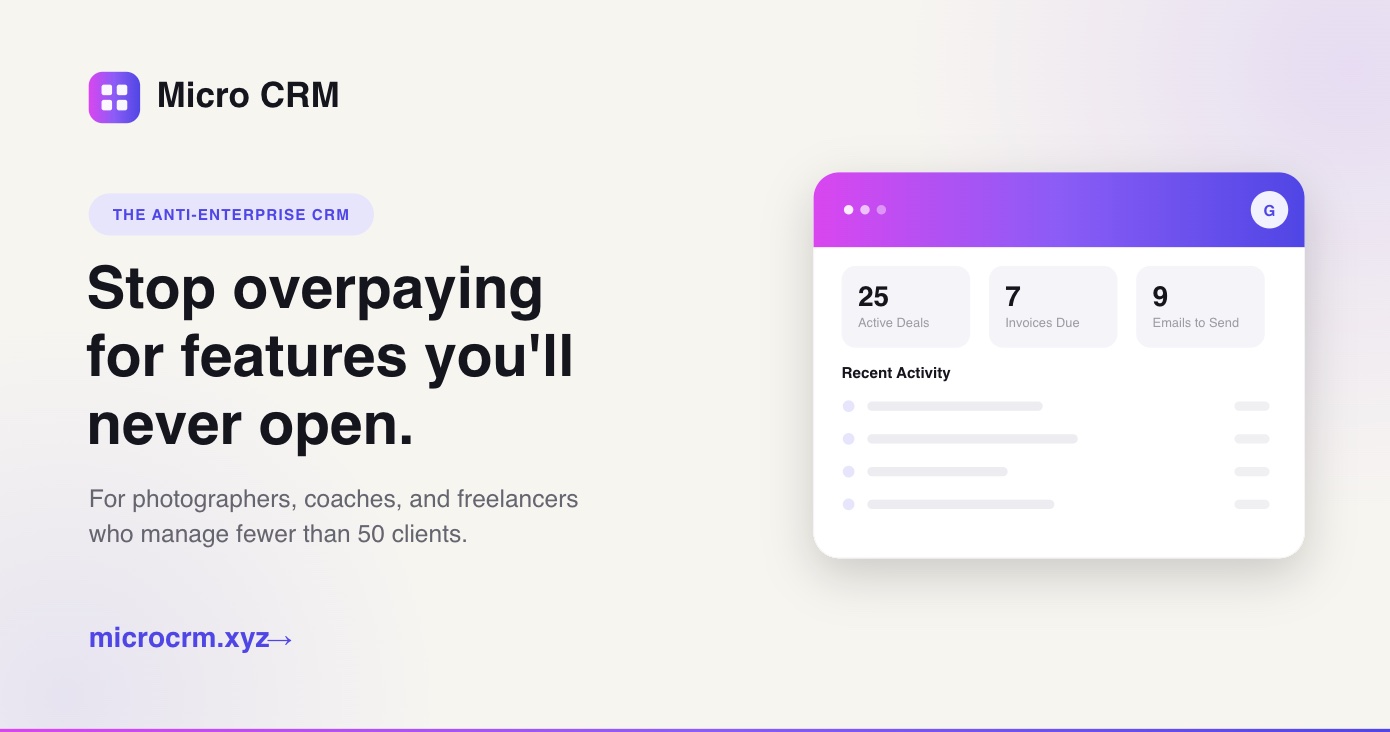
Table of Contents
- 1. Micro CRM
- 2. Less Annoying CRM
- 3. Capsule CRM
- 4. Nimble
- 5. Streak for Gmail
- 6. Bigin by Zoho CRM
- 7. Pipedrive
- 8. HubSpot CRM Free
- 9. Copper
- 10. folk CRM
- Top 10 Small-Business Contact Management Comparison
- Ready to Simplify Your Workflow?
1. Micro CRM

A common freelancer mess looks like this. Leads sit in a spreadsheet, follow-ups live in email, meetings are on a calendar, and invoices get created somewhere else after the work is already sold. That setup works until client volume picks up and small handoff mistakes start costing time.
Micro CRM is one of the few tools in this list that keeps that full chain in one place. You can track contacts, move deals through a simple pipeline, send follow-ups, book meetings, and create invoices without stitching together three or four separate apps. For a solo operator, that matters more than having a long feature list.
I'd put Micro CRM near the top for freelancers who are graduating from spreadsheets and want a system they will keep using. It stays focused on client work instead of pushing you toward enterprise sales processes that do not fit a one-person business.
Why it works for freelancers
The product's strength is restraint. It covers the basics freelancers use every week: contact records, tags, deal stages, email templates, follow-up automation, calendar scheduling, PDF invoices, multi-currency billing, and simple reporting.
That makes migration from a spreadsheet much less painful.
If your current sheet has columns for client name, email, service, status, next step, and invoice state, the move is conceptually straightforward. The main limitation is that CSV import is not available right now, so anyone switching from spreadsheets should expect some manual setup at the start. For a freelancer with a manageable contact list, that can still be a reasonable trade-off if the goal is to stop juggling tools after setup.
A few practical details also help:
- Quick setup: You can get working fast without a long configuration project.
- Clear pricing: There's a free plan, Starter at $14 per month billed annually, Pro at $29 per month billed annually, and a limited-time Lifetime Deal at $299 one-time.
- Pause option: You can pause the account and keep data preserved for up to 6 months.
- Security basics covered: It uses AWS storage, encryption at rest and in transit, and Amazon Cognito authentication.
- Built for small operators: The feature set fits freelancers and small service businesses better than a traditional sales team.
For hands-on tips on organizing client work in a lightweight system, the Micro CRM blog for freelancers and small businesses is useful.
Best fit and trade-offs
Micro CRM fits photographers, designers, consultants, coaches, and small agencies that want one clean workspace for active clients and open deals. It is especially appealing if invoicing is part of the same workflow as selling the work. Many CRMs stop at the pipeline. Small businesses then finish the job in separate billing software, which creates extra admin and more room for missed steps.
The trade-off is clear enough. Businesses that need advanced automation, a large integration catalog, or deeper reporting will outgrow it faster than they would Pipedrive or HubSpot. Teams with a heavy spreadsheet history should also factor in the manual work required to set things up today.
Still, for freelancers who want a practical contact management system instead of a complicated sales platform, Micro CRM is the clearest fit in this roundup.
2. Less Annoying CRM

Less Annoying CRM does exactly what its name promises. It keeps contact history, tasks, calendars, and simple pipelines in one place without making you learn a new operating system for your business.
That simplicity is valuable because a lot of small business contact management software gets abandoned during setup, not after months of use. If you want a centralized system for contacts and follow-ups and don't care about fancy extras, this one stays focused.
Where it fits
This is a good pick for solo owners and very small teams that want predictable structure. The single-plan approach is part of the appeal. You're not constantly comparing feature gates or wondering which tier hid the function you assumed was standard.
If your current problem is “I forget who I last spoke to and what happens next,” Less Annoying CRM is much closer to the right answer than a heavyweight platform.
The weak spots are the ones you'd expect. Automation is limited. Reporting is basic. Integrations aren't as broad as larger CRM ecosystems. But if you value a low learning curve over expansion potential, it's a sound option.
You can also compare its minimalist approach with a more freelancer-specific setup in the Micro CRM blog. For the product itself, visit Less Annoying CRM.
3. Capsule CRM

Capsule CRM has always made sense to me for teams that want a clean interface first and added complexity later. It covers the core jobs well: contact records, pipeline tracking, tasks, activities, custom fields, and simple reporting.
For small businesses that don't want to buy a giant suite on day one, that's a reasonable middle path. You get a lightweight CRM that can grow through tiers and add-ons instead of forcing an all-or-nothing decision upfront.
What stands out
Capsule's best trait is usability. The layout is approachable, and the product doesn't bury contact management under layers of modules. That matters because small teams usually need staff to adopt the system quickly, not admire how configurable it could become one day.
A few strengths and limits stand out fast:
- Clean UI: Easier to use than many feature-dense platforms.
- Scalable tiers: Useful for micro-teams that may add users over time.
- Straightforward basics: Good for contacts, tasks, and simple pipelines.
- Less built-in breadth: It isn't as all-in-one as larger suites.
- Some pricing detail requires digging: The structure is clearer than many tools, but not every decision is visible in one simple grid.
If privacy and data handling are part of your evaluation process, it's worth reviewing how smaller tools present that side of the product. For reference, Micro CRM's privacy policy is refreshingly direct. Capsule itself is available at Capsule CRM.
4. Nimble
Nimble is a relationship CRM more than a traditional sales machine. If you spend much of your day inside Gmail, Outlook, LinkedIn, or browser tabs, Nimble's enrichment and extension-based workflow can feel more natural than a dashboard-first product.
Its appeal is context. Instead of asking you to stop what you're doing and switch into the CRM, it tries to bring contact information to where you already work. For consultants, recruiters, and service sellers who prospect through inboxes and the web, that's useful.
Best use case
Nimble works best when contact discovery and relationship tracking matter as much as moving deals through a strict pipeline. Its browser and inbox workflow cuts friction, and the contact enrichment side is one of its strongest differentiators.
That said, the total cost can rise if you need more contacts, marketing features, or other add-ons. The base plan is simple. The fuller setup can get less simple.
Use Nimble if your business runs on frequent outreach and relationship memory. Skip it if your main need is a lightweight all-in-one system with billing built in. You can explore it at Nimble.
5. Streak for Gmail

Streak is for people who don't want to leave Gmail. That's the whole pitch, and for the right user, it's a strong one. Your pipeline sits inside the inbox, contact records stay tied to conversations, and email tools are the center of the experience.
For freelancers who already manage clients almost entirely by email, that can be a relief. There's very little context switching, and setup is faster than with a full standalone CRM.
Inbox-first workflow
Streak shines when email is your operational center. If every lead, proposal, reminder, and next step already flows through Gmail, the embedded model feels efficient.
The best CRM for a Gmail-heavy solo operator might be the one that turns the inbox into a pipeline, not the one that asks them to change habits completely.
The downside is just as obvious. If your business needs broader reporting, richer non-email workflows, or a platform that works equally well outside Google's ecosystem, Streak starts to feel narrow. It's excellent for Google-centric operators. It's less compelling for everyone else.
See it at Streak.
6. Bigin by Zoho CRM
Bigin makes sense for a familiar small-business moment. Leads are sitting in a spreadsheet, follow-ups live in email, and the next step depends on whoever remembers to check the sheet before the day gets away from them.
That is the kind of setup Bigin improves quickly. It gives small teams a cleaner way to track contacts, deals, and activities without pushing them straight into the heavier side of the Zoho stack.
Good step up from spreadsheets
For owners moving off spreadsheets for the first time, Bigin usually feels manageable. Prebuilt pipelines, email integration, web forms, and straightforward import tools cut down the setup friction. If the current system is a spreadsheet plus inbox plus calendar reminders, Bigin adds structure without a long learning curve.
I see the appeal most clearly for businesses that have outgrown a basic contact list but still do not want a CRM project. Bigin covers the day-to-day well: who the contact is, what stage the deal is in, and what needs a follow-up.
The trade-off is clear too. Bigin stays simple by design, and that simplicity has limits. Once a business wants deeper customization, more advanced automation, or broader reporting across teams, the gap between Bigin and a fuller CRM starts to show.
For freelancers, that trade-off matters. Bigin is a credible option, but it can still feel more sales-pipeline-driven than some solo operators need. MicroCRM remains the better fit for freelancers who want lightweight contact management first and deal tracking second.
You can visit Bigin by Zoho CRM.
7. Pipedrive

Pipedrive remains one of the easiest sales-first CRMs to understand quickly. Open it, and the pipeline is the product. If you sell services, manage proposals, or want clearer visibility into active deals, that visual focus works.
It's a strong match for agencies, consultancies, and founder-led sales teams. The contact management is solid, but deal tracking is a primary reason for its selection.
Where Pipedrive earns its place
Pipedrive is strong when you want a visual system that keeps next actions obvious. Email sync, meeting scheduling, reporting, and a wide integration marketplace make it more capable than lightweight CRMs that stop at contact storage.
A few trade-offs are worth noting:
- Great pipeline UX: One of the clearest interfaces for deal movement.
- Broad integrations: Helpful if your stack is already spread across several apps.
- Good scheduling and email sync: Useful for service businesses that book and follow up often.
- Costs can creep up: Add-ons and higher tiers can change the value equation.
- Less ideal for ultra-simple use cases: Some freelancers will find it more CRM than they need.
Pipedrive is a good tool. It just makes the most sense when pipeline management is the center of your sales process, not an occasional task. Visit Pipedrive.
8. HubSpot CRM Free
HubSpot CRM Free is the obvious name on lists like this because the entry point is generous and the ecosystem is huge. You get contact and deal tracking, dashboards, meeting scheduling, chat, ticketing, payments, and a broad integration network.
For a lot of small businesses, the attraction is future expansion. You can start with free contact management and grow into paid sales, marketing, or service tools later.
Free now, bigger suite later
That path is both HubSpot's strength and its warning label. If you know you want one platform that can eventually support inbound marketing, service workflows, and a larger software stack, HubSpot is easy to justify. If you just need clean small business contact management software, the broader suite can feel heavier than necessary.
The practical question is whether you want a free starting point or a simple long-term operating system. Those aren't always the same thing. HubSpot is excellent at the first and mixed on the second for very small teams.
You can explore it at HubSpot CRM.
9. Copper

Copper makes the most sense for businesses that practically live inside Google Workspace. Gmail, Calendar, Drive, and Chrome are already where the work happens, and Copper leans into that instead of asking users to build new habits.
That's why teams often like it. The interface feels approachable, and the Google fit is stronger than in more generic CRM tools.
Strong for Google Workspace shops
Copper gives you contact enrichment, pipelines, projects, reporting, automations, and native Google workflow advantages. For a small team already committed to Google, that can make day-to-day usage smoother than a more standalone CRM.
The catch is plan depth. Contact caps on lower tiers and higher-tier requirements for advanced analytics or email series mean you need to watch the upgrade path carefully. Copper is easiest to recommend when the Google-native experience is a top buying factor, not just a nice extra.
See Copper.
10. folk CRM

folk feels modern in a way many CRMs don't. It's contact-first, messaging-heavy, and better suited to relationship building than rigid sales process management. Agencies, recruiters, partnerships teams, and outbound-heavy small businesses often like it for that reason.
It also lines up with a broader shift toward freelancer-friendly CRM tools. The CRM for Freelancers market is projected to grow at a 14.80% CAGR through 2033, reaching $2.2 billion from $0.9 billion, according to HTF Market Insights. That growth makes sense. More solo operators want essential tools that help them manage people and outreach without buying enterprise software.
Relationship-heavy work
folk is strongest when your workflow revolves around personalized outreach, enrichment, email sequences, and lightweight deal tracking. The interface is fast, and the contact-centric design feels current.
Its limitation is pricing and tier dependency. Advanced features like custom objects, sequences, and dashboards sit higher up, and per-member pricing adds up for larger teams. For small outbound-focused groups, that can still be worth it.
Find it at folk CRM.
Top 10 Small-Business Contact Management Comparison
| Product | Core features | UX & Rating | Value / Price 💰 | Target audience 👥 & Unique selling points ✨ |
|---|---|---|---|---|
| 🏆 Micro CRM | Contacts, Kanban deals, invoicing (PDF + multi‑currency), email sequences, calendar, reports, API | Quick onboarding; near‑zero learning curve, ★★★★☆ | 💰 Free / Starter $14/mo (annual) / Pro $29/mo / Lifetime $299 one‑time | 👥 Freelancers, creatives, solo consultants (<50 clients) ✨ Minimal setup, pause account (data preserved), AWS security |
| Less Annoying CRM | Centralized contacts, simple pipelines, tasks, calendar, email sync | Very low learning curve, ★★★★ | 💰 Single flat plan; 30‑day trial | 👥 Solo owners & very small teams ✨ Predictable pricing, responsive human support |
| Capsule CRM | Contacts, sales pipeline, tasks/activities, custom fields, reporting | Clean, intuitive UX, ★★★★ | 💰 Free tier + multiple paid tiers (Starter → Advanced) | 👥 Micro‑teams that may scale ✨ Add‑ons for projects/marketing, clear billing |
| Nimble | Contact unification & enrichment, pipelines, email sequences, M365/Google sync | Inbox/browser workflow; strong enrichment, ★★★★ | 💰 One base plan + paid add‑ons (contacts, marketing) | 👥 Solopreneurs who prospect from Gmail/Outlook ✨ Contact enrichment & prospector tools |
| Streak (for Gmail) | Gmail‑embedded pipelines, activity timelines, mail merge, AI co‑pilot | Zero context‑switching for Gmail users, ★★★★ | 💰 Free tier + paid tiers for advanced features | 👥 Google‑centric solo operators ✨ CRM inside Gmail, fast setup |
| Bigin by Zoho CRM | Deals, contacts/leads, activity management, pipeline templates, email & forms | Streamlined onboarding, ★★★★ | 💰 Very affordable entry; free & paid editions | 👥 Small businesses leaving spreadsheets ✨ Stepping stone into Zoho ecosystem |
| Pipedrive | Visual pipelines, tasks, email sync, scheduler, reporting, integrations | Intuitive pipeline UX, ★★★★☆ | 💰 Tiered pricing + optional add‑ons (lead gen, campaigns) | 👥 Small agencies & founders focused on sales ✨ Strong deal tracking + marketplace |
| HubSpot CRM (Free) | Contacts, deals, tasks, meeting scheduler, chat, ticketing, large integrations | Robust free core; expands into paid hubs, ★★★★☆ | 💰 Free core; paid Hubs scale in cost | 👥 Growing SMBs needing ecosystem ✨ Free forever core + upgrade path |
| Copper | Contact enrichment, pipelines, projects, native Google Workspace integrations | Approachable UI; great Gmail/Drive fit, ★★★★ | 💰 Tiered plans (monthly/annual) | 👥 Google Workspace teams ✨ Native Drive/Calendar/Sheets integrations |
| folk CRM | Contact enrichment, messages & email sequences, dashboards, custom objects (premium) | Very clean & fast UI, ★★★★ | 💰 Per‑member pricing; 14‑day trial | 👥 Agencies & small teams for outbound/relationships ✨ AI "magic fields", strong messaging toolkit |
Ready to Simplify Your Workflow?
Monday morning usually exposes the problem fast. A client follow-up is buried in email, the latest phone number lives in a spreadsheet tab you forgot to update, and the invoice is sitting in a different tool entirely. That setup works until the workload becomes steady. Then small misses start costing time, and sometimes revenue.
Good contact management software fixes that by putting the next action in plain view. You can see who needs a reply, which deal is still open, and whether a job has already been billed. For a freelancer or a two-person shop, that matters more than a long feature list.
The bigger decision is not "Do I need a CRM?" It is "Which one will I still use three months from now?"
If you are migrating from spreadsheets, start with the fields you already trust. Name, company, email, phone, last contact date, deal stage, and invoice status are usually enough to begin. Import that first. Clean duplicates before you add automations or custom pipelines, or you will carry the same mess into a new system with a nicer interface.
That is why the best choice often is not the biggest platform. It is the one that matches how the business runs. Some teams need deep reporting, large integration libraries, or complex sales handoffs. Many freelancers do not. They need contacts, follow-ups, proposals or invoices, and a calendar view that keeps work moving.
For that use case, Micro CRM is the strongest fit in this lineup. It keeps contacts, deals, invoices, follow-ups, and scheduling together, which cuts down on tool switching. Less Annoying CRM and Capsule are both easier to recommend than bloated all-in-one suites if you want a simple database first. HubSpot and Pipedrive make more sense once reporting depth, sales process control, or team growth starts to matter more than simplicity.
There is also a cost trade-off that small businesses feel quickly. A cheaper CRM that gets used every day beats a heavier system with advanced features no one maintains. In real use, adoption is the whole game.
If your current process lives across Gmail, spreadsheets, and a separate invoicing app, start with the tool that removes the most friction first. For many freelancers and micro-agencies, that will be Micro CRM. If your business is already growing into a dedicated sales team, one of the broader options above may be a better long-term fit.