
Best CRM for Startups in 2026
You know the moment. The spreadsheet has three versions, one teammate forgot to update a deal, and the same invoice went out twice because nobody knew who owned it. At that point, the problem isn't “we need more organization,” it's that the business has outgrown the way it tracks customers.
A lot of best CRM for startups articles jump straight into feature lists. That's backwards. The core decision is whether your team has crossed the line where a spreadsheet is costing you follow-ups, clarity, and time, then choosing a CRM that fits the way you sell. The global CRM market is already huge, valued at USD 72.9 billion in 2024 and projected to reach USD 163.16 billion by 2032 with a 10.6% CAGR (Fortune Business Insights data summarized here), but that scale doesn't matter to a five-person team unless the software helps them work faster today.
| Tool | Best for | Free tier | Core trade-off |
|---|---|---|---|
| HubSpot CRM | Growing teams | Yes, unlimited users on the free plan | Broadest core functionality, then pricing climbs as you want more automation and reporting |
| Pipedrive | Sales-led teams | No permanent free plan | Best pipeline visibility, but you pay for the sales-first simplicity |
| MicroCRM | Freelancers and very small teams | Yes | Simple all-in-one workflow without enterprise clutter |
Table of Contents
- When a Spreadsheet Stops Working for Your Startup
- What a Startup Needs from a CRM
- The Top CRM Contenders for Startups Right Now
- Why MicroCRM Fits Freelancers and Very Small Teams
- MicroCRM vs HubSpot and Pipedrive for a One-Person Team
- Setting Up MicroCRM in Your First Week
- The Five-Minute Decision Rule
When a Spreadsheet Stops Working for Your Startup
The spreadsheet starts failing in the same boring way every time. One column turns into the source of truth, then someone forgets to sort it, then a lead sits untouched, and then a customer gets a duplicate invoice because two people were tracking the same account differently. That's not a software problem, it's an operations problem.
The tipping point is smaller than founders think
A CRM starts paying for itself when the team can't hold the customer picture in its head anymore. Quickbase's startup CRM guide says that point is often somewhere between 50 and 200 contacts or when more than one person is involved in selling (Salesforce startup CRM guide). That's a practical benchmark, not a rule carved in stone, but it's close enough to guide a real decision.
Practical rule: if you're asking, “Who last spoke to this lead?” more than once a week, you're already past spreadsheet comfort.
The trap is assuming a heavy CRM is the only serious answer. It isn't. A five-person startup usually doesn't need service desks, territory management, or a giant automation stack on day one. It needs a clean place to store contacts, see deal stages, and stop relying on memory.
For a founder, the question is simple. Do you need more software, or do you need a better operating system for clients and deals? If the answer is the second one, the wrong CRM can feel just as messy as Excel, only more expensive.
You can also see why the buying mistake happens. Enterprise-style tools advertise breadth, but early-stage teams usually care about very few things, and they care about them every day. That's why a small-business CRM should be judged on fit, not on the length of its menu.
If you want a practical primer on how a CRM should support day-to-day work, this guide to using a CRM system is a useful reference point.
What a Startup Needs from a CRM

A startup CRM has one job: help a small team keep deals, contacts, and follow-up in one place without turning setup into a side project. Once a team starts bouncing between spreadsheets, inboxes, and notes, the tool is already failing. Salesforce's startup CRM guidance puts the buying checklist in plain terms, teams should look at whether the system can grow with the business, what implementation and management costs look like, whether hidden fees show up later, how well it connects with existing tools, and whether it is easy to use and understand (Salesforce guide in Spanish).
The six things that matter
- Ease of use. If a solo founder needs a manual to get started, the tool will sit untouched.
- Low implementation effort. Early teams do not have time for a setup project that drags on.
- Transparent pricing. Free tiers matter because cash is tight and surprise costs hurt.
- Pipeline visibility. You should see deal stage at a glance, not after digging through records.
- Integrated invoicing or billing. If billing lives in another system, context disappears fast.
- Room to grow. The CRM should fit a larger team later without forcing a painful migration.
Those criteria show up again and again in buying guides because they map to real startup pain, not vendor marketing. Rework's startup CRM guide organizes tools around free tiers and starting prices, which makes the low-friction entry point obvious for early-stage buyers (Rework comparison guide). The same pattern appears in the Spanish-language roundup from Ahora, which describes HubSpot as a low-complexity option for startups and marketing teams with a free plan and paid plans starting at 18 euros per user (Ahora CRM roundup).
A startup CRM should cut down the number of tabs you live in, not add another one you ignore.
Use a simple test for any option. Can one person learn it fast, can the team afford it, can you see the pipeline clearly, can it handle billing, can it connect to the tools you already use, and can it still work once the team gets a little larger? If the first two answers are weak, move on.
If you want a practical framework for comparing tools before you buy, start with this guide to choosing a CRM. It helps you judge fit before you get distracted by feature lists.
A first CRM does not need deep AI add-ons, service-desk modules, or complex territory rules. It needs a clean system that helps one or two people move deals forward and collect money without friction. That is the actual standard.
The Top CRM Contenders for Startups Right Now
The market keeps settling around the same names because each one wins a different kind of startup. HubSpot is the free-tier benchmark, Pipedrive is the pipeline-first choice, and Attio is the modern flexible option with a free plan and a strong data model. Hackceleration's 2026 startup roundup also places Attio, HubSpot, and Pipedrive among the best startup CRMs, which matches what most founders eventually discover in practice, the right pick depends on fit, not feature volume (Hackceleration startup CRM comparison).
HubSpot wins when you need the broadest free base
HubSpot CRM is the clearest free-tier benchmark because its no-cost plan includes unlimited users, contact management, deal tracking, email integration, and basic reporting (HubSpot startup CRM comparison). That makes it the safest choice for a startup that wants broad functionality without paying on day one.
It's the right call if your team is growing, but still early enough that you need to keep the budget tight. The catch is obvious, pricing escalates once you want deeper automation or reporting. For founders who know they'll eventually want a bigger system, that's fine. For everyone else, it can be more than you need.
Pipedrive wins when the sales pipeline is the whole game
Pipedrive is the best pipeline-centric option because it pairs a visual Kanban-style deal process with a low entry price of about $14 to $14.90 per user/month and a setup time of around 1 hour (startup CRM comparison). That's a strong fit for sales-led teams that want clarity fast.
Use Pipedrive when your startup lives and dies by deal stages, next actions, and follow-up discipline. It's not trying to be your billing system or your marketing hub. It's trying to keep selling visible.
Attio wins when flexibility matters more than polish
Attio keeps showing up in startup lists because it feels modern and adaptable, and it has a free plan. That makes it appealing to technical founders who want to shape the CRM around their own objects and relationships instead of accepting a rigid sales process. The trade-off is setup time. Flexible usually means more work up front.
My read: HubSpot is the broadest free starter, Pipedrive is the fastest sales pipeline, and Attio is the most flexible if you're willing to configure.
Quick verdict by startup type
- Choose HubSpot if you want the biggest free on-ramp and broad core features.
- Choose Pipedrive if your sales process is simple, visual, and founder-led.
- Choose Attio if your team wants structure you can shape yourself.
For freelancers and micro-teams, though, all three can be more system than you need. That's where a lighter workspace starts to make sense.
Why MicroCRM Fits Freelancers and Very Small Teams
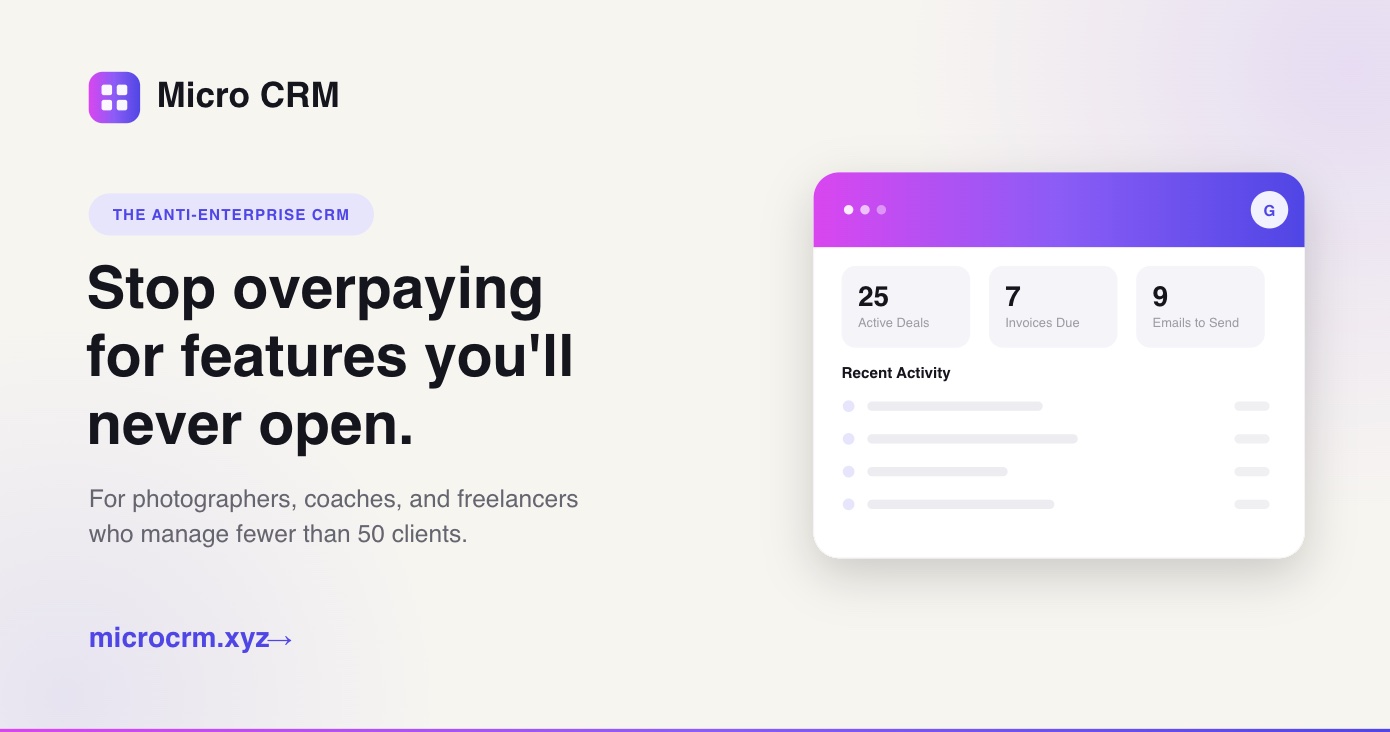
MicroCRM makes sense when one person is handling leads, deals, and billing, and the whole client base is still small enough that you want speed more than depth. It's built around a simple flow, contacts, pipeline, invoices, emails, and appointments in one place, which means less bouncing between tools and less admin drift.
The real advantage is workflow consolidation
A solo founder doesn't need to stitch together five products to stay organized. MicroCRM combines contact management, a visual Kanban pipeline, invoicing, automated follow-ups, and an appointment calendar, so the same person can move from first inquiry to paid invoice without losing context. It also supports multi-currency invoicing, which matters the moment you work across borders.
That kind of consolidation is the point. If you've ever used one app for leads, another for invoices, and a third for reminders, you already know the hidden cost is attention, not subscription fees. A simpler system lowers the chances that a prospect gets forgotten or a bill gets delayed.
It's built for fast adoption, not setup theater
MicroCRM is positioned around minimal setup and a low learning curve, with the ability to sign up in seconds and start working without setup calls or long documentation. It also offers a free plan with no credit card required, plus a limited-time Lifetime Deal for founders who prefer to avoid recurring subscriptions.
If cash flow changes, you can pause the account without losing data. That's a small detail, but for freelancers and tiny teams, it's the kind of detail that matters. The product also uses AWS-backed storage with encryption at rest and in transit, which gives you practical security without turning the CRM into an IT project.
For a fuller look at the freelancer angle, this CRM guide for freelancers is worth a read.
The line I keep coming back to is simple. A startup CRM should help you manage clients, deals, and invoices without making the software itself a second job. MicroCRM is built for that exact use case.
MicroCRM vs HubSpot and Pipedrive for a One-Person Team
For a one-person business, the key question is not “Which CRM has more?” It's “Which one keeps me selling and billing without extra tools?” That's where the trade-offs get sharp.
| Criterion | MicroCRM | HubSpot | Pipedrive |
|---|---|---|---|
| Learning curve | Very low, built for quick adoption | Low on the free tier, but broader once you expand | Low for pipeline work, but still more setup than a simple all-in-one |
| Invoicing | Native invoicing built in | Usually handled outside the core CRM workflow | Typically needs a separate billing tool |
| Pipeline focus | Kanban pipeline with a simple flow | Solid deal tracking, broader system overall | Strongest visual pipeline of the three |
| Free access | Free plan available | Free plan available with unlimited users | No permanent free plan |
| Best fit | Freelancers and micro-teams | Growing teams that want breadth | Sales-led founders who want pipeline discipline |
MicroCRM versus Pipedrive
Pipedrive is the better pick if you want deeper pipeline analytics and your sales motion is the main thing you care about. It's designed around selling, and that shows. But if you're the only person doing sales and billing, Pipedrive usually pushes invoicing outside the core workflow.
MicroCRM wins when you want fewer moving parts. One place for deals and invoices is easier to live in than a sales tool plus a billing tool. For a solo founder, that usually beats extra reporting depth.
MicroCRM versus HubSpot
HubSpot is stronger if you need the broadest free CRM base and expect to grow into marketing or service modules later. It's also the safer choice for a team that wants a familiar ecosystem and doesn't mind adding complexity over time.
MicroCRM is the sharper choice when you don't want that ecosystem at all. If you're not running campaigns, support, and multi-team reporting on day one, HubSpot can be more platform than startup. MicroCRM keeps the job smaller and clearer.
Short version: if you need a company operating system, pick HubSpot. If you need a simple client workflow, pick MicroCRM.
Setting Up MicroCRM in Your First Week
The first week should feel boring in the best way. You import your contacts, define your stages, send your first invoice, and stop wondering where everything lives.
Start with the contacts you already know. Import them, add tags that match how you sell, and keep the structure simple so you don't create cleanup work later. Then build a Kanban pipeline with the stages you really use, not the stages that sound strategic in a meeting.
After that, create the first invoice and connect the appointment calendar. If you bill in more than one currency, set that up immediately so you don't have to rebuild the workflow later. Then draft the first email sequence with templates and variable placeholders, because the whole point is to stop rewriting the same follow-up from scratch.
A few habits make the setup stick:
- Connect only what you'll use soon. Don't wire up every integration on day one.
- Pause the account during quiet months if needed. Keeping data is better than paying for idle software.
- Use the Lifetime Deal only if it matches your cash flow. Upfront savings matter more for some founders than monthly flexibility.
- Keep the pipeline narrow. Fewer stages make updates faster and more accurate.
A founder doesn't need a long onboarding project. They need a system they can start using before the week ends. That's why simple tools win early.
Midweek, check whether the CRM is reducing work. If it isn't helping you send invoices faster, follow up on time, or see the next deal clearly, the setup is too heavy. Strip it back.
A short video walkthrough can also help you see the flow before you build it yourself.
The Five-Minute Decision Rule
If you're a solo founder or a very small team, use this rule. If you have fewer than 50 clients, one person is managing sales, and invoicing needs to live beside your pipeline, pick the simplest tool that does all three jobs without extra setup. If you need a broader CRM for marketing or future scale, HubSpot makes sense. If your whole world is deal stages and nothing else, Pipedrive is the cleaner sales-first choice.
That's the filter. Don't buy for the business you hope to have in two years if it slows you down today. Buy for the workflow you need this week.
Want to better organize your clients and business opportunities?
👉 Try MicroCRM for free: https://microcrm.xyz
MicroCRM gives freelancers and small businesses one place to manage contacts, deals, invoices, and follow-ups without fighting a complex CRM. If you want a lighter system that fits a small client load and gets out of your way, visit MicroCRM and start for free. No credit card required.