
Calendar Scheduling Software Compared for Small Teams
You're trying to run a small business from an Excel sheet, an inbox, and several calendars. A client asks when you're free, you search three places, send possible times, forget to follow up, and later discover that someone else booked the slot. Meanwhile, contact details sit in one tool, invoices in another, and your next action lives in your memory.
Calendar scheduling software removes that back-and-forth by letting clients choose from your real availability. The right tool can also confirm the appointment, send calendar invitations, protect working hours, and connect the booking to client records, payments, or follow-ups. The wrong tool adds another subscription and another dashboard.
For freelancers, consultants, photographers, designers, and small agencies, the decision shouldn't center on the longest feature list. It should center on privacy, schedule protection, setup effort, and the cost of essential scheduling features. This guide compares those practical trade-offs and shows when a focused scheduler makes sense, and when an all-in-one CRM with an appointment calendar is the cleaner option.
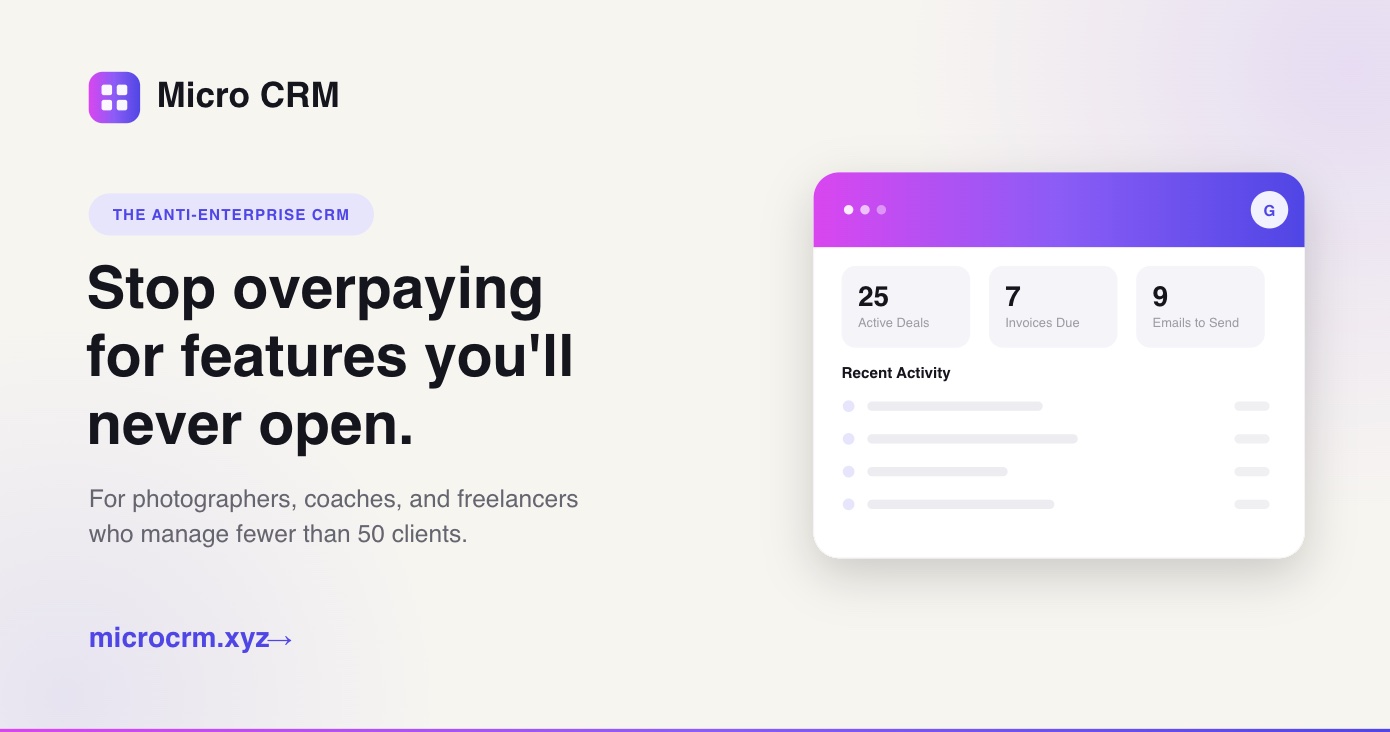
Table of Contents
- Why Scheduling Still Breaks for Small Teams
- How Calendar Scheduling Software Actually Works
- What to Compare Before You Choose a Scheduler
- Pricing and Feature Trade Offs You Should Expect
- Which Scheduling Setup Fits Your Real Workflow
- Why Micro CRM Keeps Calendar Scheduling Simple
- How to Choose and Launch Your Scheduling Flow
Why Scheduling Still Breaks for Small Teams
A typical small-team workflow starts innocently. A designer keeps prospects in Excel, tracks active work in a notebook, sends invoices from a separate app, and uses a personal calendar for meetings. A client replies to an old email asking for a call, so the designer checks availability manually and proposes a few times.
Then the exceptions arrive. One calendar contains a recurring personal commitment that isn't visible in the work calendar. A colleague books the same slot through another channel. The client chooses a time, but nobody sends a confirmation. The appointment exists in the inbox, not in the client record, so the follow-up gets lost after the meeting.
This isn't a failure of effort. It's a fragmented workflow. Each app handles one task, but nobody owns the complete sequence from inquiry to appointment to follow-up and invoice.
The hidden cost is coordination
A booking page alone won't fix a messy operation. If your availability is inaccurate, clients can still select inconvenient times. If your team assignment rules are unclear, a meeting can land with the wrong person. If the appointment doesn't connect to a contact or deal, you'll still spend time rebuilding context before the call.
A reliable scheduling setup should answer four questions:
- Who is booking? The appointment should attach to a recognizable contact or client record.
- When can they book? The system should read current calendar conflicts and respect working hours.
- Who handles the meeting? Solo operators need a personal calendar, while agencies may need team routing.
- What happens afterward? Confirmation, reminders, notes, invoices, and follow-ups should have a clear next step.
Practical rule: If a scheduler saves the email exchange but creates more manual work after the booking, it hasn't solved the operational problem.
Calendar scheduling software is the operational fix when it connects availability with a self-service booking flow. For a small business, though, a standalone scheduler isn't always necessary. A focused CRM such as Micro CRM can combine contacts, deals, invoices, email follow-ups, and an appointment calendar without forcing a team into an enterprise system.
The comparison below uses the criteria that matter in daily work, not marketing claims.
| What matters | A workable setup | Why small teams care |
|---|---|---|
| Calendar connection | Current availability across connected calendars | Prevents avoidable conflicts |
| Booking flow | A shareable link with clear event types | Reduces email coordination |
| Team handling | Assignment or routing rules when needed | Stops manual triage |
| Follow-through | Confirmations, reminders, and client context | Keeps appointments from disappearing into the inbox |
| Business fit | Simple setup and proportionate cost | Avoids paying for unused complexity |
How Calendar Scheduling Software Actually Works
Modern scheduling software follows a straightforward flow. It connects to your calendar, checks busy and free periods, applies the availability rules you set, and presents suitable slots through a booking page. The client chooses a time without asking you to inspect your schedule manually.

The three practical stages
First, connect your calendars. A scheduler needs access to the calendars that contain conflicts. That might include Google Calendar, Outlook, or another supported calendar. The point isn't to create a new source of truth. It's to let the booking system see the commitments you already manage.
Second, define availability. You set working days, hours, appointment duration, buffers, and any periods that clients shouldn't book. A consultant might offer discovery calls during selected afternoon hours but reserve mornings for project work. A photographer might separate consultation appointments from shoot days.
Third, share the booking link. The link can go into an email signature, proposal, website, or direct message. A client selects an available slot, enters the requested information, and receives the appointment details.
A useful availability management guide can help you think through working hours, buffers, and conflicts before publishing a link. The setup should reflect how you work, not an idealized schedule that collapses under real client demands.
What happens after someone books
A modern scheduler typically adds the appointment to the connected calendar and sends a confirmation. Calendar invitations give both sides a record of the meeting, while reminders can prompt the client before the appointment and reduce avoidable no-shows. Zoom's appointment scheduler overview describes this familiar flow of automatic calendar placement, confirmations, and email reminders.
This is why scheduling is now more than a convenience feature. One recent estimate placed the Calendar and Scheduling Software Market at USD 2.59 billion in 2025, with a projection of USD 4.73 billion by 2032 and a forecast CAGR of 8.94% over that period, according to 360iResearch's market estimate. Appointment booking has also become its own category. Fortune Business Insights valued the global appointment scheduling software market at USD 546.1 million in 2025, projected USD 1,905.90 million by 2034, with a 14.70% CAGR during 2026–2034.
The commercial lesson is simple. Clients now expect self-service scheduling, and small businesses need the surrounding controls to keep that convenience from damaging the workday.
What to Compare Before You Choose a Scheduler
A polished booking page is easy to demonstrate. The operational details determine whether the tool remains useful after setup. Compare every scheduler across calendar sync, team routing, reminders, and integrations.

Calendar sync comes first
Look for two-way synchronization, not a one-time calendar import. The system should read existing conflicts and place new appointments back on the calendar you use. Check whether it supports the calendars your team uses, such as Google Calendar, Outlook, or Apple Calendar.
A one-person consultancy may only need one connected calendar. An agency needs more careful testing. Ask whether the scheduler can read multiple calendars, distinguish personal blocks from bookable work, and handle time zones without forcing manual corrections.
Routing should match your team
Solo operators don't need complex assignment logic. Teams do.
Round-robin routing distributes bookings among available staff. Collective or panel scheduling requires multiple people to attend the same appointment. Routing forms can direct a client to the right person based on answers collected before booking.
Calendly is a useful benchmark here. A recent comparison highlights its round-robin routing, collective and panel scheduling, routing forms, and integrations with Google Calendar, Outlook, Apple Calendar, Zoom, Microsoft Teams, Stripe, PayPal, Zapier, HubSpot, and Salesforce. The same review notes setup in under one hour, a free tier, and paid plans starting at about $10 per user per month, as described by WaitWell Software's scheduling comparison.
The real differentiator isn't booking-page polish. It's whether the appointment reaches the right person with the right client context.
Reminders and integrations finish the workflow
Reminders should be automatic and configurable. You may want an email confirmation immediately, a reminder before the meeting, or a buffer that prevents tightly packed appointments. SMS can help in some workflows, but don't pay for it if email reminders meet your needs.
Integrations matter when a booking must trigger another action. A paid consultation may need Stripe or PayPal. A sales call may need a CRM record. A remote appointment may need Zoom or Teams. The best integration is the one that removes a manual handoff, not the one that adds another logo to a feature page.
Use this evaluation checklist before subscribing:
- Sync: Can the scheduler read every calendar that creates conflicts?
- Routing: Does it assign appointments automatically, or will someone triage every request?
- Reminders: Can you confirm and remind clients without copying email templates?
- Payments: Can clients pay or leave a deposit during booking if your service requires it?
- Privacy: Does the booking page reveal only necessary information?
- Protection: Can you enforce working hours, buffers, and focus blocks?
Pricing and Feature Trade Offs You Should Expect
Free plans often work for a solo user testing the concept. They become restrictive when you need multiple event types, staff calendars, intake questions, or payment support. The useful comparison isn't the headline price. It's the cost of the specific primitives your workflow cannot operate without.
| Tool | Free Plan Limit | Paid Starting Price | Standout Primitive |
|---|---|---|---|
| Calendly | One event type | $10 per seat per month | Routing and broad integrations |
| HubSpot Meetings | CRM-native scheduling | Free | Scheduling inside a CRM |
| Acuity Scheduling | Free availability varies by plan | $16 per month | Payments and intake forms |
| Cal.com | Free or self-hosted option | Free | Unlimited event types |
| Setmore | Up to four staff on the free tier | $5 per user per month | Small-team staff access |
| Zoho Bookings | Free single-user plan | $6 per staff member per month | Low-cost staff scheduling |
Pricing and limits in this table come from Albato's appointment scheduling comparison. Treat them as comparison figures, not a permanent quote. Vendors change packaging, billing periods, and included limits.
Free is useful, but limits shape behavior
A free plan with one event type may suit a freelancer who offers one kind of consultation. It becomes awkward if that person needs separate links for a short introduction, a paid session, and a project review. The team then either compresses every appointment into one generic flow or upgrades.
The same issue appears with staff seats. A small agency may start with one shared booking page, then discover that the page doesn't assign work cleanly. Paying for additional staff can be reasonable if it removes daily triage. It isn't reasonable if the team only needs a shared calendar and a simple contact record.
Payments are another dividing line. If clients pay when they book, a plan with payment support may replace manual invoices for that specific service. If you invoice after delivery, paying extra for booking payments can add cost without improving the workflow.
Benchmark cost against essential work
For a business managing fewer than 50 clients, count the features you will use every week:
- Event types: How many distinct appointment flows do you need?
- People: How many staff calendars require access?
- Reminders: Are automated confirmations included?
- Payments: Do clients need to pay before the appointment?
- Client context: Will the booking connect to contacts, deals, or follow-ups?
Don't compare feature totals. Compare the monthly cost of the smallest setup that removes your actual bottleneck.
Want to better organize your clients and business opportunities?
👉 Try Micro CRM for free. It brings contact management, deal tracking, invoicing, email follow-ups, and appointment scheduling into one lightweight workspace, with no credit card required for the free plan.
Which Scheduling Setup Fits Your Real Workflow
The right setup depends on the shape of your work. A photographer, a coach, and a small agency may all need booking links, but they don't need the same rules behind those links.

Freelance photographers and designers
A photographer usually needs a small set of clear appointment types, such as an initial consultation, a project planning call, and a review. Each should have its own duration and availability rule. Don't expose the entire calendar. Publish only the hours you can reliably give to prospective clients.
A designer may need a booking form that captures project scope before the conversation. If the scheduler supports intake questions, ask only what changes the next action. A long form creates friction, while no context forces you to repeat basic questions during the call.
Privacy matters here. Clients don't need to see why you're unavailable. They only need to see bookable times. A scheduler should reveal availability without exposing personal appointments, client names, or internal notes.
A short booking flow works best when you also protect production time. Add buffers between calls, keep project blocks unbookable, and avoid offering every open space just because the system can see it.
Coaches and consultants
Coaches and consultants often need more qualification before a meeting. An intake form can collect the client's objective, preferred format, and the reason for booking. Automatic reminders are valuable when appointments involve preparation or payment.
For a paid consultation, connect booking to payment if the tool supports it and if that matches your billing model. Otherwise, send the booking into your normal invoicing process so the client, appointment, and invoice stay connected.
The booking page should also make boundaries visible. Set working hours, avoid same-day availability if preparation matters, and define a realistic cancellation policy in the event description.
Small agencies
An agency has a different problem. The question isn't only “when am I free?” It's “which person should handle this request?” Team routing, round-robin assignment, shared calendars, and CRM handoff matter more than branding controls.
This is also where spam protection becomes operationally important. A public link should collect enough information to filter irrelevant requests without exposing the team to unnecessary tracking or excessive data collection. Privacy-first settings, conflict detection, and meeting policies help keep the schedule realistic rather than maximally full.
The strongest setup protects focus time as deliberately as it protects meeting availability. A calendar with no empty spaces may look productive, but it leaves no room for preparation, delivery, or urgent client work.
A visual demo can help you see how the booking experience fits into a client workflow:
The broader 2026 scheduling conversation is moving toward privacy, anti-spam controls, conflict detection, and policy automation, rather than feature accumulation alone, as discussed in CalClear's scheduling trends overview. For a small team, that shift is practical. The best scheduler isn't the one that fills every free minute. It's the one that helps you accept the right appointments without surrendering control of the week.
Why Micro CRM Keeps Calendar Scheduling Simple
For a small consultancy, the booking request is rarely the whole job. A prospect books a call, the opportunity needs tracking, an invoice may follow, and someone must remember the next action. When those steps live in separate tools, the team pays for the gaps with repeated data entry and lost context.
Standalone scheduling software still makes sense when booking rules are the main operational problem. Sales teams may need advanced routing, clinics may require specialized intake, and larger organizations may depend on detailed permissions or reporting. A business serving fewer than fifty clients often needs a smaller set of primitives: a protected calendar, clear availability, basic client records, and a reliable handoff after the meeting.
Micro CRM combines contacts, a Kanban pipeline, invoices, email sequences, and an appointment calendar in one interface. The calendar handles appointment scheduling and availability management, while the surrounding workspace keeps the booking tied to the commercial work that follows.

When an all-in-one tool is the better choice
A freelance consultant might receive an inquiry, book a discovery call, move the opportunity through a Kanban pipeline, send an invoice, and schedule follow-up. A standalone scheduler covers the booking. A lightweight CRM keeps the related client and sales information together, reducing handoffs and repeated updates.
An integrated calendar should not replace every specialist tool. Advanced round-robin logic, collective scheduling for many staff members, and complex payment routing can justify a dedicated scheduler. For a modest client list, fewer tools usually mean less maintenance and fewer places for client details to drift out of date.
Micro CRM follows a zero-learning-curve approach, quick onboarding, and a focused feature set without AI add-ons or automation wizards. It offers a free plan with no credit card required, alongside paid plans. Seasonal businesses can also pause an account while preserving its data.
Simplicity still needs responsible security
A short setup does not excuse careless data handling. Micro CRM states that it uses AWS infrastructure, encryption at rest and in transit, and Amazon Cognito authentication. These measures do not replace strong passwords, access control, or sensible account practices, but they define a security foundation for client and business information.
Review the workspace at Micro CRM and test whether its calendar fits your current process. Choose a dedicated scheduler when specialist booking logic is the bottleneck. Choose an integrated CRM calendar when privacy, schedule protection, and fragmented client administration matter more than a long enterprise feature list.
How to Choose and Launch Your Scheduling Flow
Start with a narrow booking flow that your team will maintain. For a business serving fewer than 50 clients, privacy, protected availability, and the cost of basic scheduling functions matter more than an enterprise feature list.
- Connect only calendars with real conflicts. Link the sources that affect client availability, and keep personal or unrelated calendars private.
- Set working hours and protected blocks. Define bookable periods, then reserve time for preparation, delivery, breaks, and administration.
- Create the appointment types you sell. Give each one a clear purpose, duration, location, and buffer. Extra options make the booking page harder to use.
- Ask only useful intake questions. Collect details that change preparation or routing. Leave open-ended discovery for the meeting.
- Turn on confirmations and reminders. Check the recipient address, message wording, time zone, cancellation instructions, and privacy of calendar details.
- Test the link from the client's perspective. Make a test booking, confirm the calendar update, inspect the invitation, and verify the reminder.
- Define the next action. Connect the appointment to a contact or deal, prepare invoicing, and assign the follow-up task.
Use this appointment scheduling guide while configuring the flow. Add team routing, payment collection, and other integrations only after the basic path works reliably. Each added connection creates another place for permissions, data, or notifications to fail.
After launch, inspect the schedule for conflicts and unwanted bookings. Rewrite labels when clients choose the wrong appointment type. Tighten availability or add buffers when meetings consume delivery time. Review privacy settings as carefully as booking rules, especially when a calendar exposes titles, locations, or client details.
The right calendar scheduling software cuts email, protects working time, and makes the next action clear. Micro CRM can keep appointments connected to contacts, deals, invoices, and follow-ups, while a focused scheduler may suit teams that need specialist booking logic.
Choose the smallest setup that protects the schedule and removes manual work. Expand it only when a real workflow problem appears.