Client Onboarding Process: A Freelancer Playbook
Monday starts with three different inboxes open.
A photographer is digging through Gmail for a signed contract, a designer is matching a Stripe payment to the right client in a spreadsheet, and a coach is trying to remember whether the kickoff link was sent in Slack or buried in a DM. The work itself isn't the problem. The messy handoff between “yes, let's do this” and “we're officially underway” is.
That handoff is your client onboarding process. If it lives across email, spreadsheets, notes apps, calendar invites, and an invoicing tool, you're not running a process. You're relying on memory and cleanup. The fix usually isn't more software. It's a tighter system with fewer moving parts, one that carries a client from pre-sign paperwork to kickoff, delivery, invoicing, and follow-up without forcing you to hunt across tabs all day.
Table of Contents
- The Real Cost of Disorganized Client Onboarding
- Pre-Sign Checklist That Sets the Tone
- Kickoff Meeting and Welcome Sequence
- Pipeline Stages and Delivery Milestones
- How a Lightweight CRM Replaces Five Disconnected Tools
- Onboarding Playbook by Service Type
- KPIs, Timing, and Your Repeatable Onboarding Checklist
The Real Cost of Disorganized Client Onboarding
The ugly version of freelance onboarding rarely looks dramatic. It looks small.
You resend a contract because the client says they never saw it. You realize the deposit invoice went out but the reminder didn't. You open Notion for the project brief and land on a page mixed in with personal notes. None of that feels catastrophic in the moment. It still costs you money.
Where the leak actually happens
Most freelancers start with email plus a spreadsheet because it's familiar and cheap. That choice makes sense early on. Then the client load grows a little, and now basic admin starts eating billable time.
A scattered client onboarding process usually creates problems in three places:
- Cash flow slips: Deposit invoices go out late, reminders depend on memory, and final invoices wait until the project feels “basically done.”
- Scope gets fuzzy: If the agreed scope only lives in call notes and old email threads, clients fill the gaps with assumptions.
- Trust erodes: Clients notice slow replies, duplicate questions, missing links, and uncertain next steps faster than freelancers think.
Practical rule: Clients judge your process before they judge your craft.
The teams that handle onboarding well tend to move fast and use structured follow-up. A 2026 benchmark found the top 20% of firms respond within 4 hours of signing, complete onboarding in 5 days or fewer, and rely on portals plus automated follow-ups instead of manual email chains. The bottom 20% often take 2 to 3 weeks, with median completion times of 4.8 days versus 23.7 days, and lose 25% to 35% of clients in the first 90 days. You can review those figures in the client onboarding benchmark report.
Why freelancers feel this first
A freelancer doesn't have a separate ops team to clean up after a messy start. If the onboarding sequence is weak, the same person who sold the work also has to chase the signature, issue the invoice, schedule the kickoff, gather files, and explain next steps.
That's why operations discipline matters so much at a small scale. A cleaner setup improves speed, but it also protects your reputation. The practical side of that shows up in everyday systems like business efficiency habits that reduce admin drag.
Pre-Sign Checklist That Sets the Tone
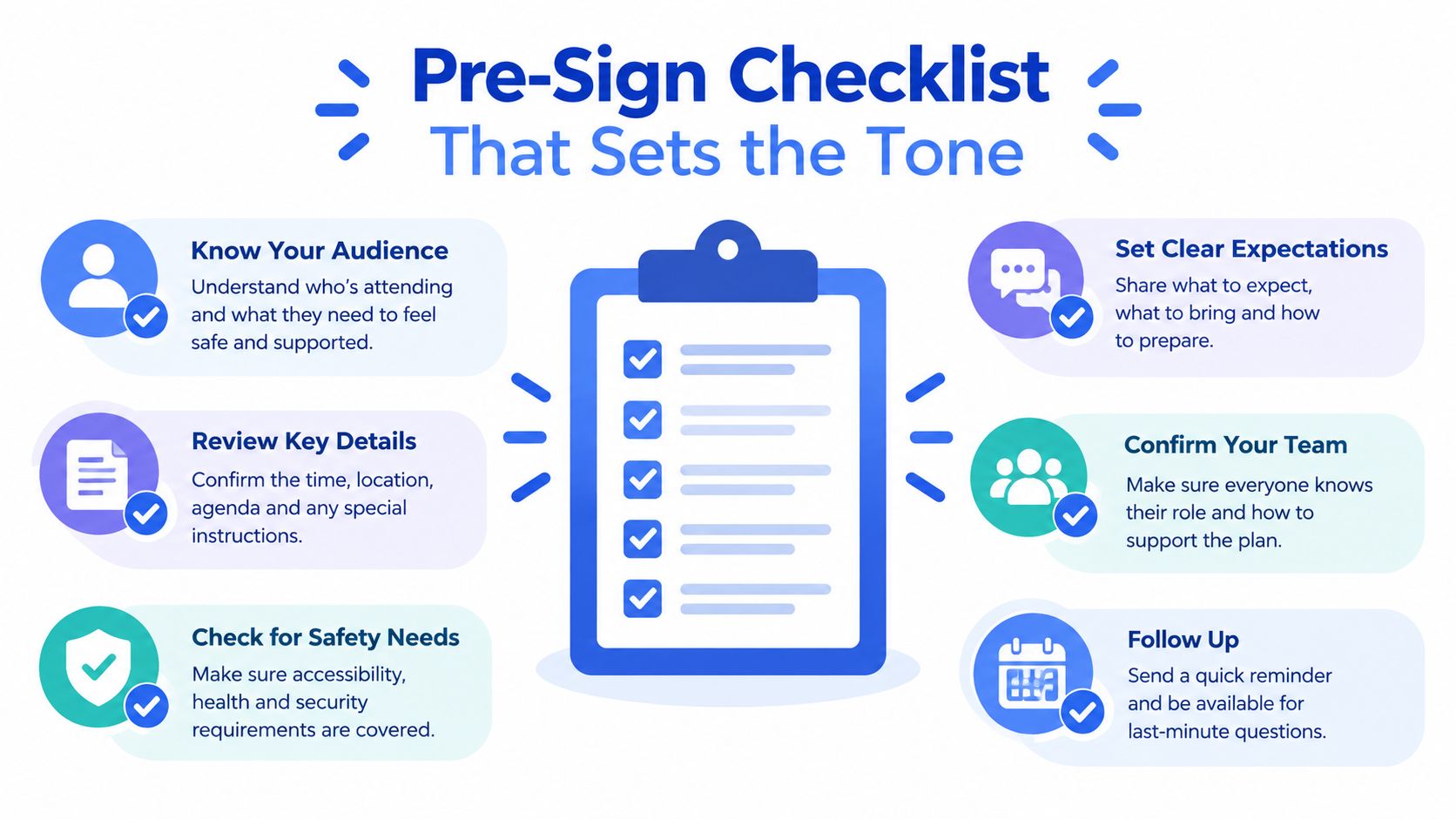
Before a client becomes active, four things should exist. Not eventually. Before work starts.
If any one of them is missing, the project begins with guesswork.
The four documents that matter
First is the welcome packet. Keep it short. One page is enough for most freelancers. It should confirm scope, timeline, price, and what happens immediately after signing. Clients relax when they see the deal summarized clearly in writing.
Second is the contract. Sign it through something like HelloSign, DocuSign, or a built-in e-sign flow. The important part isn't the brand. It's storage. The contract belongs inside the client record, not in a desktop downloads folder with six versions of the same file.
Third is the deposit invoice. Send it as soon as the contract comes back. Same hour if possible. Include the due date, payment method, and what happens if payment is late. That one move sets the tone that your process is active and monitored.
Fourth is the intake form. This should be brief enough that clients complete it. Ask for assets, deadlines, decision-makers, communication preferences, and any must-know constraints. If the questionnaire feels like homework, completion drops.
The order matters more than people think
A lot of freelancers have these pieces, but they don't connect them. That's the problem.
Use clear triggers:
- Contract signed: Move the deal from proposal to signed.
- Deposit paid: Open the kickoff task.
- Intake submitted: Send the welcome email and booking link.
Send the deposit invoice while the agreement is still fresh. Waiting even a day gives friction room to grow.
This part of the client onboarding process tells a client what working with you will feel like. If these steps are clean, they assume delivery will be clean too. If these steps are messy, they start managing around you before the project even begins.
Kickoff Meeting and Welcome Sequence
The kickoff isn't the beginning of the work. It's the beginning of alignment.
Treat it like a short working session with a purpose, not a loose “nice to meet everyone” call. For most freelance projects, a brief video meeting is enough if the prep is solid and the next steps are already attached to the client record.
Set the call up so the client arrives prepared
Use a booking link tied to the client entry and send the agenda in advance. That alone cuts down the vague, meandering version of kickoff calls that leave everyone nodding without deciding anything.
A simple agenda works:
- Introductions: Names, roles, and who approves what.
- Scope check: Confirm what's included and what isn't.
- Timeline review: Walk through milestones and dates already discussed.
- Three key questions: Ask what success looks like, what could delay approvals, and how they want communication handled.
- Next steps: End with dates, files, and responsibilities.
Clients don't need a theatrical kickoff. They need certainty.
A welcome email that does actual work
Save a reusable template so you're not rewriting this every time. If your system supports automation, trigger it when the deal status flips to active. If not, use a saved draft and send it manually.
A plain version looks like this:
Thanks for signing. Attached are your contract copy, deposit receipt, intake form, and booking link for our kickoff call. If there's anything you meant to mention on our call and didn't, reply here and add it before kickoff.
That email works because it answers the client's immediate questions before they ask them. It also creates one stable thread for the project start. If you want to build this kind of repeatable outreach, a useful reference is this explanation of how an email sequence works in practice.
What must exist when the call ends
The kickoff should end with three concrete outputs:
- A recap email: Same day if possible.
- A project channel or email thread: One place for updates and questions.
- A dated first deliverable: On the calendar, not in someone's head.
A lot of onboarding trouble starts because the meeting ends with “great, we'll follow up soon.” That's not a next step. That's a delay disguised as politeness.
Pipeline Stages and Delivery Milestones
A Kanban board is where the client onboarding process stops being a pile of promises and becomes operational.
For freelancers, the trick is keeping the pipeline simple enough to scan in seconds and specific enough that every card has an obvious next action. If you need to open five threads to understand a stage, the board is too vague.
The stages that usually work
For service businesses, I like these stages:
Lead, Signed, Kickoff, In Progress, Review, Delivered, Paid.
That sequence reflects the client journey without turning the board into project management theater. Every move should happen because something verifiable happened, not because the week changed.
| Stage | Trigger to Move Forward | Probability |
|---|---|---|
| Lead | Client agrees to proceed and paperwork is sent | Qualitative |
| Signed | Contract countersigned | 80% |
| Kickoff | Deposit cleared and kickoff scheduled or completed | 90% |
| In Progress | First active delivery task starts | Qualitative |
| Review | First draft or core deliverable sent for feedback | Qualitative |
| Delivered | Final files or agreed deliverables approved | 100% |
| Paid | Final invoice settled | 100% |
Keep movement tied to proof
Many freelance pipelines go soft. A card sits in “review” for days because no one wants to chase the client. Or something lands in “in progress” before the deposit clears because the freelancer wants momentum.
That creates false visibility.
Use these rules instead:
- Assign an owner: Even if you work solo, the card still needs one accountable person.
- Add a due date: A stage without a date drifts.
- Flag stale review items: If a client sits in review too long, require written confirmation before invoicing or revising further.
Review is where projects get stuck most often. If feedback is delayed, pause assumptions and ask for a decision in writing.
The point of stage probabilities isn't mathematical perfection. It's honest forecasting. A signed project is much closer to revenue than a lead, and a delivered project should never still feel uncertain on the board.
How a Lightweight CRM Replaces Five Disconnected Tools
The practical question is not whether you can run onboarding from separate apps. You can. The question is how many handoffs you want to manage every time a client moves from signed proposal to kickoff, from kickoff to delivery, and from delivery to payment.
That trade-off shows up in the numbers. Analysts at Onramp found that 60% of companies manage customer onboarding across four to six separate tools, while only 13% of SMBs use a dedicated onboarding solution, as summarized in these customer onboarding statistics.
Comparing the common setups
I've seen the same pattern with photographers, designers, and coaches. They start with tools they already know, then bolt on one more app each time a gap appears. The setup works until a client asks a simple question like, “Did you get my questionnaire?” and the answer lives in the wrong place.
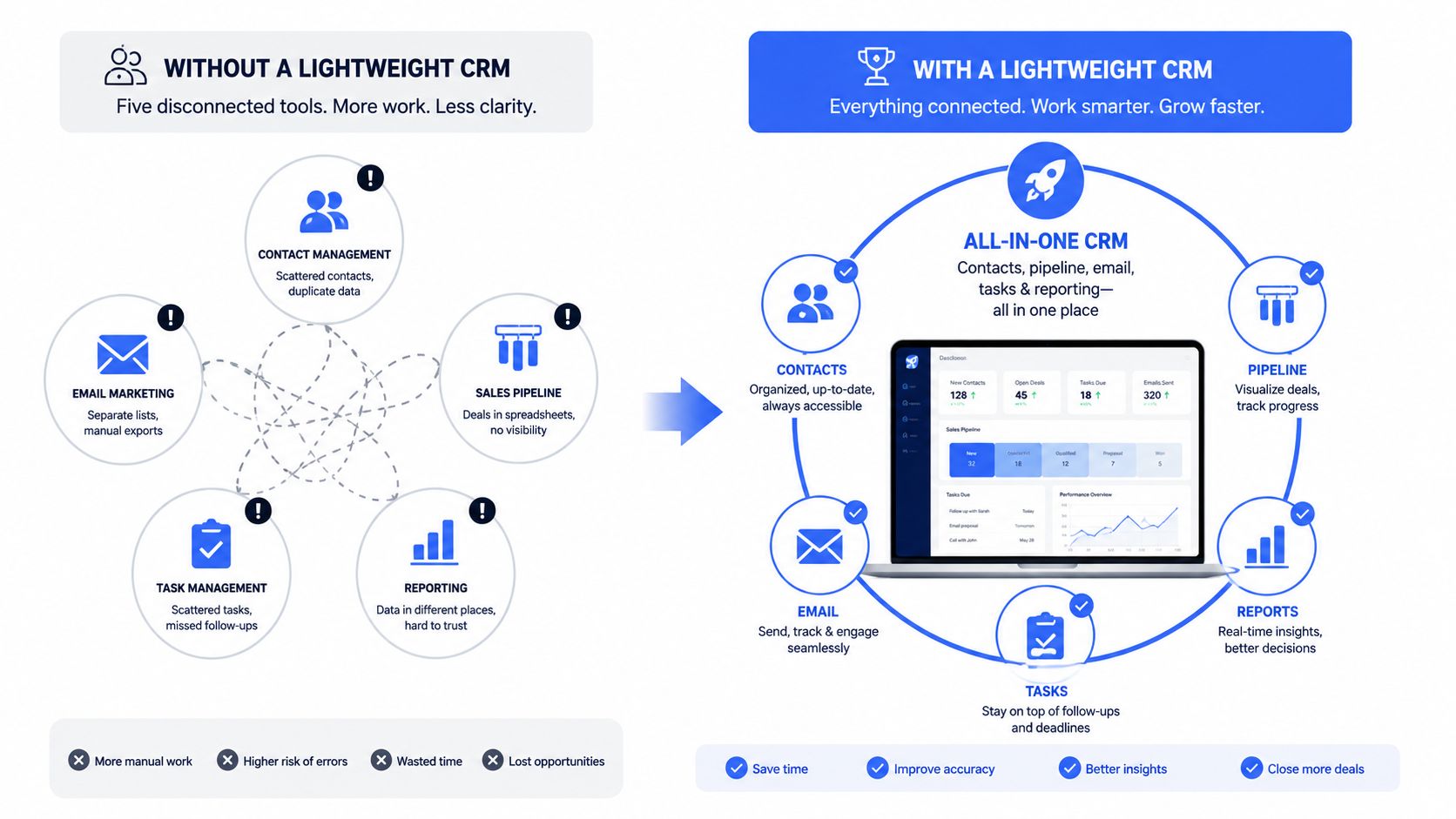
Spreadsheet plus email stays cheap and familiar. It also depends on memory. You still have to check whether the contract was signed, whether the invoice was paid, whether the kickoff link was sent, and whether anyone followed up after delivery.
Enterprise CRM software gives you more control than most solo service businesses need. You get custom fields, automation, reporting, and permission settings. You also get setup overhead, admin work, and a system built for sales teams rather than one person running the full client lifecycle.
A lightweight CRM handles the middle ground better. A tool built for a freelancer CRM workflow can keep contacts, pipeline stages, invoices, email templates, booking links, and notes in one record. That matters because freelance onboarding is one loop, not five separate jobs. Pre-sign paperwork, deposit tracking, kickoff prep, delivery milestones, final invoicing, and follow-up all belong in the same place.
Where the consolidation actually pays off
The gain is not convenience for its own sake. The gain is fewer dropped steps.
If a coach has signed but not booked kickoff, the next action is visible. If a designer paid the deposit but has not submitted brand assets, the delay is visible. If a photographer delivered the gallery but the final invoice is still open, the project is not treated as done.
That kind of visibility is hard to get when each stage lives in a different tool.
Follow-up is usually the first place the process breaks. New leads often need 6 to 8 follow-ups to convert, according to these follow-up sales statistics. The same pattern shows up in onboarding. Clients miss forms, forget to choose a time, delay feedback, or overlook an invoice. A lightweight CRM helps because reminders, status, and money are tied to the same client record instead of scattered across tabs.
For a solo freelancer, that usually matters more than extra features. A simpler system with fewer seams is easier to keep accurate.
Onboarding Playbook by Service Type
The backbone stays the same across freelance services. What changes is the intake, the kickoff conversation, and the delivery artifact.
That's good news, because it means you don't need a new client onboarding process for every offer. You need one structure that adapts cleanly.
Photographer
A wedding photographer still needs the same basic sequence: signed agreement, deposit, intake, kickoff, delivery, payment. But the intake form should ask for venue, timeline, family shot list, and who can make day-of decisions.
The kickoff is less about abstract goals and more about logistics. After delivery, the milestone may be a private gallery link, then a print selection or final confirmation before the project is closed.
Designer
A brand designer needs tighter boundaries earlier. The welcome packet should make revision rounds visible. The contract should define what counts as a revision versus a new request.
At kickoff, the useful questions are different. Who approves the concept? Are there existing brand assets? Is there a mood board or reference set that needs formal approval before design starts? The pipeline can stay identical even if the client-facing materials change.
Good onboarding reduces revision chaos because decision-makers and approval rules are named before the first concept lands.
Coach
A leadership coach usually runs a more relationship-heavy version of onboarding. The intake form should surface goals, session cadence, scheduling constraints, and preferred communication boundaries.
The kickoff often becomes a discovery session rather than a project briefing. After that, the delivery milestone may be a recurring calendar slot, a shared action plan, or a post-session follow-up sequence. Same structure. Different payload.
That consistency is what makes your process repeatable. You shouldn't have to reinvent your backend every time your service type changes slightly.
KPIs, Timing, and Your Repeatable Onboarding Checklist
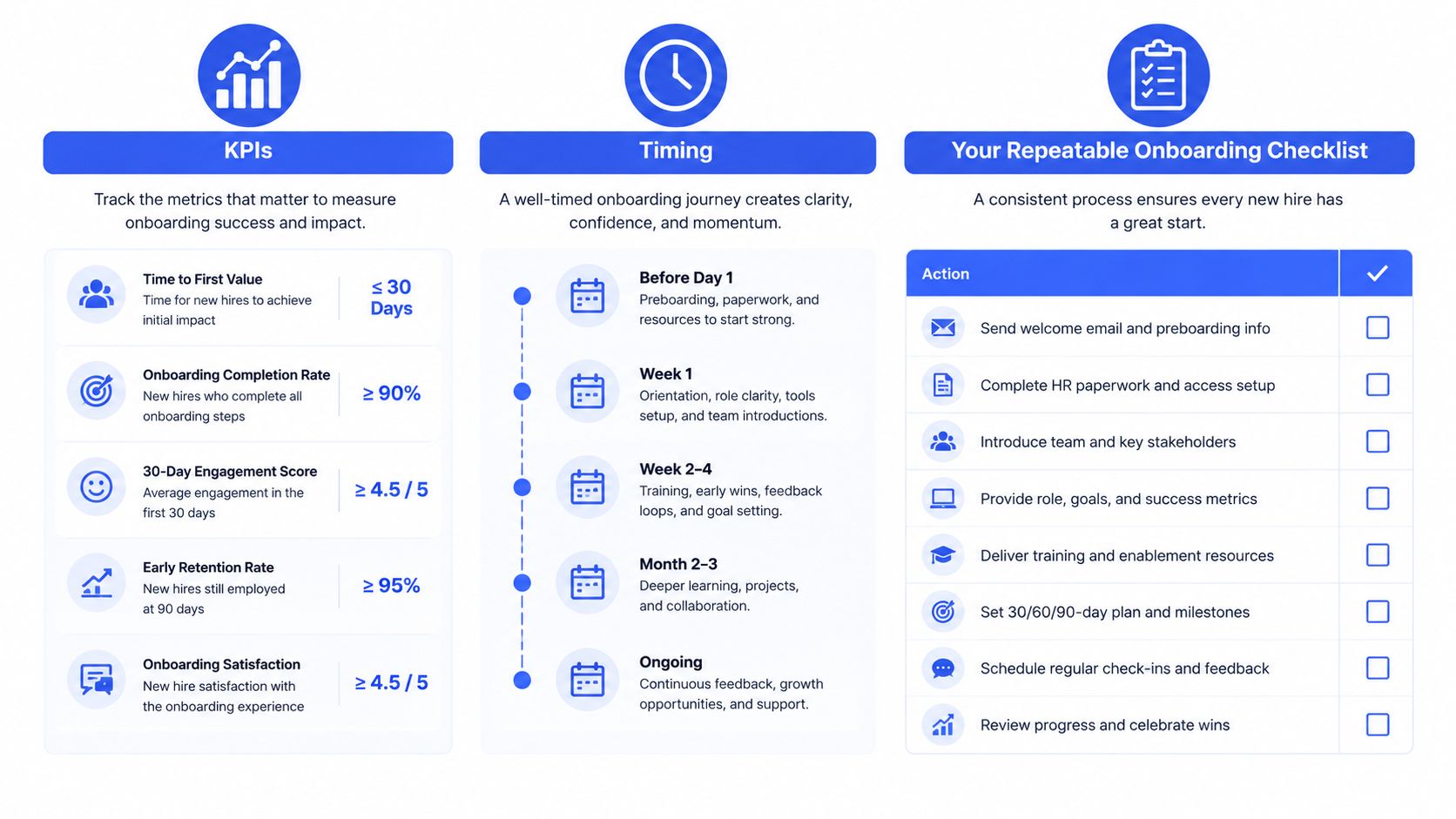
A freelance onboarding process usually breaks in quiet places. The contract is signed, but kickoff drifts for a week. The first invoice goes out, then sits. A client asks the same setup question twice because the answer lived in an email thread instead of the client record. That is the point of tracking KPIs. They show where the handoff is slowing down across the full loop, from paperwork to payment to follow-up.
For freelancers, the useful metrics are tied to moments a client can feel. Analysts cited in this roundup of customer onboarding statistics and trends found that onboarding affects purchase confidence and retention decisions. Enterprise timelines and team structures do not map neatly to solo service businesses, but the underlying point holds. Early friction changes how secure a client feels about hiring you.
The KPIs worth watching
Track the few numbers that expose delay fast:
- Contract to kickoff: Keep this under five days if your service includes a live kickoff.
- Kickoff to first deliverable: Under seven days works well for many freelance offers because it gives clients proof that the project is active.
- Invoice to payment: Watch how long deposits and final invoices stay open.
- Follow-up completion rate: Measure whether every client gets the post-project check-in, testimonial request, or next-step offer.
- Repeat client rate: Use this to see whether a strong onboarding experience is turning into more work.
Completion rate can help too, but only if you define the steps clearly. Researchers at Intellum explain in their piece on customer onboarding metrics that completion rate is commonly used because it shows how many users finish the intended setup flow. In a freelance business, that might mean signed contract, paid deposit, booked kickoff, submitted intake, and confirmed first milestone. If clients stall halfway through, the fix is usually a shorter checklist, clearer ownership, or fewer tools.
This week's cleanup list
Start with the parts that remove chasing:
- Pull contacts, active leads, and current clients into one CRM so status, notes, files, invoices, and next steps live in the same place.
- Set your core stages from pre-sign to closed project, including payment and follow-up.
- Create templates for the welcome email, kickoff agenda, deposit invoice, and project recap.
- Add timing targets to each stage so stalled deals are visible without checking five apps.
- Review one recent project from inquiry to payment and note where information got lost, repeated, or delayed.
There is a trade-off here. Higher-ticket custom projects usually need more intake and more approval points. Fixed-scope offers need faster movement and less ceremony. The right checklist is the one you can run consistently inside one lightweight system, without rebuilding your process for every client or relying on memory to carry the project from signed paperwork to final invoice.