
Contact Management CRM Software: A Practical Guide
You've got a spreadsheet full of clients, leads, and old prospects. A few conversations live in Gmail, others are buried in calendar notes, and invoices sit in a separate app. Then a client asks whether you sent the revised proposal, and you spend ten minutes searching instead of answering.
That's the point where contact management CRM software earns its place. The right system gives you one reliable record for people, companies, conversations, deals, invoices, and follow-ups, without forcing a freelancer into an enterprise sales operation. MicroCRM is one lightweight option built around that contact-first approach, with a free plan that doesn't require a credit card.
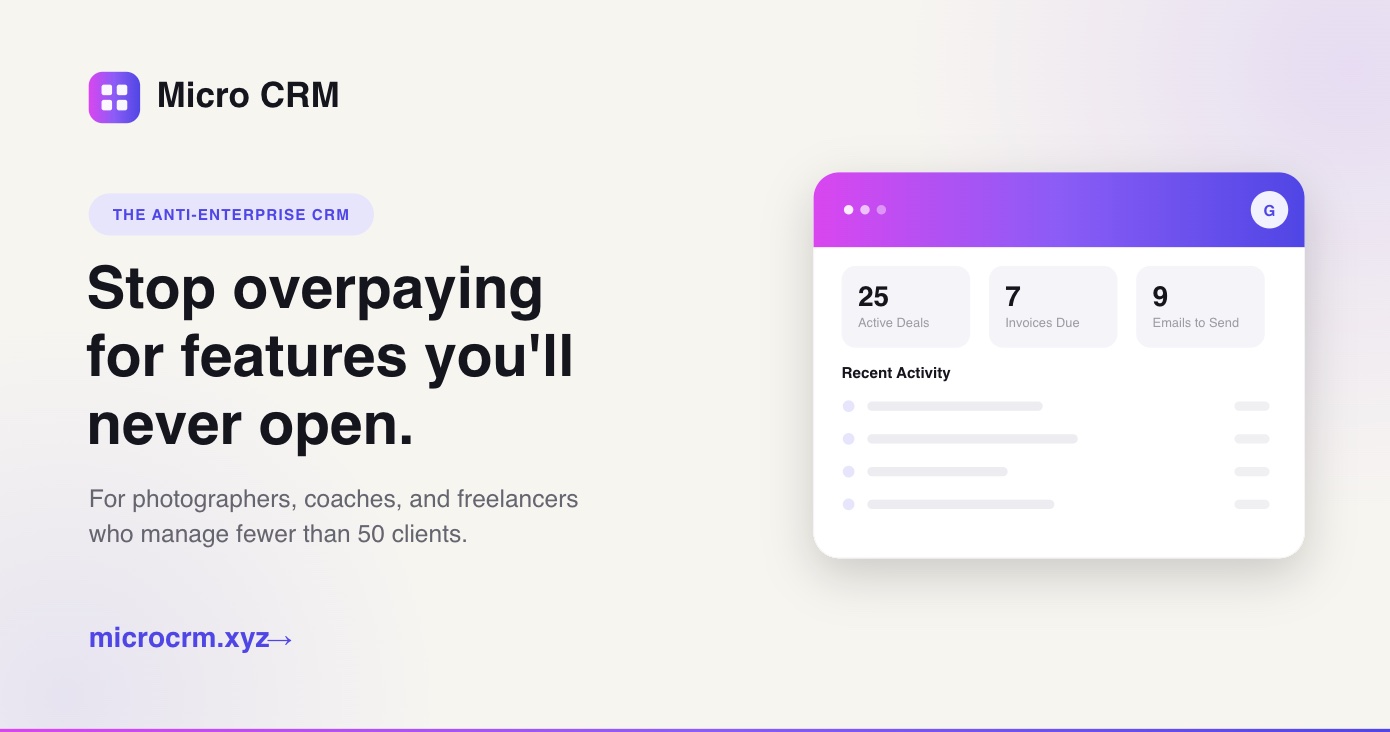
Table of Contents
- The Spreadsheet Trap Freelancers Keep Falling Into
- What Contact Management CRM Software Actually Does
- How a Lightweight CRM Compares to Spreadsheets and Enterprise Tools
- Mapping Features to Real Freelance Workflows
- Buyer Checklist for Freelancers and Micro-Businesses
- Quick Setup Path Using a Contact-First CRM
- Choosing the Right CRM Without Overpaying
The Spreadsheet Trap Freelancers Keep Falling Into
A freelance designer I know had been working with a client for months. The project was moving quickly, with feedback arriving through email, chat, and occasional calls. When the client asked about the final mockup, the designer couldn't remember whether she'd sent it, saved it as a draft, or attached it to an earlier message.
Her spreadsheet had 180 rows. It looked organized at first glance, but the last-contact column was outdated, names weren't consistently formatted, and notes were scattered across cells. Searching manually took longer than replying should have taken.
That's the normal spreadsheet failure mode. Excel feels familiar and costs little to start, but it makes you responsible for every reminder, filter, status update, and history entry.
The breaking points usually appear in the same places:
- Manual search: You scan rows instead of finding a person by name, company, email, or conversation.
- No useful tags: “Potential client,” “warm referral,” and “waiting for approval” become inconsistent notes rather than usable segments.
- No shared history: A call note, proposal, invoice, and follow-up email stay in separate places.
- No reminders: The spreadsheet won't tell you that a promising lead has gone quiet.
- Duplicate records: A contact entered from a referral can appear again after an inquiry form submission.
The problem isn't that spreadsheets are bad. They're useful for simple lists. The problem is asking a list to manage a relationship workflow.
Practical rule: If you regularly ask yourself “What happened last?” or “Who needs a reply?”, your spreadsheet has stopped being a contact system and become an administrative liability.
What Contact Management CRM Software Actually Does
Contact management CRM software is a contact-first system of record. It stores each person, company, conversation, note, task, and deal in one searchable workspace, then adds workflow tools that help you act on the information.
A proper system does more than hold an address book. Look for these six capabilities.
Shared contact records
Each client should have one record containing their email, phone number, company, role, notes, linked deals, and relevant activity. When a client asks for a previous quote, you should be able to open one profile and see the surrounding context rather than search three applications.
Automatic contact history
Email and activity history should attach to the contact record with minimal manual work. You might review every message with a client before a project call, including the latest request, your response, and any promised next step.
Tags and segmentation
Tags let you group contacts without creating duplicate lists. A copywriter could use labels such as warm, quoted, and ghosted, then review one group without changing the underlying contact record.
Fast cross-field search
Search should work across partial names, companies, email addresses, phone numbers, and notes. If a virtual assistant remembers only a company name fragment, that should still be enough to locate the right person.
Reminders and follow-up triggers
A CRM should help you schedule the next action, whether that's a proposal follow-up, renewal check-in, or appointment reminder. Automated emails can handle routine sequences while personal tasks remain visible.
One-click export
Your data should be portable. Exporting contacts, notes, and deal information gives you a practical exit route if the product changes, pricing no longer fits, or your business outgrows the platform.

Data quality matters as much as software selection. Uniform formats for names, phone numbers, emails, and job titles make records easier to search and segment, while dropdowns for lead status and source reduce inconsistent entries. Nimble's CRM contact management guidance also emphasizes validation and regular duplicate-merging workflows.
How a Lightweight CRM Compares to Spreadsheets and Enterprise Tools
A freelancer managing fewer than 50 clients usually doesn't need the machinery built for a large sales department. They need reliable records, a visible pipeline, reminders, and a billing workflow that doesn't create extra admin.
| Option | Monthly Cost | Setup Time | Contact History | Automation | Best Fit |
|---|---|---|---|---|---|
| Spreadsheets | Low or none | Immediate, but manual | Shallow and inconsistent | Manual reminders and formulas | Simple lists and very early operations |
| Lightweight CRM | Low, often with a free plan | Quick, with a focused import | Centralized notes and interactions | Follow-ups, sequences, and task reminders | Freelancers and small teams with modest client volumes |
| Enterprise CRM | Higher and often plan-dependent | Longer, with configuration | Deep and highly customizable | Extensive workflows and integrations | Larger sales teams with dedicated administration |
Spreadsheets win on familiarity. They lose when you need reliable search, interaction history, duplicate handling, or reminders. Enterprise products such as Salesforce and HubSpot Pro win on breadth, but that breadth brings configuration work, training, and features a solo operator may never use.
The lightweight category is the sensible middle ground. It gives you a real system of record without asking you to hire a sales-operations specialist.
This guide to CRM alternatives is useful if you're still deciding whether to replace Excel, use an inbox-based tool, or adopt a dedicated contact-first platform.
The market context supports that shift. One independent model estimates the CRM market grew from USD 76.4 billion in 2020 to USD 146.0 billion in 2025, while paid user equivalents rose from 173 million to 310 million over the same period. The model also estimates cloud and SaaS delivery increased from 68% of revenue in 2020 to 82% by 2025, with historical growth of 13.8% CAGR. Ken Research's global CRM market model shows why even small-business tools now compete in a mature, cloud-first category.
For a micro-business, the decision isn't “Which CRM has the most features?” It's “Which system removes the most recurring work without creating a new job?”
Mapping Features to Real Freelance Workflows
Feature lists do not show whether a CRM earns its place. Start with the moments that create missed revenue or repeated admin, then match each one to the smallest capability that resolves it.

A photographer managing rescheduled shoots
Rescheduled sessions expose the value of an interaction history. The contact record should hold the original booking details, revised dates, call notes, location information, and the next action.
Before confirming a new slot, the photographer can review the record and see what changed. That prevents conflicting promises and avoids searching through several inbox threads.
A copywriter reviewing lead status
A copywriter may get more value from saved filters than from another set of tags. Views such as “proposal pending,” “needs portfolio,” or “follow-up this week” turn a mixed contact list into a practical work queue.
The filter should preserve the full record behind each result. That lets the copywriter review prior messages and decide whether to send a proposal, answer a question, or close the opportunity without duplicating contacts.
A virtual assistant handling referrals
Referral work depends on search speed and accuracy. The assistant may know only part of a name, a company, or when the last conversation took place.
A contact-first CRM should find records from partial details and show related people at the same company. That combination reduces duplicate entries and lowers the chance of sending a private update to the wrong contact.
A consultant preparing review conversations
Quarterly reviews slip when overdue check-ins stay buried. Saved filters and groups surface clients without a recent conversation, accounts with open proposals, or relationships approaching renewal.
The result is a defined queue. The consultant opens the relevant view, checks the record, and completes the next action instead of relying on memory.
A contact-first platform earns its keep when these moments connect. Deal stages show commercial progress, email sequences handle routine follow-ups, invoices remain attached to the client, and calendar tools reduce scheduling back-and-forth. For freelancers and micro-businesses, that is the minimum feature set worth paying for.
The minimum useful CRM is the one that tells you who matters, what happened, and what to do next.
Buyer Checklist for Freelancers and Micro-Businesses
You can evaluate a contact management CRM software subscription quickly if you focus on operational risks rather than impressive demos. Test the system with your own contacts and one real workflow.
Data hygiene
- Import formats: Can you bring in a CSV, vCard, or Google Contacts file without rebuilding every record?
- Duplicate detection: Does the importer flag matching names, emails, and companies before creating new records?
- Required fields: Can you keep the form simple, or does the tool force fields you'll never maintain?
Ask the vendor: “What happens when two imported records share the same email address?”
Free plan limits
Check the limits that matter after the initial setup:
- Contact count: Does the free tier cap the number of people you can store?
- Pipeline stages: Can you represent your actual sales process without paying for additional stages?
- Seats and access: Will adding a collaborator trigger per-seat pricing?
Ask: “Which limit will force me onto a paid plan first?”
Import and export
A CRM should provide a clean exit. Test CSV export before you commit, and confirm whether notes, tags, deals, and communication history remain usable outside the platform.
The portability question matters because migration problems and user adoption remain common barriers, while one out of four SMBs still use spreadsheets or Excel for contact management, according to Demand Sage's CRM statistics roundup.
Ask: “Can I export all records and activity without requesting support?”
Pause functionality
Seasonal freelancers shouldn't have to pay year-round for a system they use intensively only during certain periods. Look for an account pause option that preserves data without billing, rather than a cancellation process that deletes or archives your workspace.
Ask: “Can I pause billing while keeping my contacts, history, and settings intact?”
For smaller operations, prioritize data import, searchable history, and billing flexibility above advanced reporting or artificial intelligence. A tool that handles those three areas well will beat a feature-rich CRM you stop using after onboarding.
For a broader selection framework, use this guide to choosing a CRM before comparing plans.

Quick Setup Path Using a Contact-First CRM

A freelancer with a crowded spreadsheet does not need a weeklong CRM project. Build a usable workflow first, then add structure only when a real problem appears.
Export the spreadsheet as a CSV. Map its columns to contact fields, review the suggested matches, and let the CRM flag possible duplicates before you approve the import. Keep the first pass conservative. A clean name, email, phone number, company, and note will serve you better than custom fields nobody completes.
Start with three starter tags: lead, active, and past. They cover the basic relationship states without creating extra maintenance. Add referral, retainer, or industry tags only after you have a clear reason to use them consistently.
Create one default pipeline with four stages:
- New opportunity
- Conversation
- Proposal sent
- Won or lost
MicroCRM provides a practical reference setup, combining searchable contacts, tags, interaction history, a Kanban deal pipeline, invoicing, email follow-ups, and appointment scheduling in one interface. Its free plan does not require a credit card, giving you a way to test the workflow before choosing a paid plan.
Connect your personal or business email after the pipeline is ready. New activity can then attach to contact records instead of depending on manual logging.
Use this contact organization guide to clean the source spreadsheet before importing it.
Keep configuration narrow. Each custom field creates another item to understand, complete, and maintain. If it does not solve a current pain point, leave it out.
Choosing the Right CRM Without Overpaying
Use a simple decision test. Count your active contacts, identify the two workflows currently costing you time or missed follow-ups, and match those problems against the core capabilities of a contact-first CRM.
If your problems are scattered history and forgotten next steps, prioritize searchable records, activity timelines, reminders, and email follow-ups. If invoicing consumes the admin time, choose a system that links clients, deals, invoices, and payment communication instead of adding another disconnected application.
Pricing should match the shape of your business. A contact management CRM software plan under $20 per month with no per-seat fees can be a better fit than an enterprise product priced for a sales team of 50. Treat that figure as a practical screening point, not a guarantee of total cost, because plans differ.
Watch for three traps:
- Contact caps: Some plans limit stored or active records in ways that only become visible as your database grows.
- Storage limits: Attachments, files, and history may sit behind a higher tier.
- Annual commitments: A provider may require payment before you've tested import quality and daily usability.
The strongest safety valve is the ability to pause or downgrade while preserving your data. Try a lightweight CRM for 30 days and measure one thing: does it remove at least one recurring administrative task each week? At this scale, that's the ROI metric that matters.
Adoption remains uneven among the smallest businesses. MarketingCharts reports CRM use among 11% of sole proprietors and 20% of SMBs with 1 to 9 employees, which suggests the barrier isn't always need. Often, it's complexity, cost, and the effort required to migrate.
Micro CRM brings contacts, deals, invoices, email follow-ups, and appointments into one focused workspace for freelancers and small businesses. Visit Micro CRM, start with the free plan, and test whether a simpler contact management CRM software workflow keeps your client history organized without a credit card.