
10 CRM Alternatives for Freelancers and Small Businesses
You're probably dealing with the same mess right now, clients in Excel, next steps in a notebook, invoices in another app, and follow-ups that slip because nothing lives in one place. For freelancers and micro-businesses, the best crm alternatives aren't the ones with the longest feature list, they're the ones that fit how you sell, schedule, bill, and deliver work.
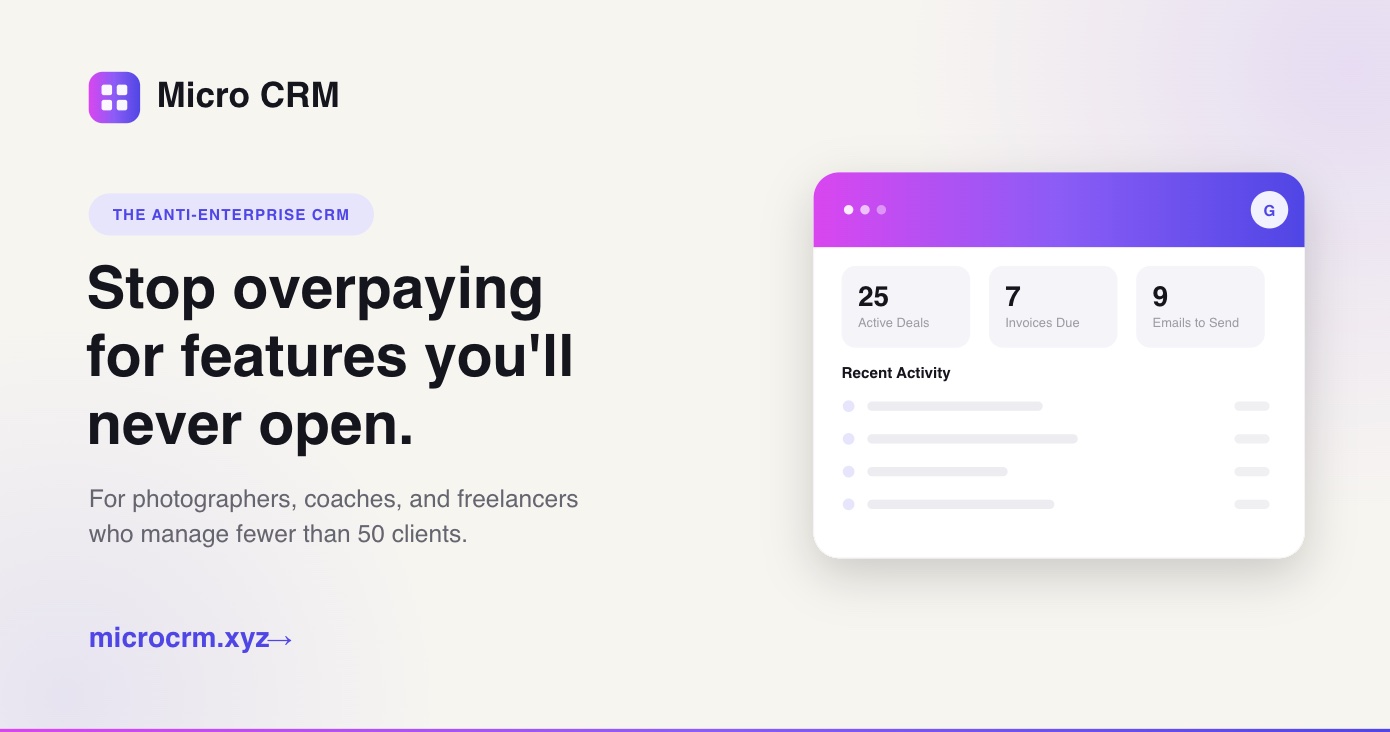
Micro CRM is built for that exact gap. It keeps contacts, deals, invoices, follow-ups, and scheduling in one lightweight workspace, so you can stop stitching together spreadsheets and separate tools. If your business is small enough that you don't want enterprise setup, but structured enough that you can't keep improvising, Micro CRM is the clean reference point.
The right choice still depends on workflow. Some tools are better for pipeline tracking, some are better for proposals and contracts, and some are really just nicer spreadsheets with a CRM label. The ten options below cover those differences fast, so you can match the tool to the way you work.
Table of Contents
- 1. Micro CRM
- 2. HubSpot CRM
- 3. Pipedrive
- 4. Zoho Bigin
- 5. Freshsales
- 6. Capsule CRM
- 7. Less Annoying CRM
- 8. HoneyBook
- 9. Dubsado
- 10. Bonsai
- Top 10 CRM Alternatives: Features & Pricing
- Make the Switch Without Adding More Work
1. Micro CRM
Micro CRM makes the strongest case for small operators who want to replace spreadsheets without buying a full sales stack. It centralizes contact history, deal stages, invoices, automated follow-ups, and scheduling in one place, which is exactly what a freelancer needs when a lead becomes a client and then becomes a billing task.

Best fit for lean client work
Use Micro CRM if you manage a modest client list and need speed more than depth. The interface is intentionally simple, sign-up is fast, and the workflow stays focused on the basics, contacts, a Kanban pipeline, invoicing, email follow-ups, and calendar booking.
That matters because CRM software is supposed to centralize customer information and streamline work, not create another admin job. PCMag describes CRM as software that helps by “streamlining tasks” and “consolidating customer information” while Jotform defines CRM as managing relationships “with one central place”. Micro CRM leans into that idea with a single workspace instead of a pile of disconnected tabs, and that's why it fits freelancers better than broad enterprise systems. PCMag's CRM overview and Jotform's CRM glossary both support that centralization model.
Why it beats the spreadsheet habit
Micro CRM is also a better daily system than Excel when you need reliable follow-up. A spreadsheet can list names and notes, but it won't naturally move deals through stages, send reminders, or tie billing to the same record. Micro CRM gives you a visual pipeline, invoice generation, email templates with follow-ups, and appointment scheduling, so client work stays in one flow instead of scattering across tools.
Practical rule: if you can count your active clients without opening a second browser tab, a lightweight CRM is enough. If you need a separate admin meeting just to maintain the CRM, the tool is already too heavy.
The pricing setup is straightforward too. There's a Free tier, then paid plans for users who need more contact, deal, invoice, and email capacity, plus a limited-time lifetime option for people who prefer a one-time purchase. That structure makes Micro CRM the cleanest choice for freelancers who want to start small and avoid paying for features they'll never touch.
Trade-offs you should expect
Micro CRM is not trying to be a giant automation platform. That's the point. If you need deep multi-team reporting, lots of integrations, or complex sales logic, you'll outgrow it.
It also makes a deliberate trade-off on lower plans, so don't expect every advanced feature to be available from day one. For a small business that mainly needs to manage clients, deals, and invoices without app switching, those limits are acceptable and often preferable to paying for clutter.
Want the simplest route? If your workflow is lead, follow-up, invoice, repeat, Micro CRM is the easiest place to keep it all together.
2. HubSpot CRM
HubSpot CRM is the right choice when you want a free starting point and a path into a larger ecosystem later. It's more than a contact list, it's a gateway into sales, marketing, and service tools, which makes it a strong option for small teams that expect to grow into more structure over time.
Choose the right CRM fit before you commit to a platform that's broader than your actual workflow. HubSpot can work well for freelancers, but only if you're willing to accept a lot of surface area.
Good for growing teams, not bare-bones workflows
HubSpot's free CRM gives you contacts, deals, tasks, reports, and meeting links, so the basics are covered. It also works well if you need to add more power later, because the platform extends into paid hubs for sequences, automation, and more advanced functions.
That flexibility is useful, but it's also the main downside for a micro-business. HubSpot's breadth can feel like too much if all you need is a clean pipeline and a fast invoice-to-follow-up workflow. For solo operators, a tool like Micro CRM is usually easier because it skips the extra layers entirely.
Where HubSpot makes sense
Use HubSpot if you want to build around integrations and future expansion. It's the safer pick for a business that may eventually need marketing campaigns, service workflows, or more formal reporting.
- Start free: useful when you want to test CRM habits without paying upfront.
- Add later: better if you expect sequences and automation to matter soon.
- Stay broader: stronger if your business is already moving beyond one-person operations.
HubSpot is a practical choice, but it's not the simplest one. If your real goal is to get out of Excel and into one easy workflow, the extra ecosystem can be more than you need.
3. Pipedrive
Pipedrive fits freelancers and small teams that need a sales pipeline they can read in seconds. It keeps deal stages visible, so you can see who needs a follow-up, who is stalled, and who is close to buying without digging through a crowded system.

Best when the deal board is the business
Pipedrive's main strength is its Kanban-style pipeline. That layout works well if your day revolves around moving leads from first contact to booked call to closed deal. The activity calendar, scheduler, and email integration keep those steps tied to the board, so the next action stays obvious.
For freelancers selling projects, that can be enough structure to keep sales moving. A prospect books a call, you move them into the right stage, then you follow up and send the invoice through an accounting integration. That flow is clean for lead tracking and follow-ups, especially if your client work starts only after the sale is won.
Where it falls short
Pipedrive is strong for deal tracking, but it does not act like a full client operations hub. Quoting, document handling, and some scheduler features sit behind higher plans or add-ons, so the workflow gets split if you want to manage the full quote-to-cash process in one place.
Compare CRM options if your work depends on more than pipeline visibility. Compare CRM options if you want to judge how each tool handles follow-ups, invoicing, and scheduling against a simpler all-in-one setup like Micro CRM. Pipedrive is the cleaner choice if you want a polished sales board first and can live with extra tools for the rest.
4. Zoho Bigin
Zoho Bigin is the best answer for small teams that want a lightweight CRM without adopting the full Zoho stack on day one. It's pipeline-first, built for simple setup, and aimed squarely at small businesses that care about speed.
Small-business CRM with payment links
Bigin is useful when your workflow includes contact tracking, stage movement, and getting paid without building a complicated process around it. It supports pipeline templates, connected team pipelines, built-in telephony, email and WhatsApp integrations, and payment links tied into tools like Stripe and PayPal.
That makes it practical for consultants, agencies, and local service businesses that want one place to manage lead progress and payment steps. It's less ambitious than a full enterprise CRM, which is why it often feels easier to use.
The trade-off
Bigin is simpler than Zoho CRM, but that simplicity comes with limits. Advanced email and automation features live higher up the stack, and its reporting stays lighter than a full-scale CRM.
That's fine if your goal is fast adoption and less setup. It's less ideal if you want native invoicing, follow-up sequences, and scheduling all in one compact workspace. For that, Micro CRM is more direct. For teams that like the Zoho ecosystem and want a gentle entry point, Bigin is the better fit.
5. Freshsales
Freshsales is a sales-focused CRM for teams that want email, phone, chat, and deals under one roof. It's more operational than stylistic, which is useful if you need every conversation tied to a single customer record.

Strong for direct selling workflows
Freshsales works best when your business runs on active selling and live communication. Built-in email and phone support make it a good fit for small teams that call prospects, move deals through stages, and want chat tied into the same record.
It's also part of a broader product family, so businesses can expand into more marketing and automation later. That makes it appealing if you know you'll need more structure as the team grows.
Why some freelancers skip it
Freshsales can feel bigger than a freelancer needs. The feature naming and tier structure are less straightforward than a compact all-in-one tool, and the best automation usually sits in higher-priced plans.
If you just want to manage clients, invoices, appointments, and follow-ups without wading through product-family complexity, Micro CRM stays easier. Freshsales is for teams that want a more traditional sales environment, not a solo workflow.
6. Capsule CRM
Capsule CRM is the calm option. It keeps contacts, tasks, pipelines, and reports uncluttered, which makes it a good fit for businesses that want clarity without a lot of configuration.
Clean enough to use every day
Capsule gives you contact history, tasks, calendar support, opportunities, and simple reporting in an interface that doesn't fight you. That matters for small businesses because adoption usually fails when the CRM becomes annoying to update.
It also integrates well with accounting and marketing tools such as Xero, QuickBooks, and Mailchimp. So if you already have a billing tool and only need a central hub for contacts and opportunities, Capsule can be a tidy middle ground.
Direct recommendation: choose Capsule if you already have separate invoicing and email tools, and you mainly need a clean place to track relationships and next steps.
The main limitation
Capsule doesn't try to be a billing platform. Invoicing is handled through integrations, not natively, and the automation layer is lighter than what larger CRMs offer.
That keeps the interface simple, but it also means more tool switching than Micro CRM. For teams that want contact management and pipeline visibility only, Capsule is strong. For businesses that want invoicing and follow-up in the same flow, it's one step too fragmented.
7. Less Annoying CRM
Less Annoying CRM is exactly what the name suggests, a no-drama CRM for small businesses that just want contact and pipeline management without complexity. It's the easiest recommendation for owners who care more about predictability than feature depth.
One plan, less friction
The appeal is simple. You get contacts, pipelines, calendars, tasks, email sync, support, and no setup fees or contracts in one predictable package. That's useful for solo operators who want to budget cleanly and avoid decision fatigue.
Its biggest advantage is that nothing feels buried. You don't spend your first week learning menus or rebuilding your process around the software. You just start using it.
Where it stops short
Less Annoying CRM is not built for native invoicing or advanced automation. If you want quotes, billing, and follow-up sequences handled together, you'll need outside tools.
That makes it a solid contact manager, but not a full workflow hub. If your day involves both selling and billing, Micro CRM is the more practical all-in-one choice. If you only want a simple pipeline and a calendar, Less Annoying CRM is a sensible low-friction option.
8. HoneyBook
HoneyBook is built for service businesses that move from inquiry to proposal to contract to invoice without needing a separate stack. It suits creatives, coaches, and freelancers who want a polished client experience from the first message onward.
Best for booking-to-billing work
HoneyBook combines proposals, contracts with e-sign, invoicing, payments, scheduling, and a client portal. That makes it especially useful when clients need a guided experience and you want to keep the back-and-forth out of email.
For photographers, designers, and consultants, that flow can save a lot of admin time. The templates are also helpful if your service process is repeatable and you want to send the same structure to each new client.
The trade-off for simple operators
HoneyBook is prescriptive. That's great if you like being guided through the process, but it can feel heavy if your needs are basic and you only want a CRM with light invoicing and follow-up.
It's also less flexible if you're trying to manage a lean pipeline without committing to a full clientflow product. Micro CRM stays simpler because it handles the essentials without trying to redesign your entire service business. HoneyBook is better when the client-facing workflow itself is the product.
9. Dubsado
Dubsado is for service businesses that need deeper customization. It's a strong fit for photographers, studios, coaches, and agencies that want forms, proposals, contracts, invoices, and automations tied together.

Heavy-duty service workflows
Dubsado handles inquiry-to-delivery workflows well. Its automations, called Flows, help you move a client from first contact through scheduling, forms, proposal approval, and billing. That's useful when your service process has more steps than a plain sales pipeline can manage.
It also supports multi-brand setups, which helps agencies or operators juggling more than one brand identity. If your process is detailed and repetitive, Dubsado can reduce manual follow-up.
Why it's not the easiest option
The flexibility comes with setup effort. Dubsado asks you to configure more, and some advanced automation lives on higher plans.
That's fine for businesses that already have defined processes. It's overkill for freelancers who just want contacts, deals, invoices, and scheduling in one place. Micro CRM is faster if you want to keep the stack simple. Dubsado is stronger when your workflow is more complex than your software budget suggests.
10. Bonsai
Bonsai is the freelancer-heavy option for people who want proposals, contracts, invoicing, scheduling, and basic project tracking in one client platform. It's especially good for solo operators who want to move from quote to cash without bouncing between apps.
Built for one-person operations
Bonsai covers the core freelance flow well. You can send proposals, collect signatures, issue invoices, take online payments, schedule meetings, and keep lightweight project and time tracking in the same system.
That makes it practical for consultants, designers, and creative freelancers who need a professional client portal and a template library that reduces setup time. It's a full workflow tool, not just a contact database.
See how Micro CRM fits freelancers if you want a simpler workspace with less overhead.
Where it gets less friendly
Bonsai is less flexible than a traditional CRM if you need multi-user sales processes or a more customizable pipeline. Per-seat pricing can also become a factor if you add collaborators.
That means Bonsai works best when your business is still centered on one primary operator. If you're looking for a simpler, lighter place to manage contacts, deals, invoices, and follow-ups, Micro CRM is usually the cleaner fit.
Top 10 CRM Alternatives: Features & Pricing
| Product | Core features | UX / Quality | Price & Value | Target audience | Unique selling points |
|---|---|---|---|---|---|
| Micro CRM 🏆 | Contacts, Kanban deals, invoicing (PDF, multi-currency), email sequences, calendar, reports | ★★★★★, ultra-simple, quick onboarding | 💰 Free; Starter $14/mo (annual); Pro $29/mo (annual); LTD $299 one‑time | 👥 Freelancers & very small teams (<50 clients) | ✨ All‑in‑one minimal setup, pauseable account, AWS + Cognito security |
| HubSpot CRM | Contacts, deals, email logging, meeting links, basic reports | ★★★★☆, polished but can feel heavy | 💰 Generous free tier; paid Hubs add cost | 👥 Small teams scaling toward enterprise | ✨ Ecosystem & marketplace, easy upgrade path |
| Pipedrive | Visual Kanban pipelines, activity calendar, scheduler, email integration | ★★★★☆, best pipeline UX | 💰 Free trial; paid per‑seat plans (add‑ons for invoicing) | 👥 Sales‑focused small teams, solo sellers | ✨ Fast Kanban + scheduler, invoicing via integrations |
| Zoho Bigin | Pipeline templates, telephony, email/WhatsApp integrations, payment links | ★★★★, lightweight, purpose‑built | 💰 Free tier; low‑cost SMB plans, upgrades into Zoho suite | 👥 Small teams wanting simple pipelines & payments | ✨ Built‑in telephony, easy path to Zoho Books/Invoice |
| Freshsales (Freshworks) | Email, phone, chat, deal pipelines, activity mgmt | ★★★★, unified comms, competitive entry pricing | 💰 Free/entry plans; suites add automation (per‑user pricing) | 👥 Teams needing native telephony + email | ✨ Native phone + chat, easy expansion into Freshsuite |
| Capsule CRM | Contacts/history, pipelines, tasks, reports, Xero/QuickBooks integrations | ★★★★, uncluttered, gentle learning curve | 💰 Free trial; simple per‑user pricing | 👥 Small businesses needing clean contact hub | ✨ Strong integrations with accounting & marketing tools |
| Less Annoying CRM | Contacts, pipelines, calendar/tasks, basic email sync, live support | ★★★★, extremely simple | 💰 💰 Flat low per‑user price (all features included) | 👥 Solo operators & small teams wanting predictability | ✨ Single‑plan simplicity, included support |
| HoneyBook | Proposals, contracts/e‑sign, invoicing/payments, scheduler, client portal | ★★★★, end‑to‑end creative workflows | 💰 💰 Tiered per‑seat pricing; all‑in workflows | 👥 Creatives & service businesses (booking→billing) | ✨ Client portal + templates + payment flows |
| Dubsado | Proposals/e‑sign, invoicing/recurring, scheduler, robust automations (Flows) | ★★★★, powerful but steeper setup | 💰 💰 Subscription tiers; advanced features on higher plans | 👥 Photographers, studios, service firms needing automations | ✨ Deep customizable automations and forms |
| Bonsai | Proposals/e‑sign, invoicing/payments, scheduling, basic project/time tracking | ★★★★, freelancer‑friendly templates | 💰 💰 Per‑seat subscription; freelancer‑focused plans | 👥 Solo freelancers wanting unified quote‑to‑cash | ✨ Freelancer templates, client portal, SOC 2 Type II security |
Make the Switch Without Adding More Work
Choose Micro CRM if you want one focused workspace for contacts, deals, invoices, follow-ups, and scheduling. Choose HubSpot or Freshsales if you want a broader growth ecosystem. Choose Pipedrive or Zoho Bigin if you want pipeline-led selling with a clearer deal board. Choose Capsule or Less Annoying CRM if you only need straightforward contact and opportunity management. Choose HoneyBook, Dubsado, or Bonsai if your business runs on client-facing service workflows and you want proposals, contracts, and billing tied together.
The smartest selection process is simple. Count your active clients, decide whether invoicing or contracts need to live inside the CRM, check how much automation you'll use, confirm the integrations you can't live without, and test the daily workflow before you migrate anything. That's the fastest way to avoid paying for features you won't touch.
For freelancers and micro-businesses, the best CRM is the one that removes admin work instead of adding it. Micro CRM is the simple option when you want to reduce spreadsheet work and app switching without giving up the basics that keep client work moving.
Manage clients, deals, and invoices in one platform. 👉 https://microcrm.xyz Start for free. No credit card required.
Micro CRM gives freelancers a simple way to manage clients, deals, invoices, follow-ups, and scheduling in one place. If you're ready to stop running your business from spreadsheets and scattered tools, visit Micro CRM and try the free plan.