
CRM Comparison for Freelancers and Micro-Businesses
You're probably doing the same thing most freelancers do. Client names live in a spreadsheet, follow-ups sit in your head, invoices get built in a separate app, and one missed reply turns into an awkward delay. That's why a serious CRM comparison for solo operators should start with one question, not twenty. How fast does the tool help you stop losing time?
| Option | Best use case | Main weakness | Time to useful daily use |
|---|---|---|---|
| Spreadsheets | Very early-stage tracking | No pipeline automation, no follow-up system | Immediate, but fragile |
| Complex enterprise CRM | Large sales teams with layered process | Too much setup, too much overhead | Slow |
| Lightweight CRM | Freelancers and micro-agencies | Fewer advanced enterprise features | Fast |
Table of Contents
- Why Most CRM Comparisons Fail Freelancers
- Enterprise vs. Lightweight CRM Cost Differences
- Comparing Micro CRM Against Popular Lightweight Alternatives
- How to Choose the Right CRM for Your Client Volume
- Onboarding Speed and Total Cost of Ownership
- Migrating From Spreadsheets or a Complex CRM
- Which CRM Should You Pick
Why Most CRM Comparisons Fail Freelancers
A designer finishes a project, promises to send an invoice, then spends ten minutes hunting through tabs to find the right client record. A consultant means to follow up on Tuesday, forgets, and only remembers after the prospect has already booked with someone else. That's the true pain behind CRM selection, not “which platform has the longest automation menu.”
Most comparison articles are written for sales teams with multiple reps, managers, and ops support. They obsess over workflow depth, AI features, and integration breadth because that's what matters when an organization has people dedicated to administering software. For a freelancer, that list is mostly noise.
Practical rule: If the CRM doesn't replace at least two separate tools, it's probably too heavy for a solo operator.
A better crm comparison starts with the daily drag you're trying to remove. For a micro-business, the choice is usually between a spreadsheet plus scattered apps, or a single workspace that handles contacts, deals, invoices, reminders, and scheduling. That's why lightweight tools keep winning with freelancers, even when they don't look “feature rich” on paper.
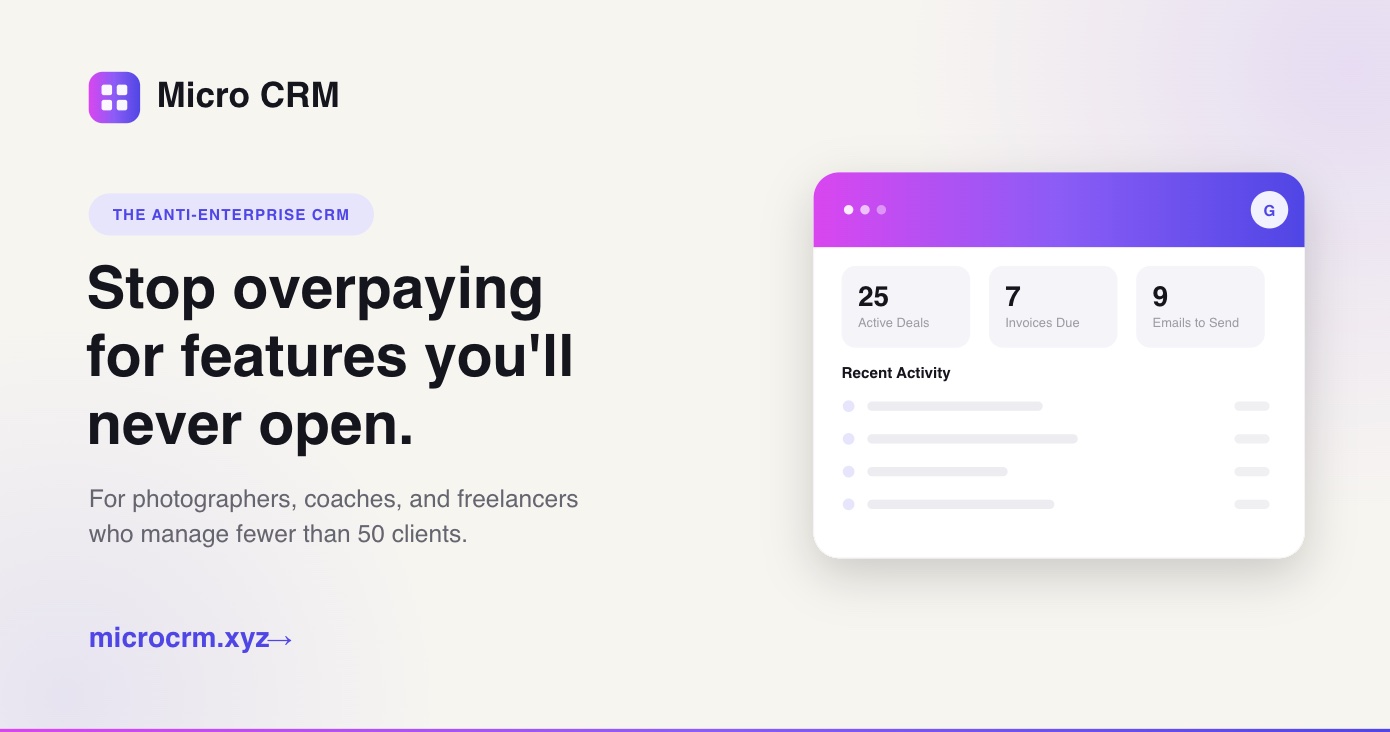
This is also why Micro CRM belongs in the conversation for small client loads. It's built around a simple operating model, not an enterprise checklist, so the comparison should focus on time-to-first-value, not the size of the settings menu. If you can't use the system on day one without a setup project, it's the wrong fit.
Enterprise vs. Lightweight CRM Cost Differences
A CRM's sticker price tells you very little. Enterprise tools usually look reasonable until implementation, training, integrations, and ongoing support show up on the bill. One independent guide says year-one CRM total cost of ownership is often 2 to 3 times the licence fee once those hidden costs are included, and it recommends comparing pricing over 24 months instead of fixating on the sticker price alone, as outlined in this CRM comparison guide.
The market has also shifted hard toward cloud delivery. In 2008, only 12% of businesses used cloud-based CRM, while that share rose to 87% in recent years, and cloud CRM is growing 3.2x faster than on-premise systems, according to the CRM statistics roundup from Breakcold, which tracks the shift to cloud delivery. That changes the buying standard. Server ownership and custom installation matter far less than speed, subscription pricing, and low maintenance.

Enterprise pricing and small-business reality
The pricing gap is the clearest reason freelancers get pushed into the wrong category. One industry source reported that in 2026 the average enterprise CRM deal is $142,000 per year, while SMB deals average $18,400 annually, a spread that makes it obvious why feature-heavy platforms overshoot the needs of tiny teams, according to SearchLab's 2026 CRM statistics. That same source says businesses earn an average of $8.71 for every $1 spent on CRM software, which shows CRM can pay off, but only when the tool matches the scale of the business.
For freelancers, the right move is to buy less software, not more. A lightweight CRM earns its keep by cutting context switching and reducing maintenance. A bloated one creates a second job.
If you want to sanity-check what you are paying for, start with a clear CRM pricing breakdown before you compare feature pages.
Why cost should include operating friction
The useful question is not whether a CRM has advanced automation. It is whether the system helps you respond faster, keep track of deals, and send invoices without bouncing between tools. Industry guidance says CRM benchmarking should center on lead-to-customer conversion rate, sales-cycle length, pipeline velocity, repeat purchase or churn rates, and automation coverage, because those tie to real outcomes, as explained in the CRM benchmarking guide.
That framing is why the “cheap” option can become expensive fast. A platform that takes weeks to set up, needs constant admin work, or requires add-ons for invoicing is not lightweight in practice. For a freelancer, the right CRM is the one that gets out of the way.
Comparing Micro CRM Against Popular Lightweight Alternatives
A lot of people start with spreadsheets because they feel free. Then they add color coding, then filters, then manual reminders, and eventually the sheet becomes a fragile system that only one person understands. The comparison below is more honest for solo operators, because it asks what gets handled in one place and what still needs another tool.
| Capability | Spreadsheets | Small-Business CRM Tier | Micro CRM |
|---|---|---|---|
| Contact management | Manual entries, easy to break | Built in | Built in |
| Deal pipeline | Usually improvised | Usually built in | Built in with visual Kanban |
| Invoicing | Separate tool | Sometimes separate | Integrated |
| Automated follow-ups | None or manual | Often available, may cost more | Included |
| Appointment calendar | Separate tool | Sometimes included | Included |
| Setup burden | Low at first, messy later | Moderate | Low |
| Tool consolidation | Very low | Medium | High |
Where spreadsheets still make sense
Spreadsheets work when you barely have any client movement. They're fine for a one-off project list or a temporary tracking sheet. They break down the moment you need a reliable follow-up system, interaction history, or visibility into which deal is moving forward.
Where small-business CRM tiers help, but not enough
The small-business tiers of bigger CRMs, like HubSpot or Zoho, are better for pipeline visibility and basic automation. They're useful if you're willing to accept a broader platform with more configuration. But once you need invoicing, scheduling, and client follow-up in the same place, you often end up stitching together extra tools anyway.
Where Micro CRM fits
Micro CRM is built for the narrower job of keeping client work organized without layering on enterprise extras. It combines contacts, deals, invoicing, email sequences, and the calendar in one interface, so a freelancer doesn't have to assemble a stack just to stay on top of work. For teams that want a simple CRM without adopting a larger system, that's the point.
If a tool can't cover your basic client lifecycle, you're not buying a CRM, you're buying another tab.
Want to better organize your clients and business opportunities?
👉 Try Micro CRM for free: https://microcrm.xyz
How to Choose the Right CRM for Your Client Volume
Start with client volume and workflow complexity, not brand reputation. If you manage only a handful of clients, the right system should stay out of your way. If your pipeline is growing, you need more structure, but you should still avoid paying for features you will never use.

Solo freelancers under 20 clients
Focus on contact management, deal stages, invoice creation, and simple reminders. At this size, the job is to replace spreadsheets and stop follow-ups from slipping through the cracks. If a system takes longer to learn than to use, it is the wrong fit.
A lightweight CRM should help you see every active client at a glance, log conversations without extra clicks, and keep invoices tied to the right deal. That is the whole point. You do not need a platform that asks you to build a process before you can run one.
Small studios with 20 to 50 clients
Prioritize shared visibility, a cleaner pipeline, and basic email sequences. By this point, manual tracking starts creating avoidable mistakes, especially when projects overlap or several people touch the same account. You still do not need a heavy admin layer.
This is the range where a focused CRM starts saving real time because it replaces a mix of spreadsheets, inbox searches, and scattered notes. If you are comparing options, keep your shortlist tight and read a practical guide such as how to choose a CRM for small client teams before you commit. A broader platform can work, but only if you are willing to spend time configuring it and maintaining it.
Growing teams with more than 50 clients
Look for reporting, automation, and more structured handoffs. At this point, the question changes from whether you can keep up to whether the system can support repeatable work without adding admin drag. A more complex CRM can make sense here, but only if the team is ready to keep it organized.
That is where feature bloat becomes expensive. More modules sound useful until they slow adoption, create duplicate data, and force people back into side tools. Choose the system that reduces handoff friction and keeps the daily workflow clear.
Test against your own work, not a feature list
A major business publication makes the right point here. CRM comparisons are meaningless unless you test the software with your own real data and check whether it can handle the exact tasks you need, like leads, contacts, calendars, marketing efforts, and task automation, as argued in Forbes. That advice matters even more for freelancers because your workflow is small enough to model in a single day.
If the CRM cannot follow your real process, it will not save time. It will only add another place to update information.
Practical rule: Import a real client list, run one pipeline through it, and see whether the CRM saves time or adds steps.
If it does not simplify daily work, skip it.
Onboarding Speed and Total Cost of Ownership
The hidden cost in CRM selection is almost always implementation friction. Enterprise-style onboarding brings setup calls, data migration projects, and training sessions, which makes sense for large teams but creates drag for a solo operator. If you want value quickly, the software needs to be usable without a service engagement.
Micro CRM's appeal is that you can sign up in seconds and start working without a long configuration path. That sounds basic, but for freelancers it's the difference between “I'll set it up later” and “I'm using it today.” The ability to pause an account without losing data also matters when client volume changes seasonally or a business needs to slow spending for a while.
Security also belongs in the cost conversation. Micro CRM is described as running on AWS, with encryption at rest and in transit and authentication through Amazon Cognito, which means the platform's simplicity doesn't come from cutting basic protection. That matters because solo operators still need a trustworthy system, even if they don't need enterprise bureaucracy.
What total cost really means
Total cost of ownership isn't just subscription price. It's the time spent learning the tool, the work of connecting other apps, and the effort of keeping the setup alive. If a CRM needs a consultant to stay tidy, it's not lightweight.
The right benchmark is whether the system helps you sell, invoice, and follow up without creating admin overhead. That's why a simple tool can outperform a more famous one in real life. It gets used.
For readers comparing options carefully, this guide to the easiest CRM to use is a useful lens because ease of use is the operating cost.
Migrating From Spreadsheets or a Complex CRM
The migration step is where people stall. They worry about losing data, redoing work, or setting up the new system wrong. The fix is to move only the information that supports the next 90 days of work, not every scrap of history you've ever saved.

If you're coming from spreadsheets
Start by cleaning the columns. Keep client name, email, phone, deal stage, next action, and invoice status. Don't overbuild the sheet into a warehouse of every note you've ever written. The cleaner the import, the faster the new CRM becomes useful.
Then define your pipeline stages before importing. A simple sequence like inquiry, active conversation, proposal, won, and invoiced is enough for many freelancers. Once that structure exists, you can sort contacts into it without guessing later.
If you're coming from a complex CRM
Export the data you use, not the fields you inherited from someone else's workflow. In many cases, that means contacts, open deals, notes, and recent activity. If the old system is full of dead records and unused fields, starting fresh can be smarter than dragging clutter into a simpler tool.
Map the old fields to the new structure before you import. That prevents duplicate effort and reduces the chance of making the new setup look complicated. The goal is to simplify, not recreate the old mess in a different interface.
First-week setup that pays off
Set up email templates first, then invoice settings, then follow-up sequences. Those three pieces create immediate daily value because they touch outreach, billing, and continuity. If the calendar is important to your work, connect that too so appointments don't live in a separate system.
A freelancer doesn't need a migration project. A freelancer needs a working system by the end of the week.
Which CRM Should You Pick
If you manage under 50 clients and need contacts, deals, invoicing, email follow-ups, and scheduling in one place, choose the simplest tool that handles those jobs cleanly. That is the dividing line in CRM comparison. Not logo count, not automation bragging rights, not whether a platform can scale to a company you do not run.
For solo operators and micro-agencies, Micro CRM makes sense when speed and consolidation matter more than deep configuration. It offers a free plan with no credit card required, and it keeps the client workflow in one place instead of pushing you into separate apps. If you need a more complex sales engine later, you can move up. If you need control now, start with the lighter option.

If your current setup is a spreadsheet plus three other apps, you are paying for that chaos with time. A lightweight CRM is the practical answer when you want a clearer pipeline, faster follow-up, and fewer tools to maintain. For freelancers who just want to get on with the work, that is enough.
Manage clients, deals, and invoices in one platform. Micro CRM keeps the workflow simple for freelancers and micro-businesses that do not need enterprise bloat. Start free with no credit card required if that matches the way you work.