
CRM Pricing Explained for Freelancers and Small Teams
You've probably seen this already. A freelancer starts with a spreadsheet, adds a few email threads, then loses track of a warm lead, forgets an invoice, and spends another evening cleaning up the mess. The problem isn't discipline, it's that Excel was never built to manage contacts, deals, follow-ups, billing, and scheduling in one place.
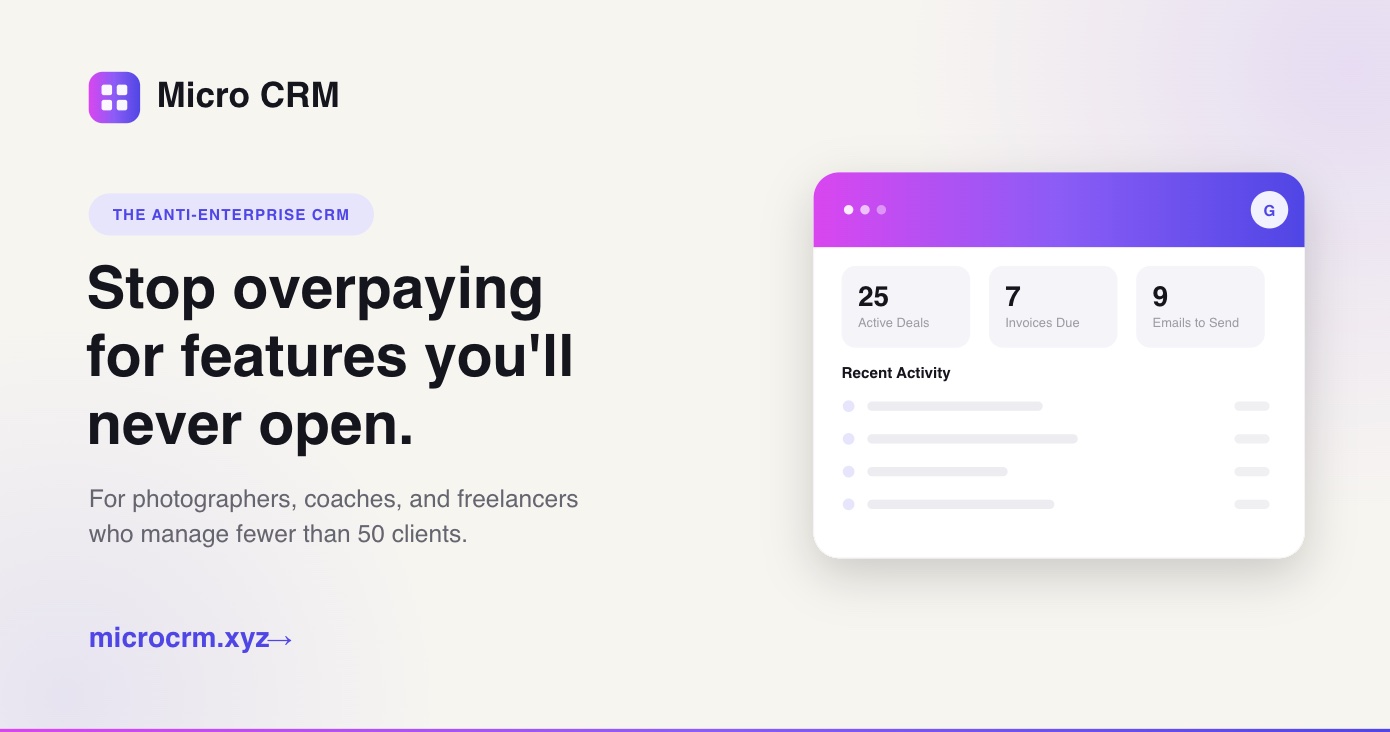
That's why crm pricing matters more than most buyers think. The wrong tool looks cheap on the pricing page and expensive the moment you need setup, migration, or extra seats. A lighter option like MicroCRM is built for the opposite job, keeping client work, deals, invoices, and follow-ups in one simple workspace instead of turning software selection into a second job.
Table of Contents
- The Freelancer's CRM Problem and What Comes Next
- How CRM Pricing Models Actually Work
- Realistic Price Benchmarks You Can Trust
- Hidden Costs Most Pricing Pages Skip
- Matching CRM Profiles to Freelancers and Micro-Businesses
- How to Evaluate Any CRM Plan Before You Pay
- Key Takeaways and Choosing Your Next CRM
The Freelancer's CRM Problem and What Comes Next
A designer finishes a proposal, promises a follow-up, then buries the lead in a spreadsheet tab she won't reopen until Friday. A coach keeps client notes in one place, invoices in another, and scheduling links in a third. By the time a buyer replies, the thread is buried, the invoice is late, and the momentum is gone.
Why spreadsheets break first
Excel is fine until your business stops being a list and starts being a process. The minute you need stages, reminders, invoices, and a history of every client touchpoint, the spreadsheet becomes a liability. It can store data, but it can't run your workflow.
That's where a lightweight CRM earns its place. The point isn't to collect more features, it's to remove the little failures that cost you money every week. A simple system that centralizes contacts, deal stages, invoicing, email follow-ups, and calendar booking is usually enough for freelancers and small teams.
Practical rule: if you're still copying the same client name between your spreadsheet, inbox, and invoice tool, you've already outgrown the spreadsheet.
For solo operators, the right question isn't “Which CRM has the most?” It's “Which one helps me respond faster, invoice faster, and stop dropping warm leads?” That's why a focused tool like MicroCRM makes sense for people who don't need a configuration project just to send a follow-up.
If you want a related walkthrough on the freelancer side of the decision, see this guide to choosing a CRM for freelancers.
What comes after the spreadsheet
The next step is not an enterprise platform with a dozen modules you'll never touch. It's a workspace that keeps the whole client flow in one place: contact record, pipeline stage, invoice, calendar slot, and email sequence. That's the fix for the daily friction most freelancers live with.
When a tool does that cleanly, pricing becomes easier to judge. You're no longer comparing glossy feature lists, you're comparing the actual cost of keeping your business organized.
How CRM Pricing Models Actually Work
CRM vendors do not all charge the same way, and that is where buyers get fooled. The number on the pricing page often hides the underlying model, and the model decides what you pay once your team, contacts, or workflows grow. Treat it like a phone plan, not a flat utility bill.
The four models you'll see
A per-user subscription is the most common. Every seat adds cost, so the bill grows the moment you add help. A per-feature tier works more like a restaurant menu, where the cheap dish looks fine until you realize the sides, drinks, and dessert are separate.
A freemium plan gives you a free starting point, but the limits usually show up in contacts, seats, or automation. A pricing roundup found that many tracked CRMs offer a free tier, usually with limits on contacts or seats, which tells you free is often a lead-in, not a full product (Comparedge CRM Pricing 2026).
A flat-rate or lifetime deal looks different again, because you pay once or pay the same regardless of seats. That can work for a tiny business, but only if the feature scope matches what you need. If the tool is bloated, a flat fee just locks you into paying for clutter.
A pricing page is only useful if you know what triggers the next bill. Seats, contacts, email sequences, and add-ons matter more than the headline number.
MicroCRM follows the kind of structure small operators can reason about, with Free, Starter, Pro, and Lifetime Deal options, and usage limits that scale with contacts, deals, emails, and sequences. Start with the model first and the price second. Otherwise you compare the wrong things and overpay for a plan built for someone else's workflow.

If you want a quick companion read on plan types, this free CRM guide for small business buyers is worth a look.
Realistic Price Benchmarks You Can Trust
A small business buyer should read CRM pricing as a range of real entry points, not a single sticker price. For 2026, tracked CRM platforms start around $11 to $299 per user per month, and the median entry price sits at $25 across 18 platforms, according to the pricing roundup. That spread matters because the market is not one product class. It is several very different tools sold under the same label.
What the ranges mean in practice
The best way to read the market is by segment. Industry guides place basic plans around $10 to $50 per user per month, mid-tier plans around $50 to $150, and enterprise plans above $300 per user per month when advanced analytics, custom workflows, and large-scale setup are part of the package (WalkMe CRM pricing guide). Another pricing guide shows the same pattern, with small-business CRMs often in the $10 to $30 range and larger deployments climbing to $150 to $1,000+ per user per month as complexity rises (Creatio CRM pricing glossary).
Those ranges fit freelancers and small teams for a reason. If you manage fewer than 50 clients, you usually need contacts, pipeline visibility, invoicing, email follow-ups, and scheduling. You do not need AI layers, custom permissions, or heavyweight automation logic, and paying for them is just waste.
CRM Pricing Tiers and Typical Audiences
| Tier | Price Range per user per month | Best For | Examples of Limits |
|---|---|---|---|
| Free | $0 | Very small teams testing a workflow | Seat caps, contact caps, limited automation |
| Basic | $10 to $50 | Freelancers and small businesses | Fewer workflows, lighter support, simpler reporting |
| Mid-tier | $50 to $150 | Growing teams with more process needs | More automation, deeper integrations, broader permissions |
| Enterprise | Above $300 | Large orgs with complex setup | Advanced analytics, tailored workflows, broader security controls |
A price range only tells part of the story. The 2026 report also says 44% of tracked tools offer a free tier, which matters because a free option can delay paid spend if the limits are acceptable. For a freelancer, that can be enough to move off spreadsheets without signing up for a monthly bill right away.
Hidden Costs Most Pricing Pages Skip
The sticker price is not the bill. Vendors obscure the true cost because setup fees are harder to market and easier to overlook until you have already signed up. Data migration, onboarding, training, integrations, and internal admin time can make a low-priced CRM far more expensive than the one that looks pricier upfront.
The bill that shows up after purchase
ZoomInfo's 2026 cost analysis says small businesses with fewer than 100 employees face average CRM implementation costs of about $3,000, while enterprise deployments with 100+ users can cost between $180,000 and $420,000 in total, and the largest organizations average about $450,000 per implementation (ZoomInfo CRM implementation costs). Those totals include migration, training, customization, and integrations, which is why headline pricing can be misleading.
The same analysis recommends budgeting an extra 20% to 30% for training and data migration (ZoomInfo CRM implementation costs). That is the core calculation for any buyer with data sitting in spreadsheets, inboxes, and invoices.
If the setup process needs a call, a consultant, and a week of cleanup, the CRM is not cheap.
Zendesk also calls out hidden costs in CRM buying, especially the extras tied to migration, workflow consolidation, customizations, and add-ons (Zendesk hidden CRM costs). For a freelancer, those charges turn a neat-looking monthly fee into a bad decision.
What to ask before you commit
Ask whether onboarding is self-serve or billable. Ask whether email, automation, and integrations are core features or paid extras. Ask whether you will need outside help just to make the system usable.

A simple tool wins here because it cuts setup overhead instead of creating more of it. MicroCRM's value proposition is direct, sign up quickly, start working, and avoid the support circus that comes with bloated platforms. For sub-50-client operators, that often makes the difference between a useful CRM and a project you keep postponing.
Matching CRM Profiles to Freelancers and Micro-Businesses
Not every CRM is built for the same buyer. Some are designed for enterprise teams with deep automation and AI layers. Others are made for growing sales orgs with larger pipelines and more internal process. Freelancers and micro-businesses sit in a narrower lane, and that lane deserves a different price ceiling.
Three profiles, three very different budgets
Enterprise CRMs make sense when a business needs advanced permissions, custom workflows, compliance controls, and large-scale reporting. They're built for complexity, and complexity costs money. Mid-market tools sit in the middle, usually for teams with larger client bases and more handoffs.
Lightweight CRMs are the better fit for sub-50-client operators. They focus on the parts that matter most, contact tracking, pipeline stages, invoicing, reminders, and scheduling. That's enough for many freelancers and small agencies, and it keeps the system usable instead of overloaded.
A 2026 calculator shows CRM pricing can range from $0 per month for free tiers to $330+ per user per month for top plans, and a 10-user team can therefore face anything from free to $3,300 per month in license fees alone before add-ons or services (CRM cost calculator). That's a brutal reminder that team size changes the bill fast.
What the right fit looks like
MicroCRM's feature set aligns with the smaller operator's job to be done. It combines centralized contacts, a visual Kanban pipeline, integrated invoicing, automated email sequences, and an appointment calendar in one place. That matters because freelancers don't need ten disconnected tools pretending to be one system.
- Centralized contact history: Keep notes, interactions, and deal context together instead of searching through inboxes.
- Kanban pipeline: See each deal's stage at a glance and move work forward without rebuilding a spreadsheet.
- Integrated invoicing: Create and send invoices from the same place you manage the lead.
- Automated follow-ups: Stop relying on memory for reminders and sequence timing.
- Appointment calendar: Reduce back-and-forth when prospects want to book time.
There's also a practical cost-control feature that gets ignored too often, the ability to pause an account while preserving data. If client work slows down seasonally, that kind of flexibility keeps the tool from becoming dead weight.
The right CRM for a freelancer is usually the one you can keep using without thinking about it every day.
How to Evaluate Any CRM Plan Before You Pay
A pricing page should answer a few blunt questions immediately. If it doesn't, you're looking at a sales page, not a buying decision. Use the same checklist every time and you'll spot weak plans in minutes.
The questions that expose the real cost
Start with the free tier. What does it restrict, contacts, seats, deal volume, or automation? Then check the paid tiers for where the limits really sit, because the meaningful jump is often hidden behind a feature cap rather than the monthly headline.
Ask whether onboarding is self-serve or billable, and whether integrations are included or extra. Check if the account can be paused without losing data, because that matters more than most pricing pages admit. Review any contract length, because month-to-month flexibility is a real advantage for small businesses.
MicroCRM is a good example of a plan structure that passes this kind of test for smaller teams. The product is built around simple usage limits and a low-friction setup, which is exactly what freelancers need when they just want to get organized and move on.
If you want a deeper decision framework, this CRM selection guide is a useful companion.
Red flags that should make you walk
- Mandatory setup calls: If the product can't be used without a consultant, the cost is higher than the price page says.
- Core features sold as add-ons: Email, automation, or invoicing shouldn't feel optional if they're part of your workflow.
- Long commitments for a simple use case: Freelancers don't need to lock into a year just to test basic client management.
- Paid integration stacks: If the CRM depends on multiple third-party tools, total cost will climb fast.
- Vague limits: If the vendor won't say what the free tier or entry plan includes, assume the cap is tight.
Buy the plan that matches your workflow today, not the one that looks impressive in a demo.
Key Takeaways and Choosing Your Next CRM
crm pricing is about more than a monthly sticker price. Real plans run from free to $300+ per user per month, and hidden implementation costs can dwarf the subscription. For freelancers and small teams, the best CRM is the one that matches your actual client volume without turning setup into a project.
Manage clients, deals, and invoices in one platform, and keep the process simple. If that sounds like your situation, try MicroCRM's free plan, no credit card required, and start organizing your business without overpaying for features you'll never use.
MicroCRM gives freelancers and small businesses a simple way to manage clients, deals, invoices, emails, and scheduling without the usual CRM bloat. If you're tired of paying for software that needs a consultant before it's useful, visit MicroCRM and start with the free plan today.