
10 Best Free CRM for Small Business Picks (2026)
Still using spreadsheets to manage your clients? If you're juggling contacts in Excel, tracking deals on sticky notes, and sending invoices by hand, it's easy for follow-ups to slip. A good CRM fixes that, but most tools are either too heavy or too expensive for a solo operator or a small team. A free CRM can centralize your contacts, pipeline, invoices, and follow-ups without forcing you into a complicated setup.
This guide focuses on the free plans that break first, because that's what matters in real use. The best free CRM for small business isn't the one with the flashiest feature list, it's the one that lets you work comfortably before the upgrade pressure starts.
Table of Contents
- 1. Micro CRM
- 2. HubSpot CRM
- 3. Zoho CRM Free Edition
- 4. Bigin by Zoho
- 5. Freshsales by Freshworks
- 6. Bitrix24
- 7. EngageBay
- 8. Flowlu
- 9. Vtiger One Pilot
- 10. EspoCRM
- How to choose the right free CRM
- Top 11 Free CRMs for Small Business, Side-by-Side Comparison
- Ready to Ditch the Spreadsheet for Good?
1. Micro CRM
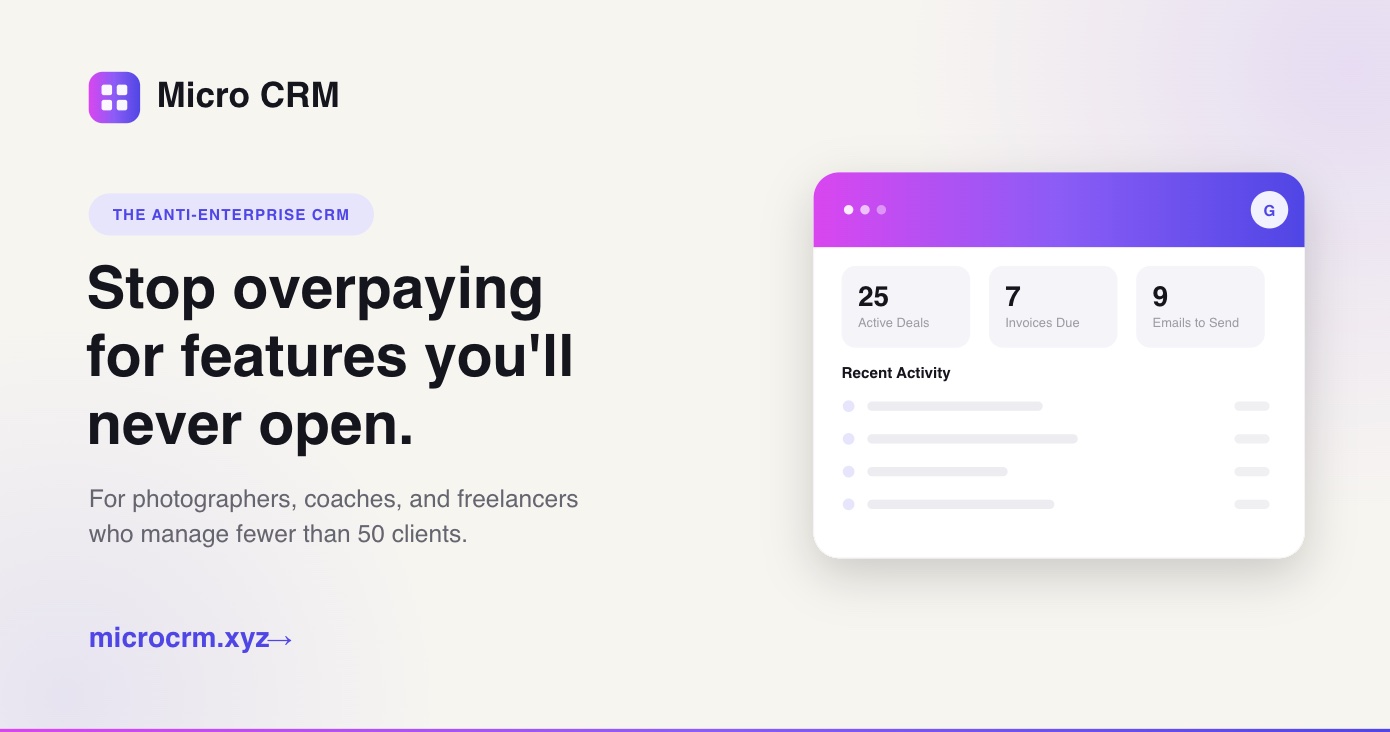
Micro CRM is a lightweight option for freelancers and micro-businesses that want a CRM centered on daily client work, not system upkeep. It keeps contacts, deals, invoices, emails, and appointments in one place, which matters if you need a simple workflow without spending time on setup. According to Micro CRM, it offers a free plan with no credit card required and is built for small operators who want to move from inquiry to invoice without a lot of extra steps.
The free plan is practical, but the limits are what define it. You get a visual Kanban pipeline, invoice generation with PDF delivery, email templates and automated follow-ups, and a calendar for scheduling. The cap on the free tier is clear, 50 contacts, 5 active deal cards, 5 invoices per month, 100 emails per month, and 1 sequence. That is enough for a modest client load, but it will force an upgrade once you start handling more prospects, more billing, or more follow-up activity. For a solo business, that is often the right trade-off, because the plan covers the basics without adding unused extras.
Practical rule: if your business has a small client list and a simple sales process, Micro CRM gives you the core tools without piling on features that slow you down.
Best for
- Freelancers who need one system for clients and billing: The workflow stays compact, so you avoid paying for functions you will not use.
- Consultants who rely on follow-ups: Email sequences and templates help you stay consistent when prospects need more than one touch.
- Photographers and creative studios: The pipeline makes it easier to track who has inquired, who is booked, and who still needs an invoice.
Micro CRM also has a few operational details that add context. It is built on AWS, uses encryption at rest and in transit, and handles authentication through Amazon Cognito. The site says it is trusted by 500+ freelancers and small businesses, and it offers a pause option that keeps data available and avoids billing for up to 6 months. For small businesses that want a simple tool with basic security and a low-maintenance setup, those details matter.
2. HubSpot CRM
HubSpot is the classic answer when someone wants a polished CRM that's easy to start with. Its free CRM is still one of the strongest “starter stack” options because it covers contact and deal tracking, basic email tools, forms, live chat, and meeting links in a single ecosystem. The free tier is also a clear example of how this market matured, since HubSpot explicitly markets a free CRM and positions it for small teams. Website: HubSpot CRM
Where it breaks
The free plan looks broad, but the limits show up quickly in real work. Salesforce's 2026 free CRM comparison notes 2 free users for Salesforce Free Suite and a 1-user trial-only setup for Pipedrive in its free category table, which is a useful reminder that free plans often separate by access and usage limits rather than by pure feature count. For HubSpot, the free version is strong on onboarding and usability, but growing teams usually run into the edges of reporting, permissions, and upgrades sooner than they expect.
HubSpot works best when you want a low-friction start and a clean handoff to paid tools later. If your business is still figuring out process, the interface feels approachable, and the ecosystem is excellent. If you already know you need deep automation, advanced reporting, or more flexible control, you'll feel the upgrade pressure earlier than with a narrower tool like Micro CRM.
HubSpot is a smart choice if you want a polished on-ramp, but it's less attractive when you need a free plan that can stay free for a long stretch.
3. Zoho CRM Free Edition
Zoho CRM makes sense for small teams that want a real CRM with some room to grow. The free edition supports core lead, contact, and deal tracking, and the Spanish SME buying guide ranks it as a free option for up to 3 users. That user cap is the first thing to watch, because it tells you exactly where the free plan stops being enough. Website: Zoho CRM
What Zoho does well is breadth. If you already use other Zoho apps, the free CRM can feel like the front door to a larger operating system. That's useful for owners who want CRM, forms, support, or analytics to play nicely together without paying for every module right away.
Best for
- Small teams already inside Zoho: The native ecosystem is the main reason to choose it.
- Owners who want more structure than a spreadsheet: Contacts, tasks, events, and basic dashboards are enough to replace manual tracking.
- Teams that can live with a heavier interface: Zoho isn't the simplest option, and the UI can feel busy.
The trade-off is straightforward. Zoho's free plan is capable, but the interface can feel cluttered, and many advanced features are reserved for paid tiers. If you want a lighter experience with faster onboarding, Micro CRM is easier to adopt. If you want a broader software family and don't mind learning the interface, Zoho is still one of the most established free options. For a direct comparison mindset, see Micro CRM's CRM comparison guide.
4. Bigin by Zoho
Bigin is the better Zoho pick when simplicity matters more than depth. It's built around pipelines, which makes it easier to adopt than a full CRM suite if your sales cycle is short and you mainly need to know who's in progress, who's waiting, and who's closed. Website: Bigin by Zoho
The free-plan appeal here is less about scale and more about clarity. You get a lightweight workflow, a straightforward Kanban-style view, and native connections to popular tools like Google Workspace, Microsoft 365, Zoom, Mailchimp, and QuickBooks. That makes it a reasonable choice for a solo consultant or a tiny service business that wants more structure than a spreadsheet but doesn't need a deep platform.
Best for
- Solo operators with simple pipelines: It's easier to start than a heavier CRM.
- Teams that value visual stages: The Kanban-first design keeps the process obvious.
- Businesses already using Zoho products: The ecosystem can reduce app sprawl.
Bigin's biggest strength is also its biggest limit. The free tier keeps you focused, but it doesn't offer the kind of depth you'd expect from a full CRM. If you need advanced automation or richer reporting, you'll move up quickly. If you want to stay lean and work out of a clean pipeline, it's a solid choice. If you want invoicing and follow-up in the same simple flow, Micro CRM is the more purpose-built option.
5. Freshsales by Freshworks
Freshsales is a strong fit for people who want a modern sales CRM without a steep learning curve. The free plan supports up to 3 users, which makes it usable for a tiny sales team or a founder plus one or two helpers. It's especially good if your daily work depends on calling, emailing, and moving deals through a simple pipeline. Website: Freshsales
Why the free plan feels usable
Freshsales stands out because the basics are clean and visible. You get contacts, deals, pipeline views, built-in phone and email tools, and mobile apps. The practical benefit is obvious, you can talk to prospects and log activity without leaving the CRM. That reduces the sort of context switching that makes follow-up work fall apart.
The limit is that the free tier stops short of the workflow features many growing businesses eventually need. You don't get the deeper automation, AI, or advanced reporting that paid teams use to standardize process. For a freelancer or a small agency, that may be fine for a while. For a team that wants invoicing and scheduling alongside sales, it's not as complete as Micro CRM.
Freshsales works well when your main problem is sales visibility, not operations management.
For a focused walkthrough of the email side of this workflow, see Micro CRM's email integration guide. If your process is mostly call, email, and track, Freshsales is clean. If you need a simple CRM that also covers billing and follow-ups in one place, Micro CRM is the tighter fit.
6. Bitrix24
Bitrix24 is the tool people choose when they want a CRM plus a lot more. It mixes sales, tasks, chat, collaboration, and basic marketing into a single workspace, which can be attractive for small teams that hate switching between apps. The free plan is broad enough to make it a real contender for businesses that need internal coordination as much as customer tracking. Website: Bitrix24
The upside is obvious once you start using it. You can handle CRM records, tasks, projects, and communication inside one environment, and that's useful if your team collaborates across sales and delivery. The downside is just as obvious. Bitrix24 can feel crowded, and the sheer number of features makes the first setup less friendly than simpler tools.
Best for
- Teams that need CRM and project coordination together: It can replace several separate tools.
- Businesses willing to tolerate a heavier interface: You trade simplicity for breadth.
- Owners who may eventually want self-hosting: That option exists here, which is rare in the free CRM space.
The market context matters here too. Salesforce's 2026 free CRM roundup treats the category as mature, and independent guides from Forbes Advisor, Zapier, and Mailchimp all published “best free CRM” guides in 2026, which tells you the audience for these tools is broad and persistent. Bitrix24 fits that reality well for teams that want a work hub, not just a contact list. If your main goal is to keep clients, deals, and invoices organized with the least amount of friction, Micro CRM stays simpler.
7. EngageBay
EngageBay is the budget-friendly option for teams that want CRM, marketing, and support in one place. The appeal is clear if you're trying to avoid stitching together separate email, help desk, and sales tools. It can cover the basics of contact management and sales pipelines while also giving you marketing and service features to work with. Website: EngageBay
The important caveat is the free plan's contact pressure. Independent roundups place EngageBay's free tier among the more limited options because the contact cap is tight enough to matter quickly for active lead generation. That means it's a better fit for a small list and a simple funnel than for a business that's growing fast.
Best for
- Small teams doing light marketing and sales together: One dashboard is easier than three subscriptions.
- Businesses that need basic support tools: Live chat and help desk features can reduce tool sprawl.
- Owners with modest contact volume: The free tier is workable only if your database stays small.
EngageBay's trade-off is straightforward. It gives you more breadth than a barebones CRM, but that breadth comes with tighter usage limits and branding in the free layer. If you're mainly trying to avoid missed follow-ups and keep invoices tied to client records, a focused tool like Micro CRM is usually easier to live with. If marketing is the center of your workflow, EngageBay earns a look.
8. Flowlu
Flowlu works best for businesses that want CRM, project management, and invoicing under one roof. That combination is useful for service companies that sell work, deliver work, and bill for work in the same month. It's less of a pure CRM and more of an all-in-one workspace with sales at the center. Website: Flowlu
That matters because it changes how you think about the free tier. Instead of asking whether the CRM alone is enough, you ask whether the whole operational stack fits. If your process includes proposals, project handoff, and invoices, Flowlu gives you a sensible starting point. If you only want simple client tracking, it may feel broader than necessary.
Best for
- Agencies and service firms: CRM plus project tracking is a useful combination.
- Businesses that invoice as part of the sales cycle: Billing is built into the same environment.
- Teams that want a single workspace: It reduces the need to patch together separate apps.
Flowlu's trade-off is that its free plan limits can push you up faster than you might expect. It's useful when you want more than contact storage, but the upgrade path becomes relevant as your business becomes more operationally complex. Micro CRM is narrower, but that narrowness is the point. It stays centered on client management, deal flow, invoices, and follow-ups without asking you to adopt a whole business suite.
9. Vtiger One Pilot
Vtiger is one of the strongest free CRM options when follow-up discipline matters. Zapier's 2026 roundup highlights Vtiger as a free CRM for up to 3,000 contacts, and that makes it relevant for small businesses that need room for a real client list. Website: Vtiger One Pilot
The practical strength is that it doesn't stop at contacts and deals. Vtiger's free layer also leans into follow-up logic, appointment booking, and basic service records. That makes it more useful than a bare contact database when your business depends on staying on top of prospects over time.
If your biggest pain point is forgetting who to call next, Vtiger has a real case for it.
Best for
- Small teams with active follow-up work: Email sequences and reminders are the point.
- Consultants who book meetings constantly: Scheduling support helps reduce back-and-forth.
- Businesses with both sales and service notes: Unified records keep context in one place.
The limit to watch is the usual one, the free tier is still bounded, and advanced capabilities require paid upgrades or boosters. That's not a flaw, it's the model. The question is whether you want a broader CRM with better follow-up mechanics or a simpler system for fewer moving parts. For owners who want billing and a lighter interface, Micro CRM still feels more focused.
10. EspoCRM
EspoCRM is the best answer for people who want full control and don't mind self-hosting. The core software is free under AGPL, and when you run it yourself, you avoid per-user fees altogether. That makes it appealing to technically confident teams that care about ownership as much as software features. Website: EspoCRM
Why it stands apart
EspoCRM's real advantage is not just cost, it's control. You can customize entities and fields, work with unlimited users and records when self-hosted, and shape the CRM around your own process. For a technically minded founder or an agency with infrastructure support, that freedom is valuable.
The trade-off is maintenance. Self-hosting means handling updates, backups, and security yourself, unless you pay a provider to do it for you. That's fine for teams that already manage servers, but it's overkill for most freelancers and small service businesses.
Best for
- Tech-savvy owners who want data control: Self-hosting keeps the stack in your hands.
- Teams with unusual workflows: Custom entities and fields make the system more adaptable.
- Businesses that hate per-seat pricing: Unlimited usage is the point, provided you can operate it.
EspoCRM is powerful, but it's not the smoothest answer for someone who just wants to start today. If you're a photographer, consultant, or solo agency owner, the maintenance burden can outweigh the savings. That's where Micro CRM has a clearer argument, because it gives you a simple hosted system without requiring infrastructure work.
How to choose the right free CRM
The right free CRM depends on where your business breaks first. If you're mainly drowning in spreadsheets, choose something simple. If you're missing follow-ups, choose a tool with email and pipeline visibility. If you're managing projects and billing too, choose something that keeps those pieces close together instead of making you stitch them together later. For a practical shortlist and a direct comparison mindset, revisit Micro CRM's best free CRM guide.
The biggest mistake is choosing a tool because it has the longest feature list. Free CRM plans almost always have a breaking point, usually in contacts, users, or automation, and the best choice is the one that gives you enough runway without forcing a migration too soon. HubSpot is the easiest on-ramp, Zoho is strong for teams already inside its ecosystem, Freshsales is neat for sales calling, Vtiger is strong for follow-up, and EspoCRM is the control-first option for technical users.
Micro CRM fits best when your business is small enough that simplicity beats depth. If you're a freelancer, consultant, creative studio, or tiny agency, the value is in having one clear place for contacts, deals, invoices, emails, and scheduling. That's usually better than adopting a larger system and only using a fraction of it.
Top 11 Free CRMs for Small Business, Side-by-Side Comparison
| Product | Key features | UX / Quality | Value / Pricing | Target audience | Unique selling points |
|---|---|---|---|---|---|
| Micro CRM 🏆 | Contacts; Kanban pipeline; Invoicing (PDF, multi‑currency); Email templates & sequences; Calendar; Reports | ★★★★★; instant 30s onboarding; minimal learning curve | 💰 Free; Starter $14/mo; Pro $29/mo; LTD $299 one‑time | 👥 Freelancers & micro‑businesses (<~50 clients) | ✨ Zero‑friction setup; AWS encryption & Cognito; pause account with data preserved; 🏆 recommended |
| HubSpot CRM | Contacts, deals, forms, basic email & lite reporting; App Marketplace | ★★★★; polished UI; scalable hubs | 💰 Free core; paid Hubs for marketing/service | 👥 Small teams planning growth | ✨ Strong ecosystem & integrations; easy upgrade path |
| Zoho CRM (Free Edition) | Leads, contacts, accounts, deals; tasks; basic reports; Zoho integrations | ★★★★; feature‑rich but busier UI | 💰 Free up to 3 users; paid tiers for advanced features | 👥 Small teams wanting Zoho ecosystem | ✨ Broad adjacent apps for expansion |
| Bigin by Zoho | Kanban pipelines; contacts & activities; basic email; native G Suite/MS/QuickBooks integrations | ★★★★; simple & pipeline‑centric | 💰 Free tier; affordable small‑biz plans | 👥 Micro‑businesses preferring simplicity | ✨ Purpose‑built pipeline UX; very easy adoption |
| Freshsales by Freshworks | Contacts/accounts/deals; built‑in phone & email; tasks; mobile apps | ★★★★; clean sales workflow | 💰 Free up to 3 users; paid for advanced features | 👥 Small sales teams | ✨ Built‑in telephony & email; sensible upgrade path |
| Bitrix24 | CRM, deals & web forms; tasks, chat & calls; file drive; simple site builder | ★★★; powerful but crowded UI | 💰 Very generous free tier; cloud & self‑host options | 👥 Small teams needing CRM + collaboration | ✨ All‑in‑one work‑OS; optional self‑hosting |
| EngageBay | Contact management; sales pipelines; email marketing; live chat; basic support desk | ★★★; all‑in‑one SMB stack | 💰 Free tier with caps; competitive paid plans | 👥 SMBs wanting CRM + marketing + support | ✨ Integrated starter stack; good early value |
| Flowlu | CRM with deals & invoicing; project/task management; client portal; time tracking | ★★★★; unified CRM + PM experience | 💰 Free limits; paid upgrades for more features | 👥 SMBs needing CRM + project management | ✨ Combines CRM, invoicing & PM in one UI |
| Vtiger One Pilot | Leads, contacts, deals; tasks & events; basic support records; mobile apps | ★★★; practical free edition | 💰 Free pilot; Booster packs to raise limits | 👥 Small teams starting sales + service | ✨ Targeted Booster packs; smooth upgrade path |
| EspoCRM | Leads, accounts, contacts, opportunities; activities; REST API; PDF templates | ★★★★; modern & flexible if self‑hosted | 💰 Free self‑host (AGPL); paid cloud/hosted options | 👥 Tech‑savvy users & self‑hosters | ✨ Open‑source control; no per‑user fees when self‑hosted |
Ready to Ditch the Spreadsheet for Good?
Choosing the best free CRM for your small business means picking a tool that helps you work, not one that gives you more software to manage. A free plan should let you organize contacts, move deals forward, and keep follow-ups visible without burying you in setup. Once you know your real client count, your team size, and how often you invoice, the right choice becomes much clearer.
The pattern across these tools is simple. Some free plans are generous but broad, some are narrow but polished, and some are powerful only if you're willing to self-host. For most freelancers and small businesses, the smartest move is to choose the platform that matches your actual workflow today and still leaves room to grow tomorrow. If you're looking for a tool that keeps clients, deals, invoices, and follow-ups in one straightforward place, Micro CRM is built for exactly that kind of work.
Micro CRM gives freelancers and small businesses a simple way to manage clients, deals, invoices, and follow-ups without the clutter of a complex CRM. If you want a free plan that stays focused on the essentials, visit Micro CRM and start organizing your business in one place.