
CRM for Consultants: A Practical Setup Guide
You know the mess already. The follow-up lives in Gmail, the proposal sits in a folder called Final Final, and one renewal slips past because you meant to come back to it on Friday. That's usually the moment a consultant stops trusting spreadsheets and starts looking for a CRM that won't turn into another system to babysit.
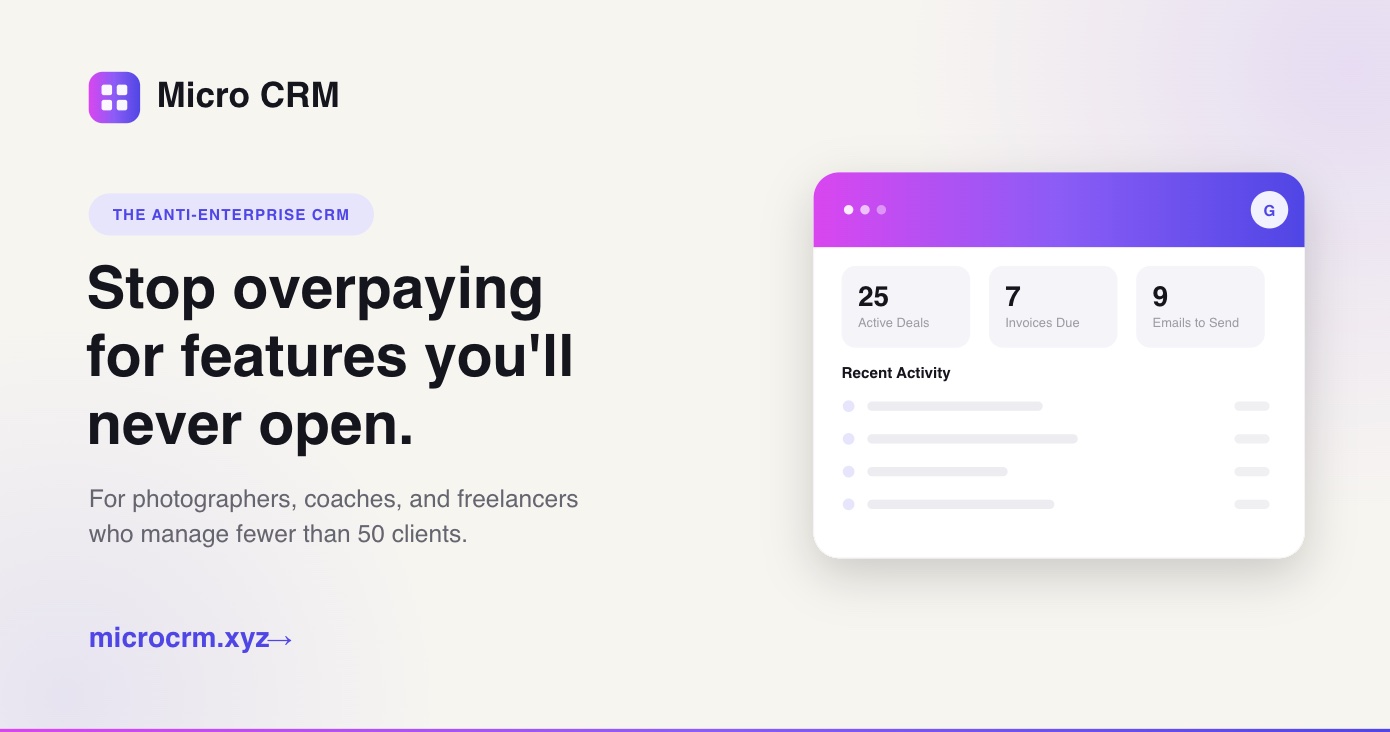
MicroCRM fits that smaller, lower-friction job. It's a lightweight way to keep contacts, deals, invoices, emails, and calendar work in one place, without forcing you into an enterprise setup you'll resent by week two.
Table of Contents
- Why Consultants Need a CRM Before They Think They Do
- The Day-One Features That Actually Matter
- Spreadsheets vs Enterprise CRMs vs Lightweight Tools
- Setting Up Your CRM in One Afternoon
- Two Workflows You Can Copy on Day One
- Pricing and Plan Guidance for Solo and Small Practices
- Keeping the System Useful Six Months In
Why Consultants Need a CRM Before They Think They Do
A consultant loses a renewal in the stupidest way possible. The client had already asked for a new scope, the note was in the inbox, and the reminder got buried under meeting replies and vendor emails. Nothing broke in the work itself, but the business still leaked money because the relationship had no single home.
That's a core consulting problem. The work is relationship-driven, and the revenue comes from follow-up, proposals, renewals, and repeat conversations, not just closing one-off deals. When those details live in spreadsheets or memory, you start missing the small moments that turn into future work. The broader CRM market has become big enough to show this is no longer a niche habit, with one 2026 compilation forecasting $163.16 billion by 2030 and 14.6% CAGR from 2025 to 2030, while another says 91% of companies with 10 or more employees already use CRM software and firms using CRM are 86% more likely to exceed sales goals. CRM market and adoption data
The hidden cost is never just one missed deal
When a consultant doesn't track the full client thread, three things happen. First, referrals go cold because the last touch never got logged. Second, cross-sell opportunities disappear because no one can see what the client already bought. Third, scope creep gets harder to bill because the extra work was discussed in calls, not captured in a system.
That's why CRM for consultants isn't really about “sales software.” It's the operating layer for client work. The earlier you centralize contact history, opportunities, and next steps, the less likely you are to confuse activity with progress. For a simple, practical framing of the small-business use case, this guide to CRM for small business matches the same reality consultants face every day.
Practical rule: if a client conversation can affect revenue later, it belongs in the CRM, not in a random inbox thread.
The Day-One Features That Actually Matter
A consultant doesn't need a bloated feature list on day one. They need a system that helps them remember what to do next, attach the right context to every client, and move from proposal to invoice without retyping the same information five times.

The seven features worth keeping
- Centralized contacts: Keep every client's emails, notes, documents, and decisions attached to one profile, because consulting work needs full context, not a contact card with a phone number.
- Visual Kanban pipeline: Use drag-and-drop stages so you can see which lead is in discovery, proposal, or negotiation without opening ten records.
- Proposal and invoice generation: Send quotes and invoices from the same workspace so the handoff from pitch to payment stays clean.
- Email and calendar sync: Log conversations automatically and stop double-booking discovery calls.
- Task management: Turn “follow up next week” into a tracked task, not a hope.
- Client portal: Let clients check project status without chasing you for updates.
- Basic reporting: Watch revenue and activity in a simple dashboard, not a spreadsheet you have to rebuild every Friday.
The point is to insist on day-one utility, not future flexibility you may never use. Consulting guidance from Insightly's CRM checklist for consultants emphasizes lead capture, pipeline tracking, proposal management, deal-to-project handoff, and reporting, which is the right order of priority. CRM best practices for consulting services also recommend keeping client data, interaction history, and billing details together in one place, rather than spreading them across separate tools. Nimble's consulting CRM practices
What to skip without guilt
Skip AI add-ons you won't configure. Skip giant marketing suites if you're sending a few targeted follow-ups, not running a campaign machine. Skip complicated automation builders if you only need a reminder sequence, a calendar, and a clean way to get paid.
If a CRM can't handle the basics above without a consultant teaching you how to use the CRM, it's already too heavy.
Spreadsheets vs Enterprise CRMs vs Lightweight Tools
The choice isn't “use a CRM or don't.” It's whether you want to keep duct-taping your business together in spreadsheets, buy a platform built for a large team, or use a lightweight tool that handles consulting work without asking for a second job from you.
The spreadsheet path looks cheap because it starts at zero. Then the hidden cost shows up in missed reminders, no mobile workflow, weak visibility, and no reliable way to connect deals to invoices. Enterprise CRMs give you more power, but they also give you setup drag, admin burden, and a habit of overconfiguring basic tasks that should've taken five minutes.
| Criteria | Spreadsheets | Enterprise CRM | Lightweight CRM |
|---|---|---|---|
| Setup time | Fast at the start, messy later | Slow, because configuration never really ends | Fast, because the core workflow is already built in |
| Ongoing admin | High, manual updates everywhere | High, if you don't have a dedicated admin | Low, because fewer moving parts |
| Cost at small volume | Cheap until the work gets serious | Usually feels expensive once seats and add-ons stack up | Easier to justify for solo and small practices |
| Fit for under-50-client practices | Weak once follow-up matters | Often too much system for the job | Strong, because the tool matches the size of the book |
The consulting sources point in the same direction. Cloud-based CRM adoption has moved from 12% in 2008 to 87% today in one cited dataset, which helps explain why simple systems are now expected, not exotic. CRM usage progression At the same time, consulting buyers increasingly want quote-to-cash support, not just lead tracking, because the work doesn't stop when the proposal goes out. Consulting CRM quote-to-cash focus
My blunt recommendation
If you're solo or running a tiny practice, don't buy a platform that assumes you've got a sales ops person. Buy the smallest tool that can hold contacts, proposals, invoices, follow-ups, and delivery notes in one place. That's the lane MicroCRM is built for.
Setting Up Your CRM in One Afternoon
Start with the work you do, not the tabs the software vendor wants to show off. The fastest setup is always the one that mirrors your consulting process instead of forcing a generic sales model onto it.

Import your contacts first. If your leads already live in a spreadsheet or address book, move them in before you touch automation. That usually takes the least time and gives you a real starting point instead of an empty dashboard that looks productive and does nothing.
Build stages that match consulting reality
Use a pipeline that reflects how you sell, not how software teams think you sell. A clean sequence is Lead, Discovery, Proposal, Negotiation, Won. That keeps you from overcomplicating the first version, and it also makes review calls easier because you can tell at a glance which opportunities need attention.
Next, connect your email so conversations attach to the right contact. People often waste time by copying and paste messages into notes instead of letting the CRM hold the thread. If you want a short walkthrough of the basic setup logic, this CRM system usage guide covers the kind of practical habit that keeps data usable instead of decorative.
Then build one or two email templates. Make them simple, with placeholders for name, company, and next step. One template should cover discovery follow-up, the other should cover proposal follow-up. Anything more at the start is usually procrastination dressed up as efficiency.
Finish with invoicing and calendar sync
Create one proposal or invoice template before you stop. If you bill for retainers, make sure recurring invoices are easy to send without re-creating the document every month. Then connect your calendar so discovery calls land on your actual availability, not your memory.
Don't optimize for elegance on day one. Optimize for the first time you send a proposal, log a call, and issue an invoice without opening three other apps.
If you want a product example with this shape, MicroCRM keeps the setup narrow on purpose, which is exactly what a small consulting practice usually needs.
Two Workflows You Can Copy on Day One

A consulting CRM should handle the full quote-to-cash loop without forcing you to rebuild the whole setup each time. The test is simple, can it carry a proposal, move a prospect into a retainer, generate a recurring invoice, and pass work cleanly to delivery. If it cannot do that, it is too much tool and not enough system.
One-off project flow
A discovery call starts as Lead. Log the note, move the record to Discovery, and send the proposal from the same client thread, with a subject like Proposal for Brand Strategy Audit. Once the deal reaches Won, send the invoice right away, then keep delivery notes and tasks on the same record instead of bouncing the client into a second project tracker.
Do not split the client across separate systems. The proposal, follow-up, kickoff note, and invoice all belong to one history, because the next time that client returns, you need the context in front of you. If the trail is scattered, you waste time rebuilding the story and you miss details that should already be there.
Retainer client flow
Retainers need a different rhythm. Use Onboarding for the first handoff, then Monthly Sync for recurring calls, Deliverables for active work, and Monthly Invoice for billing. Add a recurring invoice template, a quarterly review task, and a renewal reminder that lands before the end date, so you are not negotiating under pressure.
A short health-check note after each sync pulls more weight than people expect. It gives you a quick record of what the client cares about, what has stalled, and where the account might expand next quarter. Pipedrive's CRM guidance for consultants makes the same point, consultants do not usually lose because they cannot win work, they lose because they fail to manage what happens after the deal is signed.
Keep both flows inside one simple CRM structure, contacts, pipeline, invoicing, calendar, and follow-up. If you want a practical way to connect workflow design to the rest of the setup, this CRM and workflow guide shows the same logic from a broader system angle. MicroCRM can cover both patterns with the same core layout, which is exactly the kind of narrow setup a small consulting practice should want.
Pricing and Plan Guidance for Solo and Small Practices
Stop looking at CRM pricing like a software shopper and start looking at it like a consultant who has to protect margin. The wrong plan feels cheap until you hit email caps, per-seat charges, or automation limits that force you into an upgrade you didn't budget for.
Consulting tools tend to split into free, starter, pro, and lifetime-style offers, but the label matters less than the friction underneath it. A plan that includes contacts, deals, sequences, and invoicing can be more valuable than a lower-priced seat-based tool that makes you buy separate add-ons for the features you use. That's why the quote-to-cash angle matters so much here, because it reduces the number of subscriptions you end up nursing.
Buy for active deals, not for contact count
A solo consultant with a modest book doesn't need a system built for giant contact lists. They need enough room for live opportunities, current clients, and follow-up history. If you're still deciding between tiers, judge the upgrade by how many active deals you're juggling, not by how many old contacts you've imported.
Rule of thumb: upgrade when the CRM starts limiting your live work, not when it can't store more names.
That's also where lightweight tools win. They usually avoid the hidden cost structure that makes larger CRMs look affordable at first glance and expensive the moment you use them like an actual business. If the plan gives you a free entry point and lets you test the actual workflow before paying, that's usually the smarter place to start.
Keeping the System Useful Six Months In
A CRM only works if you keep feeding it the actual business, not the idealized version of it. Spend 15 minutes a week reviewing the pipeline, keep one place for notes and one place for invoices, pause inactive clients instead of deleting them, and attach emails instead of forwarding them into the void. That's the discipline that stops the system from turning into another abandoned tab.
MicroCRM fits the lightweight profile described here, with a free plan, a limited-time lifetime option, and the kind of setup that doesn't demand a long onboarding project. If you want crm for consultants to feel like a working habit instead of another software purchase, keep the process simple and keep the context together.
Manage clients, deals, and invoices in one platform.
Start for free. No credit card required.