
CRM for Small Business: Key Features to Look For
If your client work lives in Excel, your inbox, and a few sticky notes, you already know the failure mode. A lead gets buried under old email threads, an invoice gets sent late, and nobody can tell which follow-up is overdue because the information is scattered across too many places. That's where a CRM for small business earns its keep, especially if you're handling a modest number of clients and don't need a giant system to stay organized.
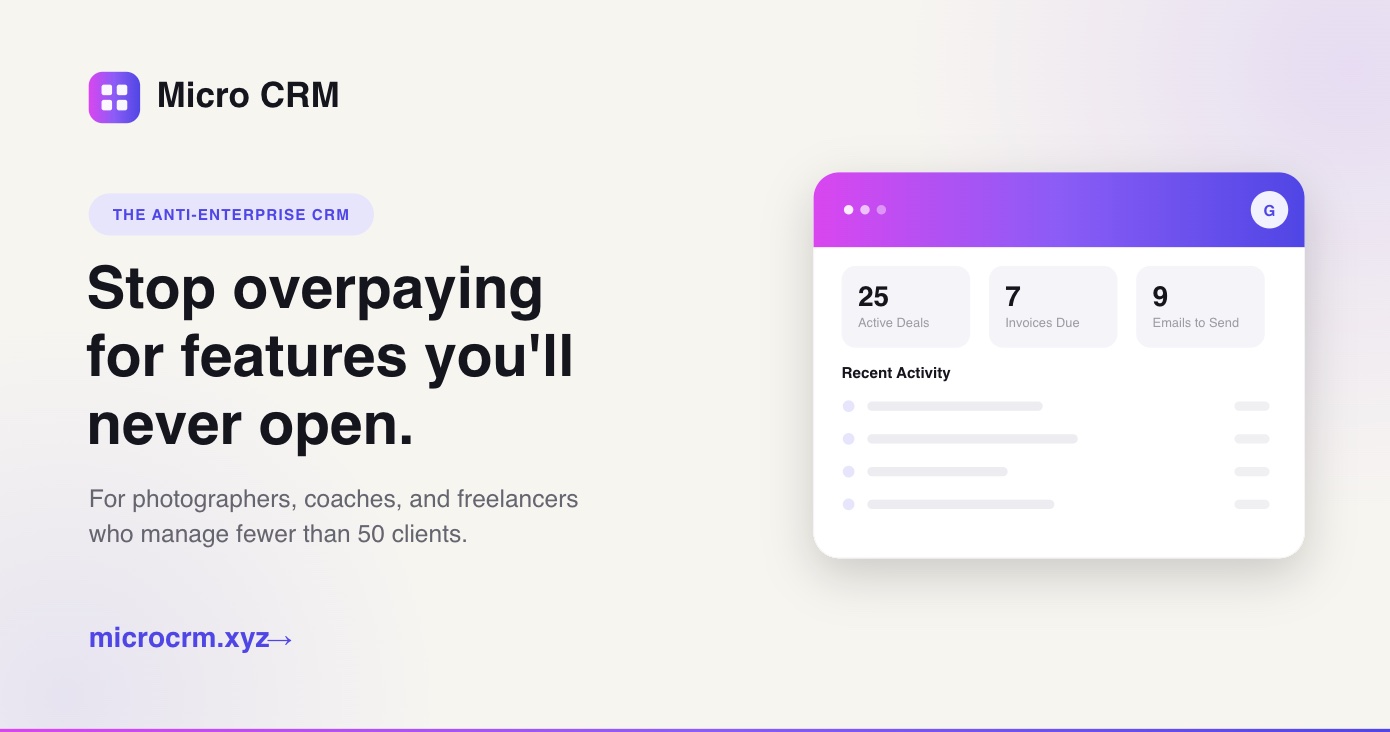
For a team of one to five, the job is simple. Keep the client record in one place, move deals forward without guessing, send invoices on time, and stop relying on memory for the next follow-up. A lightweight tool like MicroCRM fits that reality better than a bloated platform built for a sales department.
Table of Contents
- The Everyday Chaos That Pushes Small Businesses Toward a CRM
- What a CRM Does for a Small Business
- Must-Have Features and the Limits That Matter for Micro Teams
- Spreadsheets vs Enterprise CRM vs Lightweight CRM
- Setting Up a CRM Without Losing a Week
- Quick Workflows for Photographers, Designers, and Coaches
- Pricing, Free Plans, and How to Read CRM Costs Honestly
- Choosing MicroCRM as the Simplest CRM for Small Business
The Everyday Chaos That Pushes Small Businesses Toward a CRM
A freelancer does not usually wake up thinking, “I need customer relationship management software.” They wake up to three client emails, a calendar invite that needs a reply, and a PDF invoice somewhere in Downloads. By noon, the problem is not missing software, it's that no one place shows who's waiting, who's paying, and what needs attention first.
That is why spreadsheets keep failing small teams. They can store names and notes, but they do not hold the context that comes from a live client relationship, especially when a project moves from inquiry to quote to delivery to invoice. The CRM problem is really a memory problem, and memory breaks first when you are busy.
Practical rule: If a client update lives in three different places, it is already at risk.
For firms with fewer than 50 clients, the tradeoff is obvious. Another spreadsheet column adds admin, while an enterprise CRM adds setup pain and unused features. A focused CRM for small business sits in the middle and gives you one client record, one pipeline, and one place to see what happens next.
That matters because CRM has become standard business infrastructure, not a niche add-on. Freshworks reports that 71% of small businesses use a CRM system, and 73% of all businesses are expected to use CRM software in 2024. They also say CRM users are 86% more likely to exceed sales goals and that most businesses report sales revenue increases of 21% to 30% after implementation, which is exactly why small operators should stop treating client tracking like a side task. Freshworks CRM statistics
What a CRM Does for a Small Business
A solo operator usually feels the problem first in the middle of a busy day. A quote request arrives, a client wants a revision, an invoice is still unpaid, and the notes live in different tabs, inboxes, and scraps of paper. A CRM pulls that mess into one client record so you can see the history without hunting for it. Salesforce CRM definition
From lead to invoice in one record
A typical freelancer's path shows the value fast. Someone asks for a quote, you send a proposal, they reply with changes, the work starts, and later you send the invoice. If those steps sit in separate apps, the thread gets thin. If they sit inside one CRM record, the relationship stays attached to the person, the deal, and the follow-up.

That is the main job of a CRM for a micro-team. It acts like shared client memory, so you do not rebuild context every time you open an email thread or dig through an old spreadsheet. Small-business guidance keeps pointing to the same core pieces, centralized contacts, interaction history, pipeline tracking, and simple reporting, because those are the functions that stop duplicate records and missed follow-ups. ACT guidance on small business CRM features
Why contact storage is not enough
A contact list tells you who someone is. A CRM tells you what happened last time, what needs attention now, and where the opportunity stands. That difference is why small-business CRM selection should start with data centralization, not with flashy automation that nobody will set up.
A lightweight system also saves time in plain, practical ways. Analysts at Freshworks say CRM users spend less time on repetitive admin and move deals through the pipeline faster. For a one-person or five-person shop, that matters because every missed note, late follow-up, or lost client detail creates more cleanup later. Freshworks CRM statistics
Must-Have Features and the Limits That Matter for Micro Teams
A micro team doesn't need every CRM feature ever invented. It needs the few that stop work from slipping through the cracks. That usually means centralized contact management, a visual pipeline, invoicing, follow-up emails, calendar scheduling, and simple reporting.
| Feature | What it does for a small business | Main benefit |
|---|---|---|
| Centralized contact management | Keeps each client's details, notes, and history in one place | Less context switching |
| Visual deal pipeline | Shows where each opportunity sits | Faster follow-up decisions |
| Invoicing | Lets you create and send bills from the same system | Fewer missed payments |
| Email templates and follow-ups | Reuses routine messages and reminders | Less manual chasing |
| Appointment scheduling | Lets clients book time and keeps availability clear | Fewer back-and-forth emails |
| Simple reporting | Shows a small set of KPIs at a glance | Better day-to-day visibility |
The point is not that each feature is impressive. The point is that each one removes a repeated task. If you handle one client at a time, a hidden file cabinet of notes is fine for a while. Once your work becomes active pipeline plus billing plus reminders, the cost of scattered tools shows up fast.
A lightweight CRM should reduce admin before it tries to “optimize” your business.
Know where the line is
The limits matter just as much. Small-business guidance and technical checklists both push the same idea, rely on secure web access, email and calendar integration, authenticated users, and basic reporting before you worry about complex automation or AI. Small business CRM technical requirements
For a micro team, broad automation can become overhead. If you're under 50 clients, you usually gain more from reliable reminders and clean records than from building complicated workflows you won't maintain. That's the true test: if a feature doesn't remove a weekly annoyance, skip it.
Spreadsheets vs Enterprise CRM vs Lightweight CRM
A small business owner really has three choices. Stay with spreadsheets and inbox folders. Buy an enterprise CRM. Or choose a lightweight system built for a small operating pace.

| Option | Setup time | Learning curve | Daily friction |
|---|---|---|---|
| Spreadsheets | Quick to start | Low at first, then messy | High once follow-ups, invoices, and notes multiply |
| Enterprise CRM | Slow | Steep | High unless you have admin help |
| Lightweight CRM | Fast | Low | Low, because it matches a small team's actual workflow |
Spreadsheets win on entry cost, but they lose as soon as client work becomes active and recurring. Enterprise tools win on breadth, but that breadth brings configuration, training, and maintenance you probably don't want. The middle option is the one I'd choose for most solo operators and small studios, because it trims friction instead of adding process.
If you want a deeper side-by-side breakdown, this CRM comparison guide is worth a look.
The market data supports that middle ground. An industry roundup citing Fortune Business Insights projects the global CRM software market to reach $126.17 billion in 2026 and $320.99 billion by 2034, with a projected CAGR of about 12.4%. The same roundup says adoption is around 71% for small businesses and 91% for companies with 10 or more employees, which tells you CRM is already standard once a business gets formal enough to need it. CRM statistics for small business
Setting Up a CRM Without Losing a Week
Start with the clients and deals that are moving now. Import only active clients and current deals, then leave old records behind unless you need them. That keeps week one on live work, not cleanup.
Build stages around how your work moves
Your pipeline should match real jobs, not a consultant's template. For a solo operator, stages like inquiry, qualified, proposal, negotiation, won, and invoiced are enough. If your workflow uses different language, use it. The point is fast recognition, not perfect taxonomy.
Don't configure every custom field on day one. If you cannot explain why a field saves time, it probably will not earn its place.
Skip the tempting clutter
Leave tags, automation branches, and fancy scoring rules for later. A tiny team gets more value from clean contact sync, one reminder system, and a usable pipeline than from an overbuilt setup. That adoption gap is why some teams search for the easiest CRM to use, because setup time matters more than feature lists. Adoption slips when setup turns into a second job, and the CRM adoption for small businesses piece points to that same problem.
Keep the first build simple. Import contacts, define the stages, connect email and calendar, then test one live deal from start to finish. If the system cannot support that without confusion, it is too heavy for a small team.
Quick Workflows for Photographers, Designers, and Coaches
A good CRM disappears into the work. It doesn't force a new way of operating, it just makes the existing week less chaotic.
A photographer's pipeline
A freelance photographer can move every shoot inquiry through a Kanban board, from quote to booked to delivered to invoiced. That's useful because each job has a clear next step, and the board makes it visible without digging through email. A missed follow-up on a wedding inquiry is expensive, while a drag-and-drop pipeline makes that next action obvious.
A designer's client record
An independent designer needs one client record that holds the brief, revision history, and email conversation. That way, when a client asks, “Can you resend the second version?” the answer is one search away. The benefit is not fancy analytics, it's not repeating yourself and not hunting for the latest file.
A coach's reminder system
A coach usually feels the pain in scheduling and follow-up. An appointment calendar cuts the back-and-forth, and automated email sequences handle the recurring reminders that would otherwise live in the inbox. That's where a tool like MicroCRM fits naturally, because the workflow is simple enough to benefit from automation without turning into a software project.
For micro teams, the best CRM workflow is the one you'll actually keep using next Tuesday.
The pattern is the same across all three roles. Use the CRM to keep the conversation, the deal stage, the invoice, and the next reminder together. Anything beyond that should earn its place.
Pricing, Free Plans, and How to Read CRM Costs Honestly
Free plans are useful when they cover the live client set, basic deal tracking, and a little follow-up work. Monthly subscriptions make sense when you need more contacts, more emails, or more sequences than a free tier allows. Lifetime deals can be attractive, but only if the product still fits your workflow after the first month.

The honest way to judge cost is to compare it with the time you stop wasting. A small monthly fee is easier to defend than hours spent maintaining a tool that's too large for the job. For a micro team, the hidden cost of an enterprise CRM usually isn't the subscription, it's the time spent configuring features nobody uses.
If you're comparing models, read the limits closely. Free plans often cap contacts, deals, emails, or sequences, and that's fine if you're still early. The moment you need more active outreach or better visibility, step up for a feature you'll use immediately, not because the pricing page makes it look impressive.
Use this CRM pricing guide when you want a cleaner view of how to compare plans without getting lost in feature noise.
Choosing MicroCRM as the Simplest CRM for Small Business
If you run a freelance or micro-business operation, the right CRM is the one that keeps you organized without turning into another system to manage. You need centralized contacts, a visible pipeline, invoicing, follow-ups, and a calendar in one workspace. You don't need a platform that asks you to become its administrator.
That's why I'd point a team under 50 clients toward MicroCRM. It keeps the feature set focused on the work that matters for small operators, and it does it with a low-friction setup that suits people who want to get moving quickly rather than spend a week configuring fields. The free plan with no credit card required makes it easy to test against your real workload instead of guessing.
Want to better organize your clients and business opportunities?
👉 Try MicroCRM for free: https://microcrm.xyz
If you've been juggling spreadsheets, inbox folders, and late follow-ups, stop patching the problem with more tabs. A simple CRM gives you one place to manage clients, deals, and invoices, and that's usually enough to change the week.
MicroCRM gives you one place to handle clients, deals, invoices, and follow-ups without dragging you into enterprise complexity. If that's the workflow you need, visit Micro CRM and start for free, no credit card required.