10 Freelancer Billing Software Picks for 2026
You finish a client project, open a spreadsheet for the client details, search your email for the agreed payment terms, check a separate time tracker, and assemble the invoice manually. Then you add a reminder to your calendar, hope you remember the follow-up, and wonder which clients have paid.
That's when billing becomes a workflow problem, not just an invoice-creation task. The best freelancer billing software depends on whether you need standalone invoicing, accounting, time tracking, project management, payment processing, or a lightweight CRM connecting contacts, deals, invoices, email follow-ups, and scheduling. Micro CRM is one option for freelancers who want a focused workspace instead of a complex accounting or enterprise CRM system.
This comparison evaluates ten tools by the workflow they support, not just their invoice templates. It covers practical strengths, limitations, pricing information supplied for Micro CRM, and the best fit for different freelance businesses.
Use this checklist before choosing:
- Invoice creation: Can you create professional invoices, PDFs, estimates, and line items quickly?
- Recurring billing: Can the tool handle retainers, subscriptions, or repeat work?
- Payment collection: Can clients pay online, and are processing fees clear?
- Time and expense tracking: Can logged work and expenses flow into invoices?
- Client management: Can you see contacts, history, projects, and payment status together?
- Follow-ups: Does the platform support reminders, email sequences, or overdue notices?
- Integrations: Will it connect with accounting, payment, calendar, or project tools?
- Scalability: Will plan limits, users, clients, or reporting become a problem?
Table of Contents
- 1. Micro CRM
- 2. Zoho Invoice
- 3. Wave
- 4. FreshBooks
- 5. Bonsai
- 6. Harvest
- 7. Paymo
- 8. Indy
- 9. Square Invoices
- 10. Invoice Ninja
- Freelancer Billing Software, Top 10 Comparison
- Choose the Billing Workflow You'll Actually Use
1. Micro CRM
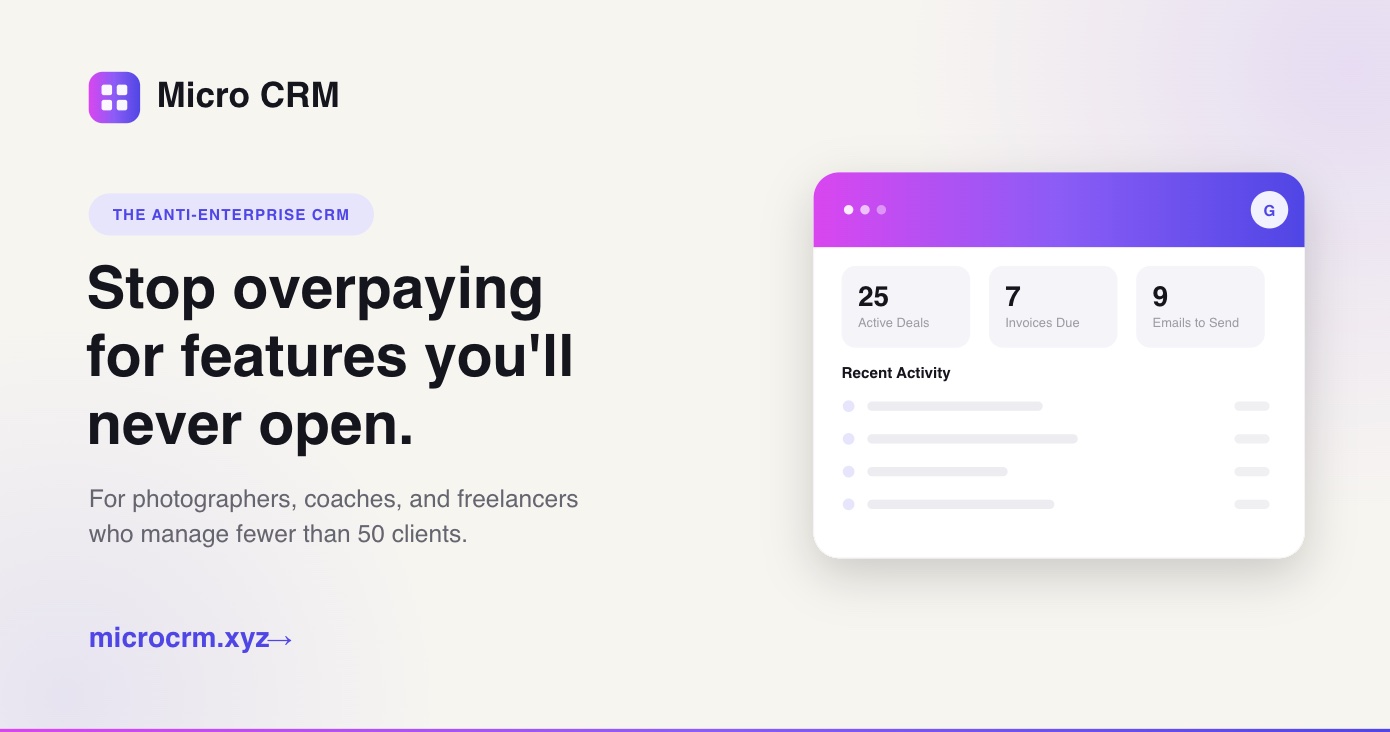
Micro CRM is the strongest choice when your billing problems begin before the invoice. It combines contacts, deal stages, invoices, email follow-ups, calendar scheduling, and reporting in one focused workspace, so you don't need to move between a spreadsheet, an email inbox, and a separate invoice generator.
The visual Kanban pipeline helps you track opportunities from new enquiry to completed work and payment. You can create professional PDF invoices, add line items, send them by email, and support multiple currencies. Templated emails and follow-up sequences keep client communication connected to the deal instead of buried in your inbox.
Why Micro CRM stands out
Micro CRM is deliberately minimal. You can sign up with an email, start without a credit card, and begin managing contacts and invoices without a lengthy setup process. Its interface is designed for freelancers and very small teams managing a modest client list, including photographers, designers, consultants, coaches, solo entrepreneurs, and micro-agencies.
The Free plan costs $0 per month and includes 50 contacts, 5 active deal cards, 5 invoices per month, 100 emails per month, and 1 sequence. It doesn't include the calendar or reporting. Starter costs $14 per month when billed annually and includes 1,000 contacts, unlimited deals and invoices, 3,000 emails per month, 10 sequences, and the calendar. Pro costs $29 per month when billed annually and adds 10,000 contacts, unlimited emails and sequences, reporting, and priority support.
A limited-time Lifetime Deal costs $299 once and includes 1,500 contacts, unlimited deals and invoices, 3,000 emails per month, 10 sequences, and the calendar, but not reporting.
Practical rule: Choose Micro CRM when you need billing connected to client history and sales activity, not when you need a full accounting ledger.
Trade-offs and best fit
Micro CRM uses AWS storage, encryption at rest and in transit, and Amazon Cognito authentication. You can also pause the account for up to 6 months while preserving your data and stopping billing. The product is trusted by 500+ freelancers and small businesses, with customer feedback highlighting its spreadsheet replacement, simple interface, and pipeline visibility.
The limitations are intentional. CSV import is still on the roadmap, although an API is available today. Advanced reporting and priority support require higher plans, and the platform isn't designed for heavy automation, AI assistants, very large contact databases, or complex multi-user enterprise operations.
Pros: Fast setup, integrated contacts and deals, PDF and multi-currency invoicing, email sequences, calendar scheduling, transparent plans, AWS-based security, and a usable free tier.
Cons: Limited integrations, CSV import not yet available, advanced reporting on higher plans, and a deliberately narrow feature set.
Visit Micro CRM if you want to manage clients, deals, invoices, and follow-ups without the overhead of a complex CRM.
2. Zoho Invoice
Zoho Invoice is the best pick for no-cost standalone invoicing. It focuses on the quote-to-payment workflow without forcing a freelancer into a broader accounting suite, making it a sensible starting point for someone who wants professional invoices, payment reminders, recurring billing, and a client portal.
The platform supports tax-compliant invoice templates, client access for viewing and payments, light time and expense tracking, and basic project controls. A freelancer who sends repeat invoices to consulting clients or maintains a small retainer roster can automate much of the routine billing work without adopting a full CRM.
Where it works well
The main advantage is its $0 pricing. Zoho Invoice offers unlimited invoicing, payment reminders, and recurring invoices, which removes much of the financial risk for a new freelancer testing a billing process. Mobile apps make it practical for sending invoices away from a desk, while the client portal gives customers a dedicated place to review documents and payments.
Independent review aggregation cited by Learn G2 lists Zoho Invoice at 8.4/10 in Forbes Advisor's 2026 roundup, while the same coverage highlights recurring billing, reminders, and ease of invoice creation and tracking. Forbes Advisor's invoicing software roundup also identifies payment reminders and integrations as important buyer priorities.
The free plan has limits that may matter as your work grows. It supports two users, three projects, and 500 invoices per year, and it includes “Powered by Zoho Invoice” branding.
Pros: Free invoicing, recurring invoices, reminders, client portal, mobile apps, and light time and expense tracking.
Cons: User, project, and invoice limits on the free plan, plus platform branding.
Choose Zoho Invoice when you want a dedicated invoice tool and don't need a sales pipeline, scheduling workspace, or broader client relationship management.
3. Wave
Wave is the right choice when you want invoicing plus simple bookkeeping in one affordable platform. It combines customizable invoices and estimates with basic accounting and receipt capture, which makes it more useful than a standalone invoice generator for freelancers who want a basic view of income and expenses.
You can create invoices from desktop or mobile, accept card and ACH payments through invoices, and keep basic financial records alongside billing activity. Payment processing fees apply when clients pay online, so compare the cost of collection as well as the subscription price.
The workflow trade-off
Wave's strength is its all-in-one feel. A freelance writer, designer, or consultant can send an invoice, record client payment, and maintain simple books without manually copying every billing event into another system. The Starter plan costs $0, while more advanced automation and integrations require the Pro plan.
The platform suits freelancers who need basic bookkeeping but don't want the complexity of a full accounting system. It isn't the best fit if your main problem is missed sales follow-ups, scattered client information, or scheduling. Wave keeps financial records together, but it isn't a focused CRM.
For a practical comparison of lightweight billing workflows, see simple invoicing software for freelancers.
Pros: Free Starter plan, customizable invoices and estimates, mobile invoicing, basic accounting, and receipt capture.
Cons: Online payment fees, advanced automation and integrations on Pro, and less emphasis on contacts, deal stages, or client outreach.
Choose Wave when bookkeeping belongs in the same decision as invoicing. If your priority is managing opportunities and follow-ups before the invoice, use a CRM alongside or instead of it.
4. FreshBooks
FreshBooks is the best choice for freelancers who need a polished time-to-invoice and accounting workflow. It connects tracked time, expenses, estimates, retainers, recurring invoices, payments, and basic financial reporting in a way that suits service professionals.
A consultant can track work against a client, record expenses, convert billable activity into invoice lines, and apply automatic reminders or late fees. Creatives and agencies can also use retainers and recurring billing for repeat engagements. Online payments support multiple currencies, and mobile apps keep the workflow accessible outside the office.
Strong for service businesses
FreshBooks has a low learning curve and a client-friendly invoicing experience. Its main limitation is cost that can rise with client counts, while some advanced reporting requires higher plans. That makes it more suitable for a freelancer whose business depends on billable time and expense records than for someone who only sends occasional fixed-price invoices.
The platform also provides a stronger accounting layer than a simple invoice app. If you need to connect work performed with the financial record, FreshBooks is more complete than a standalone invoice generator.
For international billing decisions, review multi-currency invoicing for freelancers.
Pros: Time tracking, expense capture, retainers, recurring invoices, automatic late fees, reminders, mobile apps, and online payments.
Cons: Higher costs as client counts increase, plan-based reporting limits, and more features than basic invoice-only users need.
Choose FreshBooks when your workflow is track time, record expenses, create the invoice, and maintain accounting records. Don't choose it just because you need a clean invoice template.
5. Bonsai
Bonsai is the strongest option for a freelancer who wants a complete proposal-to-payment workflow. It combines proposals, contracts, projects, time tracking, expenses, invoices, retainers, subscriptions, payments, and a client portal.
That continuity matters for longer creative and consulting engagements. You can send a proposal, secure a signed contract, manage the project, track time, and bill the client without rebuilding the same details in separate tools.
The wider client journey
Bonsai supports unlimited invoices, retainers, and subscription invoices, along with card and ACH payments. Published processing-fee details make it easier to evaluate the total cost of online collection. The modern interface and simple onboarding suit freelancers who want more than invoices but don't want to assemble a workflow from many disconnected apps.
The trade-off is breadth. If you only need to create five invoices and track whether they've been paid, Bonsai may feel like more software than necessary. Its broader toolkit is valuable when contracts, proposals, project work, and billing belong together.
Read how to invoice as a freelancer for a workflow focused on getting from completed work to payment.
Pros: Connected proposals, contracts, projects, time, expenses, invoices, payments, and client portal.
Cons: Online payment fees, a broader setup than invoice-only tools, and a suite that may exceed the needs of simple billing users.
Choose Bonsai for project-based freelancers who want every client document and payment step in one system. Choose something leaner if your work starts with existing clients and ends with a straightforward invoice.
6. Harvest
Harvest is the best freelancer billing software for hourly and time-and-materials work. Its central workflow starts with a timer or timesheet, then carries billable hours and expenses into an invoice.
You can use one-click timers, daily or weekly timesheets, project rates, and billable expense records. Invoices can include tracked time, fixed fees, and expenses, giving clients a clearer explanation of what they're paying for. That reduces the risk of forgetting small tasks or manually reconstructing a month of work.
Why hourly freelancers choose it
Harvest also offers reporting and integrations with Stripe, QuickBooks Online, Xero, and other billing or accounting tools. Paid tiers add team and profitability reporting, which helps small studios understand how projects use time and whether rates remain commercially viable.
The limitation is that usage-based elements on paid tiers can make costs harder to predict. Team features may also be unnecessary for a solo freelancer. Harvest is a specialist tool for capturing work accurately, not a broad CRM for managing deal stages, client conversations, and appointment scheduling.
Pros: Excellent time tracking, invoices generated from billable time, expense support, useful integrations, and clean reporting.
Cons: Potentially less predictable costs, team features that may exceed solo needs, and less emphasis on contact and sales management.
Choose Harvest when every invoice starts with a timesheet. If you mainly charge fixed project fees and need client follow-ups, use a CRM or project-led billing platform instead.
7. Paymo
Paymo is the best fit for project-led freelancers and small studios that want tasks, schedules, time, expenses, and invoices together. It combines project management with billing, so the invoice can reflect the work recorded inside the project rather than a separate spreadsheet summary.
You can create invoices from timesheets and expenses, prepare estimates, accept online payments, and manage work through Kanban or Gantt views. Desktop and mobile time tracking support different working styles, while scheduling and file proofing help teams coordinate delivery before billing.
Project management with billing attached
Paymo gives consultants and small creative teams more operational structure than a dedicated invoice tool. A studio can assign tasks, review files, track time, and prepare a client invoice from the same project record. API access and integrations help connect it to other systems as the business becomes more established.
That strength can also become a drawback. The interface is denser than a simple invoicing app, and freelancers who only need recurring invoices or payment reminders may spend time configuring project features they won't use.
Pros: Strong project, time, expense, scheduling, estimate, and invoice workflow; Kanban and Gantt views; online payments; team growth support.
Cons: More complexity than invoice-only software and a slight learning curve caused by its broader interface.
Choose Paymo when project execution drives billing. It's a better match for a small studio than for a solo freelancer who only needs fast payment collection.
8. Indy
Indy is a freelancer-focused choice for repeat work, retainers, and document-to-invoice workflows. It combines proposals, contracts, communication portals, project records, recurring invoices, and lightweight automation.
A freelancer can create a proposal, move the client through a contract, attach tracked time to an invoice, and use recurring invoice series for ongoing work. Automated follow-ups help maintain communication without requiring a separate sequence tool.
Lightweight and freelancer-oriented
Indy's interface is less intimidating than a broad business suite, and the workflow fits independent designers, consultants, and other professionals who need client documents alongside billing. The client project portal also keeps communication and project material closer to the invoice.
Some invoice features are available only on the Pro plan, including branding removal and workflow automations. Its ecosystem is smaller than those of the largest commercial accounting platforms, so check integrations before committing to a wider stack.
Pros: Proposals-to-contracts-to-invoices, recurring billing, time attachments, client portals, and freelancer-oriented usability.
Cons: Some invoice capabilities require Pro, and the integration ecosystem is smaller than major accounting platforms.
Choose Indy when the client relationship begins with a proposal and continues through repeat billing. For contact pipelines and scheduling without a document-heavy process, Micro CRM is the more focused alternative.
9. Square Invoices
Square Invoices is the right choice when payment processing is the centre of your billing workflow. It connects invoices to Square's card and ACH payment ecosystem, so you can send a client a payment-ready invoice without arranging a separate gateway.
The platform supports recurring and milestone invoices, multiple templates, and integration with broader Square tools such as scheduling and point-of-sale features. It doesn't require hardware for invoice payments, which makes it practical for service freelancers who already use Square or want a quick path to online collection.
Good for payment-first billing
Square's main advantage is convenience. A photographer collecting a deposit, a coach billing recurring sessions, or a contractor charging against milestones can present a clear invoice and payment option in one flow. The client doesn't need to go through a complicated payment process.
The cost model requires attention. Processing fees apply to each paid invoice, and those fees can accumulate with high billing volume. Optional Square Plus and Premium subscriptions add monthly fees for advanced functionality.
Pros: Fast setup, card and ACH acceptance, recurring and milestone billing, clear payment flows, and access to the wider Square ecosystem.
Cons: Per-transaction processing fees and optional subscription costs for advanced features.
Choose Square Invoices if you already rely on Square payments or want payment acceptance ahead of CRM and accounting depth. It isn't the best choice when your biggest issue is managing sales opportunities or client history.
10. Invoice Ninja
Invoice Ninja is the best choice for hosted or self-hosted invoicing flexibility. It supports recurring billing, auto-billing, partial payments, deposits, products, expenses, time tracking, client portals, and Kanban-style project management.
The hosted option gives freelancers a conventional cloud workflow, while self-hosting provides greater control over data and ongoing costs. Paid plans offer unlimited clients and invoices, remove branding, and provide a branded URL.
Control versus convenience
Invoice Ninja suits technically comfortable freelancers who want more control than commercial hosted tools usually provide. A small agency can manage projects, track time, collect deposits, and handle partial payments without paying for a broad enterprise suite.
Self-hosting is also the main limitation. It requires technical confidence, maintenance, and responsibility for the operating environment. Even the hosted product may feel less polished than larger commercial platforms, especially for users who want built-in accounting, advanced integrations, or a highly refined client experience.
Pros: Affordable paid plan, unlimited clients and invoices on Pro, recurring and partial billing, self-hosting, time tracking, expenses, and client portal.
Cons: Technical effort for self-hosting and fewer polished extras than larger commercial suites.
Choose Invoice Ninja when control and flexibility matter more than a guided, highly integrated user experience. For a lower-setup workspace that combines billing with contacts, deals, email, and scheduling, choose Micro CRM instead.
Freelancer Billing Software, Top 10 Comparison
| Product | Core features | UX & Quality (★) | Pricing & Value (💰) | Target audience (👥) | Unique selling points (✨) |
|---|---|---|---|---|---|
| Micro CRM 🏆 | Contacts, Visual Kanban, Invoices (PDF & multi‑currency), Email sequences, Calendar, Reports | ★★★★★ | 💰 Free / Starter $14/mo / Pro $29/mo / Lifetime $299 (limited-time) | 👥 Freelancers, solo consultants, micro‑agencies (<~50 clients) | ✨ Zero setup, AWS security, pause account w/ data preserved |
| Zoho Invoice | Invoicing, client portal, payment reminders, time/expense capture | ★★★★ | 💰 Forever‑free (limits); paid add‑ons | 👥 Freelancers wanting polished invoicing without full accounting | ✨ $0 unlimited invoicing option, strong mobile apps |
| Wave | Invoices + basic bookkeeping, receipt capture, payments | ★★★★ | 💰 Free invoicing; payment processing fees apply | 👥 Freelancers needing invoicing + simple books | ✨ Integrated bookkeeping + invoicing in one free tool |
| FreshBooks | Invoices, time tracking, retainers, expense tracking | ★★★★ | 💰 Tiered paid plans; can rise with client count | 👥 Creatives & service pros needing time→invoice flow | ✨ Strong templates, automations (late fees, reminders) |
| Bonsai | Proposals, contracts, time & project tracking, billing | ★★★★ | 💰 Paid plans; payment processing fees for payments | 👥 Freelancers/agencies wanting end‑to‑end proposals→pay | ✨ Cohesive proposals→contracts→invoices workflow |
| Harvest | Time tracking first, invoice from timesheets, reporting | ★★★★ | 💰 Free tier; paid plans for teams & integrations | 👥 Hourly consultants, agencies billing T&M | ✨ One‑click timers → invoices; robust integrations |
| Paymo | Project management (Kanban/Gantt), time tracking, invoicing | ★★★★ | 💰 Affordable tiered pricing; scales with team size | 👥 Small studios & consultants needing PM + billing | ✨ Combines Gantt/Kanban with billing & proofing |
| Indy | Proposals, contracts, client portals, recurring invoices | ★★★★ | 💰 Free + Pro for advanced features | 👥 Solo freelancers seeking light all‑in‑one toolkit | ✨ Lightweight UX with document→invoice flow |
| Square Invoices | Recurring/milestone invoices, card & ACH via Square | ★★★★ | 💰 Per‑transaction processing fees; optional subs | 👥 Sellers already in Square ecosystem | ✨ Fast payments + seamless integration with POS/scheduling |
| Invoice Ninja | Invoicing, recurring billing, time & project tracking, self‑host option | ★★★ | 💰 Very affordable hosted Pro or self‑host (low cost) | 👥 Tech‑savvy freelancers & small businesses wanting control | ✨ Self‑hosting & white‑labeling for max control and low ongoing cost |
Choose the Billing Workflow You'll Actually Use
The best freelancer billing software is the one that matches the work you already do. Don't choose based on the longest feature list. Choose based on the point where your current process breaks.
Pick Zoho Invoice for no-cost standalone invoicing, recurring billing, reminders, and a client portal. It's the clearest choice when you want professional invoices without accounting or project-management overhead.
Choose Wave for invoicing plus simple bookkeeping. It gives budget-conscious freelancers a way to keep invoices, payments, and basic financial records in one platform, although online payment fees and paid automation still matter.
Select FreshBooks when your billing starts with time and expenses. It's built for service freelancers who want tracked work to become invoice lines, with retainers, recurring billing, reminders, and accounting records connected to the same client.
Use Bonsai or Indy when the client journey starts with proposals and contracts. Bonsai is the broader project and payment suite, while Indy keeps the document-to-invoice process lighter and more freelancer-focused.
Choose Harvest when accurate time capture matters most. It's the right fit for hourly consultants, developers, designers, and other professionals who need billable time and expenses to flow into invoices.
Pick Paymo for project-led teams. It brings tasks, schedules, Kanban or Gantt views, time tracking, expenses, and invoicing together, but it's more software than a fixed-price freelancer may need.
Use Square Invoices when you already use Square payments or want card and ACH collection to be the centre of the workflow. It's fast and practical, but per-transaction processing fees should be part of your decision.
Choose Invoice Ninja for hosted or self-hosted flexibility. It's especially useful when you need partial payments, deposits, recurring billing, and control over the hosting environment.
Micro CRM belongs in a different category. It's for freelancers and small businesses that need contacts, deal stages, invoices, email follow-ups, and scheduling in one focused workspace, rather than a full accounting or project suite. It can replace the spreadsheet that stores client details, the inbox used for reminders, and the disconnected invoice tool used at the end of the project.
Want to better organize your clients and business opportunities?
There's no reason to pay for complex automation if your real need is a clear client list, a visual pipeline, professional invoices, timely follow-ups, and a calendar. There's also no reason to force a lightweight CRM to replace accounting software when you need deep financial statements, bank reconciliation, or advanced tax workflows. Match the tool to the workflow, then use it consistently.
Manage clients, deals, and invoices in one platform. 👉 https://microcrm.xyz Start for free. No credit card required.
Micro CRM brings contacts, Kanban deal stages, PDF and multi-currency invoicing, email follow-ups, and calendar scheduling into one focused workspace for freelancers and small businesses. Visit Micro CRM to replace scattered billing and client-management tasks with a simpler workflow, and start for free without a credit card.