
Managing Client Relationships That Scale Your Business
You're halfway through a client project, preparing a proposal, and chasing an overdue invoice at the same time. Excel has one version of the client list, email has the latest conversation, your calendar has the meeting, and the invoice is buried in a separate app. Then a client asks whether you remembered their preferred format, and you spend ten minutes searching for the answer.
That isn't a client-service problem. It's a workflow problem. Managing client relationships becomes much easier when contacts, deals, conversations, appointments, follow-ups, and invoices live in one reliable place. The shift matters because CRM has evolved from manual lists and folders to database marketing in the 1980s, contact management software in the late 1980s, and sales automation, loyalty programs, and segmentation by the 1990s, as TechTarget's CRM history documents.
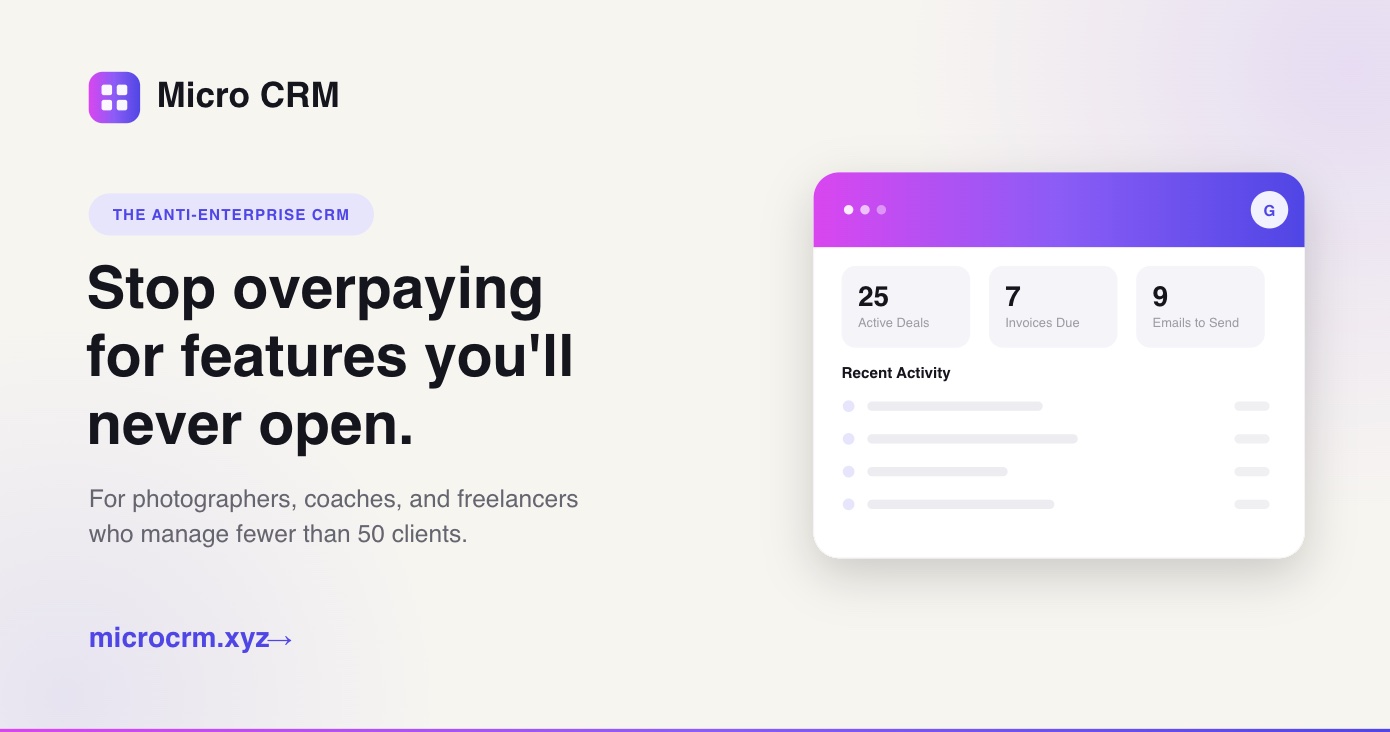
Table of Contents
- The Real Cost of Disorganized Client Work
- Centralizing Every Contact and Interaction in One Record
- Turning First Contact Into a Committed Deal on a Kanban Pipeline
- Keeping Momentum With Email Templates and Follow-Up Sequences
- Protecting the Relationship by Getting Invoicing Right
- Reading the Numbers So You Know Which Clients to Protect
- Putting It All Together in One Simple Weekly Rhythm
The Real Cost of Disorganized Client Work
A freelancer rarely loses revenue because they can't do the work. They lose it because the system around the work depends on memory.
On Monday morning, a designer searches an Excel file for a prospect's phone number. By lunch, they're looking through an email thread for the proposal version that included the agreed scope. In the afternoon, they remember a follow-up they meant to send after last week's discovery call. At night, they create an invoice from a template, then manually copy the client's billing details from another document.
Every task looks small. Together, they create constant context switching. You're not just moving between apps. You're rebuilding the history of each relationship every time you need to act.
Practical rule: If a client detail exists only in your head, an old email, or a personal spreadsheet, treat it as unavailable.
The damage shows up in ordinary moments:
- Missed follow-ups: A warm prospect goes quiet because nobody owned the next action.
- Repeated questions: You ask for information the client already supplied, which makes your operation look careless.
- Slow proposals: You delay a decision because the deal context is scattered.
- Late invoices: Billing becomes an afterthought instead of part of the delivery process.
- Uneven service: Your best clients receive attention when you happen to remember them, not when the workflow requires it.
The remedy isn't adding another specialist application to the stack. It's replacing the Excel-plus-three-apps habit with a single workspace that reflects how a small business works. A lightweight CRM should be ready in minutes, not require a long implementation project.
Start by organizing contacts in a structured client system. Once each client has one record, every later action becomes easier. You can see what was promised, what's pending, when you last spoke, and whether money is still outstanding without reconstructing the relationship from fragments.
That's the standard to use for every tool decision. If it reduces searching and makes the next action obvious, keep it. If it creates more fields, tabs, and maintenance than your client book can support, remove it.
Centralizing Every Contact and Interaction in One Record
Most relationship failures begin with a missing detail. A client mentioned their preferred file format in a casual message. They explained their approval process during a call. They sent a billing address in an email that now sits beneath dozens of newer messages.
A reliable contact record turns those details into working context. It should include the person's basic information, company details, tags, notes, follow-up history, and every meaningful interaction. The point isn't to record everything. The point is to record what another version of you will need before the next conversation.
Build the record before the work gets busy
A freelance designer onboards three new clients in one week. By Friday, each record should answer the same practical questions:
- Who makes the decision? Add the main contact and other stakeholders.
- What does the client need? Record the project type, scope, and immediate objective.
- How do they work? Note preferred communication channels, review habits, and approval expectations.
- What happens next? Add the next meeting, deliverable, or follow-up date.
- What has already happened? Log calls, emails, decisions, and unresolved questions.
Use tags to make the records useful without turning them into a database project. Tags such as “retainer,” “referral,” “awaiting feedback,” or “high priority” help you find the right group quickly. A complete interaction history then gives you the context to write a relevant message rather than a generic check-in.
| Storage Location | What Gets Lost | Fix With a CRM |
|---|---|---|
| Excel workbook | Recent notes, ownership, and the latest status | Keep contact fields, tags, and status in one record |
| Email thread | Decisions, attachments, and promised follow-ups | Log the interaction and next action against the client |
| Personal notes app | Context that only one person can access | Store searchable notes inside the shared client record |
| Calendar | Why the meeting exists and what it should resolve | Link appointments to the contact and deal |
| Invoice folder | Relationship context around payment | Keep billing activity beside the client and deal history |
The rule is simple: capture the detail where you'll use it. If a client prefers short emails, record it. If they need two internal approvals before signing, add it to the deal notes. If an invoice must go to a finance contact, save that contact rather than relying on memory.
For a practical overview of structured records, see this guide to small-business contact-management software. The best system is the one you'll update immediately after the interaction, while the information is still fresh.
Turning First Contact Into a Committed Deal on a Kanban Pipeline
A contact isn't a deal until someone knows what happens next. A name in a spreadsheet tells you that interest exists. A pipeline tells you whether the opportunity is moving, stalled, or ready for a decision.
Set up stages that match your real sales process. For a freelancer or small agency, a useful flow might be Initial Inquiry, Discovery Call, Proposal Sent, Negotiation, and Signed and Onboarding. Each column should represent a meaningful change in commitment, not an arbitrary internal label.

Give every stage a next action
Take the designer working with a potential wedding client. The inquiry includes the date, venue, and requested deliverables. After the discovery call, the designer records the client's priorities, budget discussion, decision-maker, and agreed proposal date. The opportunity moves from Discovery Call to Proposal Sent, and the next action becomes a scheduled follow-up.
That small discipline prevents a common mistake: confusing activity with progress. Sending an email isn't progress if nobody knows what decision the email should produce.
Use these rules:
- Initial Inquiry: Qualify the request and schedule a discovery call.
- Discovery Call: Record needs, timing, stakeholders, and objections.
- Proposal Sent: Set a follow-up date and attach the relevant proposal.
- Negotiation: Record changes to scope, price, timing, and approval requirements.
- Signed and Onboarding: Create the client record, invoice plan, and first appointment.
A Kanban board works because it exposes stalled work immediately. If several opportunities sit in “Proposal Sent” with no next action, you don't need another spreadsheet report. You need to decide whether to follow up, revise the proposal, or close the opportunity.
Probability fields can also help you forecast without building formulas in Excel. Treat them as planning guidance, not guaranteed revenue. A weighted view is useful only when the stages are consistently defined and the values are kept current. For a deeper operating framework, use this guide to sales pipeline management.
MicroCRM provides a visual Kanban pipeline with drag-and-drop stages and automatic probability calculations. That combination suits a modest client book because it keeps the visible workflow simple while preserving enough information for a practical forecast.
Keeping Momentum With Email Templates and Follow-Up Sequences
Most opportunities don't disappear during the first conversation. They disappear afterward, when a strong call is followed by a quiet inbox.
The fix isn't sending more messages. It's making the right message easy to send at the right moment. After every meaningful call, log the touchpoint, send a clear recap, and assign the next action before you move on to other work.
Use templates for structure, not personality
A useful recap template should include the decisions made, the client's open questions, the agreed next step, and the date you'll return. Variable placeholders can insert the client's name, project, proposal link, or appointment details without forcing you to rewrite the framework each time.
Keep the important judgment human. A template can remind you to address the client's concern about timing. It can't decide whether their concern requires a revised scope or a direct phone call.
A practical sequence might look like this:
- Call summary: Send the recap soon after the conversation.
- Proposal follow-up: Ask whether the proposal answers the client's stated priorities.
- Value-add touchpoint: Share a relevant example, explanation, or recommendation.
- Final reminder: Close the loop respectfully and make it easy for the client to respond.

The embedded calendar matters just as much. Give the client a scheduling link with defined availability instead of exchanging several messages to find a suitable time. The calendar should support the relationship, not replace it. Leave room for a personal note when the situation calls for one.
Over-automation creates its own risk. If a client has raised an objection, missed a deadline, or signaled uncertainty, pause the sequence and respond directly. Automation should handle reminders, scheduling, and routine follow-up. It shouldn't pretend that every account has the same context.
Human judgment belongs at the points where trust is won or lost.
The operating habit is more important than the sequence design. Log the call on the same day, send the recap while you remember the details, and never let an automated message go out without checking whether the client's situation has changed.
Protecting the Relationship by Getting Invoicing Right
No relationship strategy survives sloppy billing. A client can appreciate your communication and still become frustrated when an invoice contains incorrect details, arrives late, or requires repeated manual reminders.
The pressure is widespread among small businesses. QuickBooks' 2026 Small Business Late Payments Report says 59% of businesses have invoices overdue by 30 or more days, compared with 47% the year before. UK data from Sage's 2025 late-payment report found that the smallest businesses were owed an average of £42,000 in overdue invoices, while 44% of invoices were paid late.
Those figures change how you should think about invoicing. It isn't an accounting task that happens after client service. It's part of client service because clear billing protects expectations and keeps the commercial side of the relationship visible.
Make billing part of the deal workflow
Create the invoice from the deal record whenever possible. Use a professional PDF, include clear payment terms, check the billing contact, and support the currency your client expects. Send it directly by email, then let the system record that the invoice was issued.
The UK government's late-payments research found that 36% of SMEs reported that over a third of their monthly payments arrive late. The same operational pattern appears in the causes of delayed payment, including incorrect invoice details, missed reminders, and manual processes. Centralizing those steps removes avoidable friction before it becomes an uncomfortable conversation.

Integrated invoicing also helps you keep the tone professional. An automatic reminder is less awkward than a freelancer suddenly writing, “Just checking whether you saw my invoice,” after weeks of silence. You can still step in personally when an account needs attention, but the routine reminder doesn't depend on your mood or memory.
The EU report on e-invoicing describes e-invoicing adoption among SMEs as lagging, even though smaller firms stand to benefit from reduced late payments. That makes a lightweight workflow more useful than an oversized finance system for many freelancers. You need accurate creation, timely delivery, and consistent follow-up tied to the same client record.
Reading the Numbers So You Know Which Clients to Protect
When you manage more than a handful of clients, gut feel becomes unreliable. You may remember the client who emailed yesterday while overlooking the quiet account that has not responded to a proposal, approved work, or discussed renewal.
Review three categories each week: revenue, deal movement, and engagement. Revenue shows where your financial exposure sits. Deal movement shows whether opportunities are progressing. Engagement identifies relationships that need a personal conversation before a problem becomes visible.
Use retention as a baseline
Customer retention rate gives freelancers, agencies, and small businesses a practical measure of whether relationships are holding. Use the standard formula, (customers at the end of the period minus new customers acquired during the period) divided by customers at the start of the period, multiplied by 100. Track it monthly or quarterly. Then segment retained clients by revenue and engagement so your follow-up time goes to the relationships that matter most.
The economics support that focus. According to Salesforce's customer retention guidance, acquiring a new customer costs about five times more than retaining an existing one, repeat buyers spend about 67% more than first-time buyers, and a 5% retention lift can raise revenue by 25% to 95%. Retention also varies widely by industry, with media and professional services near 84% and hospitality around 55%. Compare your results with your own history rather than copying an unrelated benchmark.

A simple review ritual is enough:
- Open the revenue report: Identify the accounts with the greatest financial importance.
- Sort by recent activity: Find clients with long response gaps or no logged interaction.
- Review open deals: Look for proposals without next actions and projects approaching renewal.
- Choose three calls: Contact the accounts where personal attention can change the outcome.
For account-level risk, silence deserves attention. CustomerGauge's account lifecycle management guidance recommends combining interaction history, structured feedback, and fast responses, while treating non-responding accounts as potentially at risk. Use NPS or a similar survey when it helps, but do not collect feedback you will not act on. A single client record that connects these metrics to notes, deals, and follow-ups gives you a clearer protection list than an Excel file beside three separate apps.
Putting It All Together in One Simple Weekly Rhythm
A fifteen-minute review each Monday and Friday is enough to keep your client workflow honest. Use one workspace for contacts, deals, follow-ups, appointments, invoices, and reports, instead of maintaining an Excel file beside three separate apps.
A freelancer with a modest client book does not need an overbuilt setup. You need records you can find quickly, a visible pipeline, follow-ups that do not depend on memory, and reports that answer practical cash-flow questions without constant configuration.
Monday review
Spend fifteen minutes on the week ahead. Check open deals, overdue follow-ups, scheduled appointments, unpaid invoices, and clients whose recent activity has declined. Choose the relationships that need a personal response, then put those actions on your calendar.
Keep the review focused on three questions:
- Which client expects something from me this week?
- Which opportunity needs a decision or follow-up?
- Which invoice or payment issue could affect cash flow?
Friday cleanup
Use ten minutes to close loops. Log conversations, move deals to their actual stages, update contact notes, send promised files, and mark invoices correctly. Before travel or a seasonal slowdown, pause unnecessary automation and preserve the records you will need when work resumes.
The operating rule is simple: log every client touchpoint, deal change, and invoice action on the same day. Delayed updates create false pipeline stages, missed commitments, and unreliable reports.
A CRM statistics summary reports that 74% of businesses in the United States have implemented a CRM system, projects the global CRM market to grow 12% annually through 2028 to about $129 billion, and reports an average return of $8.71 for every $1 spent on CRM in its CRM statistics summary. These figures reflect broad-market adoption and reported averages, not a guarantee for a small business. The useful takeaway is practical: choose a tool you will update every day.
MicroCRM combines contact management, deals, Kanban stages, invoicing, email sequences, appointment scheduling, and reporting in one interface. Its free plan requires no credit card, letting you test the weekly workflow before committing money or rebuilding your processes.
Manage clients, deals, and invoices in one platform with Micro CRM, a lightweight workspace for freelancers and small businesses. Create a free account, add active clients and open deals, and build the weekly review habit before forgotten follow-ups and late invoices cost you another relationship.