
The 10 Best Free CRM Tools for 2026
Tired of managing clients in a spreadsheet? If your follow-ups live on sticky notes, your pipeline is basically a hunch, and invoicing happens in yet another app, you're paying for that chaos with lost time and missed work. A best free CRM isn't about collecting more software, it's about making client tracking simple enough that you use it every day. That's exactly why a lightweight tool like Micro CRM can make sense for freelancers and small teams that want contacts, deals, invoices, and follow-ups in one place. Micro CRM keeps the setup fast and the interface intentionally small, so you spend less time configuring and more time closing work. 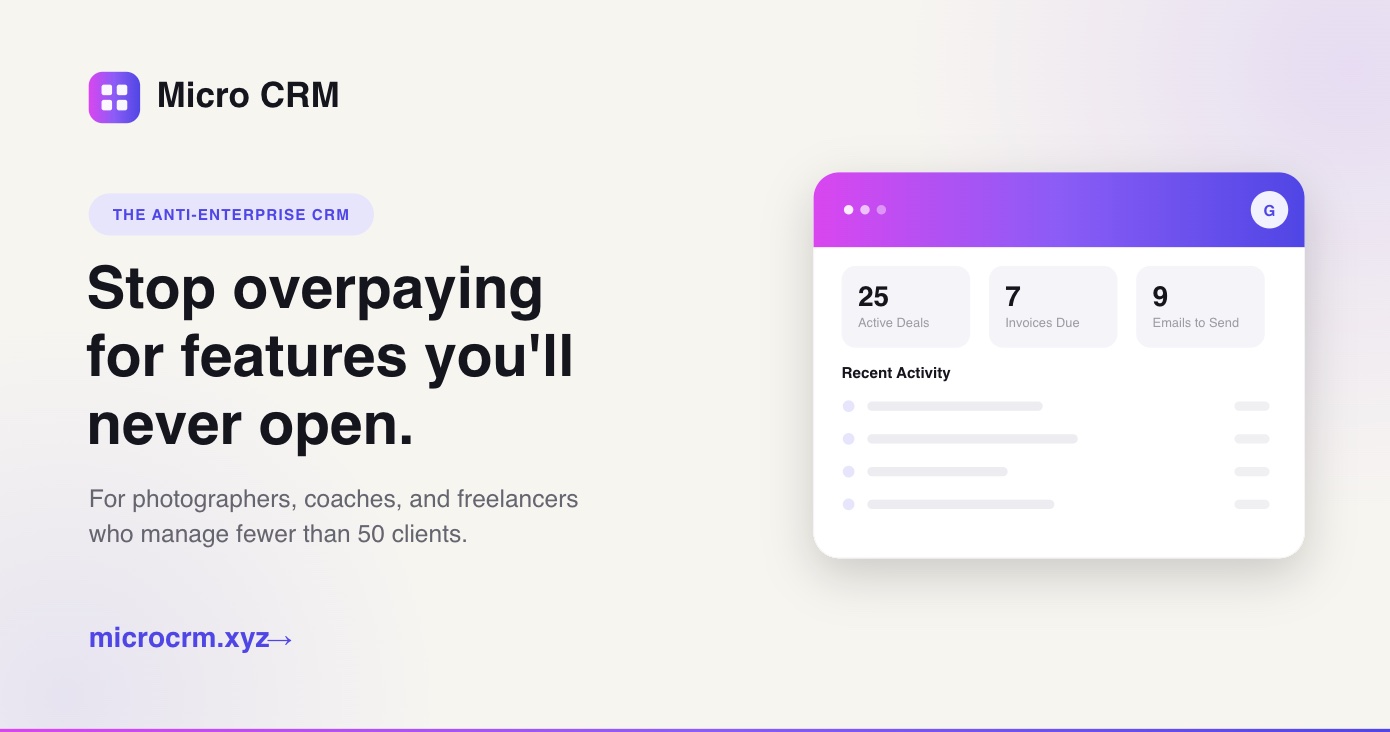
Table of Contents
- 1. Micro CRM
- 2. HubSpot CRM
- 3. Zoho CRM Free Edition
- 4. Bigin by Zoho
- 5. How to Choose the Right Free CRM and When to Upgrade
- 6. Capsule CRM
- 7. Bitrix24
- 8. Freshsales by Freshworks
- 9. EngageBay
- 10. Flowlu
- 11. Vtiger Free Pilot Edition
- Top 11 Free CRMs Comparison
- Your Next Step From Chaos to Predictable Income
1. Micro CRM
The strongest reason to look at Micro CRM first is simple, it matches how freelancers work. Most of us do not need a giant sales suite. We need one place for contacts, a clean pipeline, invoices, reminders, and a way to stop forgetting who needs a reply today. Micro CRM is built around that job, with a deliberately small feature surface and a fast setup that doesn't require training or a sales call.
It also avoids the trap a lot of free tools fall into, where the free tier looks generous but becomes awkward once you start using it seriously. Micro CRM's free plan is straightforward, with 50 contacts, 5 active deal cards, 5 invoices per month, 100 emails per month, and 1 sequence, which is enough for a very small operation that wants a real system instead of a spreadsheet replacement. The product's focus on AWS hosting, encryption, and Amazon Cognito authentication matters because a simple tool still needs to protect client data.
Why it stands out
For photographers, designers, consultants, coaches, and small agencies, the advantage is the workflow, not the dashboard. You can keep contacts, deal stages, invoicing, and follow-ups in one interface, which cuts down context switching and keeps the day moving. That matters in a market where CRM use is already mainstream, but usability still determines whether people stick with a system, not just whether they sign up for one. The broader CRM market is growing fast, with revenue projected above $88 billion in 2024 and about $131.9 billion by 2028 in one set of forecasts, according to CRM statistics from CRM.org.
Practical rule: If your business lives under 50 active clients, choose the CRM you'll open every morning, not the one with the biggest feature list.
Micro CRM's biggest trade-off is intentional minimalism. It doesn't try to win power-user contests with huge automation trees or AI gimmicks. That's a good thing if your real pain is admin overload, because a smaller surface area usually means faster adoption. If that sounds like your day-to-day reality, the free plan is worth testing on the Micro CRM website.
2. HubSpot CRM
HubSpot is usually the first name people hear, and for good reason. It's a mature free CRM with contacts, deals, tasks, forms, meeting links, live chat, and a strong documentation ecosystem, so it's easy to get moving without feeling lost. If you want a familiar all-in-one starter and don't mind a broader interface, HubSpot deserves a look. HubSpot CRM is especially useful if you want your CRM to sit inside a larger marketing and service stack.
The downside shows up fast for very small teams. HubSpot's free tier is useful, but it can feel heavy if all you really want is contact storage and a pipeline. The official comparison pages in the broader market also show tight freemium limits, which makes the upgrade path important to check before you commit your workflow to it. That's the part many freelancers miss, they sign up for convenience, then discover the free tier is built as an on-ramp, not a long-term operating system.
Where it helps and where it gets heavy
HubSpot works best if you want breadth. You can manage contacts, capture leads, and add basic marketing features without stitching together separate apps. The trade-off is complexity, because the same richness that helps a growing team can slow down a solo operator who just wants to log a lead and send an invoice.
The practical question is whether you need a marketing suite or a client manager. If you're running campaigns, forms, and chat alongside sales, HubSpot makes sense. If you're mainly keeping track of conversations, proposals, and payments, a lighter tool can be easier to live with.
HubSpot is the kind of free CRM that grows with a department. It's not always the best fit for a solo operator who just wants fewer tabs.
For a direct comparison with a simpler alternative, Micro CRM's approach is much narrower and easier to learn. If you're deciding between broad platform depth and low-friction daily use, that contrast is worth reviewing in the Micro CRM CRM comparison guide.
3. Zoho CRM Free Edition
Zoho CRM remains a strong free option if you want a classic CRM with room to grow. The free edition supports up to 3 users, and the broader market data highlights a 5,000 record ceiling on the free plan, which gives more room than many entry-level tools before you hit limits. That makes it a sensible choice for a tiny team that wants lead, contact, and deal tracking in a structured system. Zoho CRM also makes the most sense if you already know you'll live somewhere in the Zoho ecosystem.
The catch is that Zoho feels more like software built for administrators than freelancers. The interface can feel dense, and the learning curve is real if you're used to simpler apps. That doesn't make it bad, it just means the free edition is better for teams that are willing to spend some time setting things up properly.
Best for teams already in Zoho
Zoho's real strength is connected apps. If you already use other Zoho products, the free CRM can become part of a broader stack without much friction. That's useful when you want support, forms, analytics, or related tools to talk to one another without having to patch everything together.
The downside is that modern automation and more polished AI features live behind paid tiers. So if your main goal is quick daily usage, you may end up navigating more menus than you want. For a micro-business that values speed over configurability, that overhead matters.
The best use case is clear. Choose Zoho if you want a conventional CRM foundation and you're willing to trade some simplicity for ecosystem depth. If your main need is a cleaner workflow with less setup, Micro CRM is usually easier to live in.
For a broader small-business perspective, the Micro CRM guide to the best free CRM for small business is a useful companion read.
4. Bigin by Zoho
Bigin is what Zoho looks like when it gets stripped down for smaller teams. It's pipeline-first, clean, and far easier to learn than a full CRM suite. If you're a solo operator who wants deal stages and contact tracking without a lot of extra modules, Bigin is one of the most practical choices on this list. Bigin by Zoho is especially appealing when you need to move quickly.
The biggest win is simplicity. You can get a pipeline live without feeling like you need a setup checklist, and the Kanban-style workflow makes it easy to see what's moving and what's stuck. That's exactly the kind of visual management freelancers need when juggling a few clients at once.
Best for simple pipeline tracking
Bigin works well when your sales process is short and direct. New lead, conversation, proposal, close. That's where it shines. It's not trying to become your entire back office, which makes it easier to adopt than bigger systems that try to do everything at once.
The trade-off is obvious. Reporting and email features are basic on the free side, and you'll run into limits faster if you want broader automation or more advanced client management. That's fine if your goal is to replace spreadsheets, not to build a full revenue operations stack.
For service businesses, the key question is whether the CRM helps you move from inquiry to next action with less friction. Bigin does that well. Micro CRM goes a step further by putting invoicing and follow-ups into the same workspace, which often is the pain point for freelancers.
5. How to Choose the Right Free CRM and When to Upgrade
The best free CRM is not the one with the longest feature list, it's the one that fixes your current workflow without creating new work. That sounds obvious, but picking software by browsing features instead of by matching the tool to the actual job is a common mistake. If you mostly lose track of follow-ups, you need reminders and a clean pipeline. If you waste time jumping between apps, you need contact management, invoicing, and scheduling in one place.
The market data backs up that usability-first view. SLT Creative reports an average CRM adoption rate of only 26% across sectors, while top-performing sales firms are 81% more likely to use CRM consistently when the platform emphasizes ease of use over complexity, according to SLT Creative's CRM statistics. That's a strong signal that adoption matters more than feature bragging rights.
Use the free plan as a test of fit
A good free plan should answer three questions. Can you use it fast, can it support your real workflow, and will it still make sense when your client list grows?
- Start with the main job: If you need contacts and deal tracking, don't overbuy marketing tools you won't touch.
- Check the friction: If setup takes a weekend, the tool may be too heavy for a solo business.
- Inspect the limit path: A “free” CRM that becomes unusable after a few months isn't really free.
- Look at migration pain: If data export, invoicing, or email history gets messy later, you'll pay for it with admin time.
The first upgrade trigger is usually not feature hunger. It's when a free plan starts interrupting your actual work.
For small businesses, the practical cut-off often comes when a CRM can't keep your day tidy without extra tools. That's why a focused product like Micro CRM makes sense for freelancers who want to centralize the whole client flow instead of patching it together with add-ons.
6. Capsule CRM
Capsule is one of the cleanest CRMs on the market if you care more about usability than breadth. The layout is minimal, the learning curve is low, and the app keeps the focus on contacts, activity history, and tasks. Capsule CRM is a good fit when you want a simple system that doesn't fight you every time you log in.
Its free plan is intentionally small, so this is not the tool for bigger databases or growing teams. But for very small businesses, that restraint can be an advantage. You're less likely to drown in menus, and the daily work stays centered on the next action.
Best for minimal contact management
Capsule makes sense if you want to keep your client list tidy and your pipeline visible without extra clutter. You get the basics you'd expect from a lightweight CRM, and the interface stays friendly enough that you won't avoid opening it.
The trade-off is capacity and depth. Free-plan limits are tight, and advanced reporting or multiple pipelines sit behind paid tiers. That means it's good for starting small, but not ideal if you expect rapid growth or a more complex service workflow.
For freelancers, Capsule is strongest when the business is still simple. Once invoicing, follow-ups, and scheduling become part of the same daily routine, a broader but still lightweight tool can be easier to manage.
7. Bitrix24
Bitrix24 is the opposite of minimalist. It's broad, busy, and packed with work tools beyond CRM, including tasks, chat, and site-building features. If you want a free workspace that can also handle collaboration, Bitrix24 has real appeal. The free tier is unusually broad for $0, which is why it keeps showing up in comparison lists.
That breadth is useful if you run your business like a small team hub. It can pull together CRM, projects, and internal communication in one place. But that same breadth is also why it can feel overwhelming, especially if you only need client tracking and invoices.
Best for all-in-one work hubs
Bitrix24 suits teams that want one system for multiple jobs. That can be a real cost saver if you're currently paying for separate tools for task management and CRM. It also gives you enough structure to manage deals, collaboration, and basic operational work without leaving the platform constantly.
The compromise is setup time. A wide toolset takes patience, and the interface can feel like a lot when you first start using it. If you're a freelancer who wants to be productive in minutes, Bitrix24 may be too much machine for the task.
The practical test is simple. If you're looking for a work hub, it's worth considering. If you're only trying to stop spreadsheet chaos, it's probably more software than you need.
8. Freshsales by Freshworks
Freshsales is a sales-first CRM, and it behaves like one. It gives you lead capture, contact and deal management, built-in email, basic phone tools, and task management, so a small sales team can work from one place. Freshsales by Freshworks is a solid option when communication inside the CRM matters more than admin simplicity.
It's a good fit for teams that live on outreach and follow-up. The built-in communication tools reduce tool sprawl, which is exactly what you want if your current process bounces between email, call logs, and notes. The downside is that deeper automation and analytics are paid features, so the free tier is more about organization than scaling.
Best for sales-first teams
Freshsales works best when the CRM is the center of your outreach day. The Kanban view keeps deals visible, and the email and phone tools keep basic selling inside the same workflow. That makes it easier to keep momentum while you're talking to prospects.
The free plan's limits are worth respecting, though. It's useful for getting organized, not for building a sophisticated sales engine. If you need workflows, advanced reporting, or richer automation, you'll likely outgrow it.
For a freelancer, the main question is whether you need native calling. If the answer is yes, Freshsales is attractive. If not, a simpler all-in-one like Micro CRM may feel less crowded and easier to maintain.
9. EngageBay
EngageBay is a good fit when you want CRM, email marketing, and support in one place. That makes it attractive for very small businesses that don't want to stitch together a separate sales tool, newsletter tool, and helpdesk. EngageBay can be useful if your client work includes both selling and ongoing support.
The free side is broad, but the product feels more utilitarian than polished. That's not a deal-breaker, especially if your main concern is keeping costs down. It does mean the platform feels more practical than elegant.
Best for sales plus marketing
EngageBay is strongest when you're running simple campaigns and need the CRM to support the marketing side of the funnel. The combination of contacts, deals, tasks, and basic email workflows makes it versatile enough for a small operation.
The trade-off is that the platform starts to feel better once you pay. As with many free CRMs, the most useful automation and capacity are behind the upgrade wall. That's fine if you know the free tier is just a starting point, but it matters if you're trying to stay on free for a long time.
If you need one system that covers more than CRM, EngageBay belongs on the shortlist. If you want the fewest moving parts, Micro CRM is more focused.
10. Flowlu
Flowlu is one of the more interesting options for service businesses because it mixes CRM with invoicing, tasks, and project-style work. Flowlu is especially relevant if you manage clients and delivery in the same workflow, not just the sales lead that came before it. That makes it practical for agencies and consultants who want less app switching.
The experience feels sensible rather than flashy. It's built to help you move from opportunity to invoice without jumping between multiple tools, which is exactly the kind of administrative load reduction many freelancers are after.
Best for CRM plus invoicing and projects
Flowlu's strength is that it doesn't stop at the deal stage. You can keep work moving through planning, billing, and basic tracking in the same system. That can simplify the handoff between getting hired and getting paid.
The downside is that bigger automations and broader integrations are not the focus of the free tier. So while it's useful for combining workflows, it isn't trying to become a giant automation platform.
For a small studio or solo operator, Flowlu makes sense if projects and invoicing are part of the same day. If you just want a cleaner client list and follow-up system, a narrower tool may be easier to stick with.
11. Vtiger Free Pilot Edition
Vtiger has a more classic CRM feel, but that can be an advantage if you want a familiar sales process with some service tools attached. The free cloud Pilot edition is a reasonable entry point for teams that want contacts, leads, deals, tickets, and email integration in one place. Vtiger is worth a look if your business depends on follow-up discipline.
The broader market coverage also points to Vtiger as a free CRM for teams that want to follow up and close deals rather than build a minimal contact book. That focus is useful when responsiveness matters and you don't want prospects slipping through the cracks.
Best for follow-up-heavy workflows
Vtiger's appeal is workflow support. It gives you enough structure to keep prospects moving, and it includes service-style elements that can help when your business handles both sales and support.
The trade-off is that it feels heavier than the simplest tools on this list. If you want ultra-fast onboarding and a very clean interface, it may feel like more CRM than you need. If you like a classic CRM layout and expect to scale into a broader suite later, it fits better.
For freelancers who only want a few core jobs done, the question is whether the extra structure is helping or slowing them down. If speed matters more, Micro CRM stays easier to use.
Top 11 Free CRMs Comparison
| Product | Core features | UX & quality (★) | Price & value (💰) | Target audience (👥) | Unique selling points (✨) |
|---|---|---|---|---|---|
| 🏆 Micro CRM | Contacts, Kanban deals, multi‑currency invoicing (PDF+email), email sequences, calendar, reports | ★★★★☆, near‑zero learning curve, instant onboarding | 💰 Free / $14 Starter / $29 Pro / $299 LTD; pause w/ data preserved | 👥 Freelancers, coaches, photographers, solo founders, micro‑agencies (<50 clients) | ✨ Fast setup, Lifetime Deal, AWS encryption, Amazon Cognito auth, pause‑without‑data‑loss |
| HubSpot CRM | Contacts, deals, basic email & forms, meeting scheduler, chat, dashboards | ★★★★☆, mature, polished but can feel heavy | 💰 Forever Free + paid hubs; upgrades for advanced automation/reporting | 👥 Small teams wanting marketing + sales + service in one | ✨ Large ecosystem, rich docs, many integrations |
| Zoho CRM (Free Edition) | Leads, contacts, accounts, deals, tasks, standard dashboards | ★★★☆☆, powerful but dense UI | 💰 Free for up to 3 users; scalable into Zoho suite | 👥 Small businesses planning to grow into Zoho apps | ✨ Clear upgrade path into broad Zoho ecosystem |
| Bigin by Zoho | Kanban pipelines, contacts, activity tracking, basic email, mobile apps | ★★★★☆, lightweight, fast to learn | 💰 Freemium; simpler/cheaper than full Zoho CRM | 👥 Solo users & micro‑teams focused on pipelines | ✨ Pipeline‑centric, low‑friction setup |
| Capsule CRM | Contacts & organisations, sales pipeline, tasks & calendar | ★★★★☆, clean, minimal, reliable | 💰 Free limited plan; paid tiers for more storage/features | 👥 Small teams wanting a no‑bloat CRM | ✨ Minimal UI, low learning curve |
| Bitrix24 | Contacts, deals, products, quotes, tasks/projects, chat, site builder | ★★★☆☆, broad feature set; steeper setup | 💰 Very generous free plan; paid for premium channels/features | 👥 Teams wanting CRM + collaboration + site tools | ✨ All‑in‑one hub incl. telephony & site builder |
| Freshsales by Freshworks | Leads, contacts, deals, built‑in email & phone, tasks | ★★★★☆, sales‑focused, approachable UI | 💰 Free basic plan; paid for automation & analytics | 👥 Sales teams needing native email/phone features | ✨ Integrated phone/email, clear sales workflow |
| EngageBay | Contacts, deals, email campaigns, live chat, helpdesk, landing pages | ★★★☆☆, functional, utility‑focused | 💰 Generous free tier; competitive paid pricing | 👥 Small businesses wanting CRM + marketing + support | ✨ Combined CRM + email marketing + helpdesk |
| Flowlu | Contacts, opportunities, invoicing, projects, knowledge base | ★★★★☆, project‑friendly, easy navigation | 💰 Free tier; paid for higher quotas & automations | 👥 Micro‑teams needing CRM + projects + invoicing | ✨ CRM + projects + invoicing in one workspace |
| Vtiger (Free/Pilot Edition) | Contacts, leads, deals, cases/tickets, mobile apps | ★★★☆☆, classic CRM feel; more configuration | 💰 Free cloud Pilot or self‑hosted open‑source; upgrade options | 👥 Teams planning to scale into a broader suite | ✨ Option for self‑hosted open‑source flexibility |
Your Next Step From Chaos to Predictable Income
The best free CRM is the one you'll keep using. For freelancers and small businesses, that usually means choosing the tool that makes daily work simpler, not the one that promises the most enterprise features. When your contacts, deals, invoices, and follow-ups live in one place, you stop wasting time reconstructing your pipeline from memory or hunting through spreadsheets.
That's the divide in this category. Some free CRMs are broad platforms with a long upgrade path. Others are lightweight workspaces that help you stay organized without making you learn a new operating system. If your business is still small, a focused tool often wins because it gets out of the way faster.
Micro CRM fits that practical middle ground. It gives you the essentials, contacts, a Kanban pipeline, invoicing, email follow-ups, and scheduling, without the noise of a huge software suite. For solo operators and tiny teams, that usually means less admin, faster setup, and more time spent on client work.
Manage clients, deals, and invoices in one platform.
Start for free. No credit card required.
Micro CRM gives freelancers and small businesses a simple way to manage contacts, deal stages, invoices, and follow-ups without fighting a complicated interface. If you want a free CRM that's built for practical daily use, visit Micro CRM and see whether the free plan fits the way you work.