7 Cheapest CRM for Small Business: Pricing Compared
You've got one spreadsheet tab for prospects, another for active clients, a separate invoicing app, and a follow-up reminder buried under a week of emails. At first, that system feels manageable. Once client conversations, deal stages, appointments, and unpaid invoices multiply, it starts costing attention.
The right cheapest CRM for small business isn't necessarily the platform with the lowest advertised price. It's the tool that gives you enough free-plan headroom and core workflow coverage without forcing you into unused features, per-seat charges, or a painful migration later. This roundup compares seven low-cost CRM options by free-plan limits, entry pricing, user capacity, and contact headroom. Micro CRM is included for freelancers and micro-businesses that want a simple pipeline, invoicing, and follow-ups without setup overhead.
Table of Contents
- 1. Micro CRM
- 2. HubSpot CRM
- 3. Bigin by Zoho CRM
- 4. Freshsales
- 5. Bitrix24
- 6. Capsule CRM
- 7. EngageBay
- Top 7 Cheapest CRMs for Small Business
- Choosing the Cheapest CRM for Your Client Load
1. Micro CRM
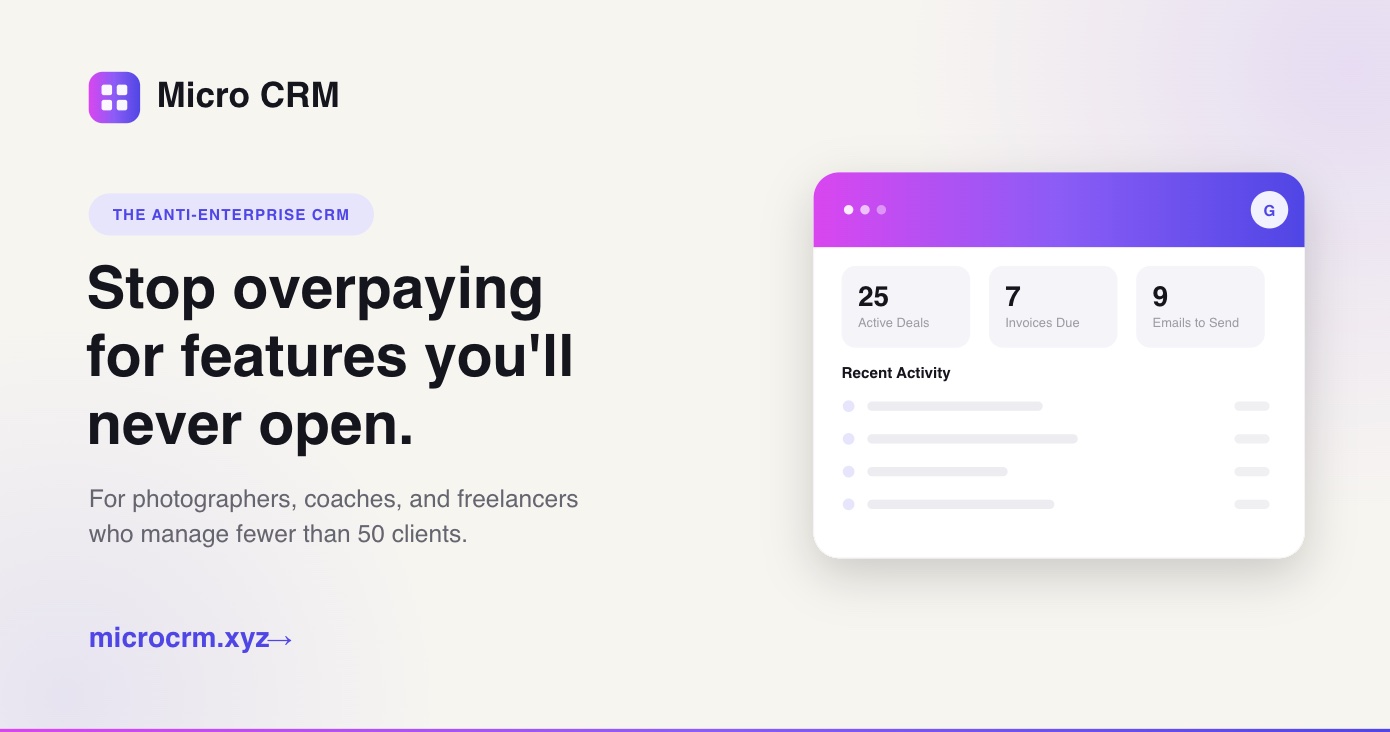
Micro CRM is the strongest fit here for a freelancer who wants a CRM rather than another sprawling business suite. It brings contacts, a visual Kanban pipeline, invoices, email follow-ups, appointment scheduling, and revenue activity reports into one interface.
The Free plan includes 50 contacts, 5 active deals, 5 invoices per month, 100 emails per month, and 1 follow-up sequence, with no credit card required. The Starter plan costs $14 per month when billed annually and raises capacity to 1,000 contacts, unlimited active deals and invoices, 3,000 emails per month, 10 sequences, and calendar functionality. Pro costs $29 per month when billed annually, while the limited-time Lifetime Deal costs $299 once.
What works well
Setup is deliberately light. You can sign up in seconds, add a contact, drag a deal through the Kanban stages, create a PDF invoice, and send a follow-up without an onboarding call or a long configuration project. PDF invoices support multi-currency, and email templates and sequences reduce the chance that a promising lead disappears in your inbox.
The product also handles practical account concerns. Data is stored on AWS, encrypted at rest and in transit, and protected with Amazon Cognito authentication. You can pause an account for up to 6 months while preserving its data, which is useful for seasonal freelancers.
Practical rule: Choose a CRM you'll update after every meaningful client interaction, not one that looks impressive during a demo.
The trade-off is scope. Micro CRM doesn't target power users who need advanced automation, AI features, or deep enterprise integrations. Lower tiers also restrict calendar and reporting access, and CSV import remains on the roadmap. For a photographer, designer, coach, consultant, or solo operator managing fewer than roughly 50 active clients, that restraint is often an advantage rather than a limitation.
Want to better organize your clients and business opportunities?
2. HubSpot CRM
HubSpot CRM is the obvious choice if you want a well-known platform with a substantial free starting point and a broad upgrade path. Its free CRM covers contact and company records, deal tracking, simple pipelines, basic dashboards, and import tools.
The appeal is immediate familiarity. Tutorials, templates, and a large user community make it easier to find answers when you're setting up fields, importing contacts, or building a basic sales process. If your business already uses HubSpot's marketing or service tools, keeping customer data in the same ecosystem can also reduce app switching.
Where the free plan stops
HubSpot's free tier is useful for core relationship tracking, but the interface advertises capabilities you may not be able to use without a paid hub. Marketing, automation, reporting depth, and other advanced tools become part of a more complicated upgrade conversation. Paid tiers also introduce per-seat pricing, so the total cost changes as more people need access.
That makes HubSpot a good fit for a business that values ecosystem breadth and expects to expand into more advanced sales or marketing operations. It's less attractive when you only need contacts, a small pipeline, invoices, and reminders.
For a more focused alternative, compare lightweight CRM options for small businesses before importing your entire client database. Migration is easiest before you've built years of notes, custom fields, and disconnected workarounds.
3. Bigin by Zoho CRM
Bigin by Zoho CRM strips Zoho's larger CRM down to the workflows small businesses tend to use most. It offers visual pipelines, contacts and companies, basic dashboards, email and WhatsApp integrations, web forms, booking links, and connections to the wider Zoho ecosystem.
Its free plan is limited to 1 user and 500 records, so it's primarily a solo-user starting point. That limit may be enough for a freelancer with a small client book, but it's a poor match if you're importing a large prospect list or need a collaborator to work inside the system.
The paid-value argument
Bigin becomes more interesting when you're willing to pay a small recurring fee but don't want a full enterprise CRM. Paid plans offer generous record limits and a clear route into Zoho CRM if your sales process becomes more complex. Integrations with Zoho products and tools such as QuickBooks can also make the platform more useful for businesses already invested in that ecosystem.
The trade-off is that some integrations and advanced automation require higher tiers or add-ons. You may also spend more time learning the wider Zoho environment than you would with a deliberately narrow CRM.
Choose Bigin when your priority is a low-cost sales pipeline with room to grow into Zoho. Avoid it if invoicing, scheduling, and follow-up communication must live in one especially simple workspace from day one.
4. Freshsales
Freshsales works best for a small sales operation that wants contact, deal, and activity tracking with communication features close at hand. The free plan supports up to 3 users, making it practical for a founder working with a couple of collaborators.
The core workflow is straightforward. You can manage contacts and deals, create tasks and notes, track email activity, and use a simple pipeline. In-product calling and chat options vary by plan, so check the current feature comparison before assuming the free tier includes every communication feature you need.
A capable free starting point
Freshsales is stronger than many free CRMs for a small sales team because you don't have to pay immediately just to give several people access. The upgrade path is clear, with Growth, Pro, and Enterprise tiers for businesses that need more capacity.
The limitations matter. The free plan supports only up to three users, and custom fields are limited to 5 per module. That's enough for a clean sales process, but not for a heavily customized database with separate logic for every service line.
Teams that need a straightforward sales CRM should consider it carefully. Freelancers who also need invoices and appointment scheduling may prefer a more integrated tool. For a broader usability comparison, see this guide to the easiest CRM to use.
5. Bitrix24
Bitrix24 combines CRM with tasks, Kanban boards, calendars, chat, video, website tools, and collaboration features. If you're trying to replace several subscriptions with one workspace, its free cloud plan gives you a lot to test before paying.
The free plan includes core contact and deal management plus 5 GB of storage. Paid tiers use flat organizational pricing rather than charging for every seat, which can become attractive when several people need access. That pricing model is fundamentally different from a conventional per-user CRM.
Broad coverage, heavier handling
Bitrix24 is useful when the CRM must connect closely to project delivery. A small agency could track a deal, assign follow-up tasks, coordinate internal work, and keep team communication nearby. You're not limited to a narrow sales database.
The downside is configuration weight. A solo consultant who only needs contacts, a few deal stages, and invoice reminders may find the interface crowded with tools that don't contribute to daily work. The free accounts are also auto-deleted after 50 days of inactivity, so an account owner should log in regularly and maintain exports or backups where appropriate.
The lowest subscription price can still be expensive if the team avoids using the system because it feels like an internal operating platform rather than a simple CRM.
Bitrix24 makes sense for a collaborative team that wants an all-in-one workspace. It's less suitable for a freelancer looking for near-zero setup and a focused client view.
6. Capsule CRM
Capsule CRM takes a leaner approach. It focuses on contacts, tasks, opportunities, a visual pipeline, and calendar-related work, with project support alongside its CRM features.
The free plan includes 250 contacts, 5 custom fields, and 50 MB of storage. Those limits are easy to understand, which helps a small business estimate whether the free tier will last. The clean interface also reduces the setup burden for someone moving from a spreadsheet.
A good fit for simple relationship tracking
Capsule is particularly comfortable for an individual or micro-business with a modest client list. You can create contact records, assign tasks, move opportunities through stages, and keep the system centered on the next action rather than a large collection of dashboards.
Paid plans add integrations such as Xero, QuickBooks, Gmail, and Outlook, along with more reporting and customization. That creates a predictable upgrade route, but it also means billing workflows may remain outside the free CRM.
Capsule is a sensible pick when contact organization and pipeline clarity matter more than built-in invoicing or email sequences. If you want invoices, follow-up sequences, scheduling, and deal tracking under one roof, compare its lighter CRM model with Micro CRM before deciding.
7. EngageBay
EngageBay combines CRM, marketing, live chat, and helpdesk features. Its free plan supports up to 15 users with no credit card required, which gives it the largest team headroom in this list.
That capacity is useful for a small agency or service team that needs several people to view prospects and customer conversations. The platform includes pipelines, email templates and sequences, forms, landing pages, live chat, helpdesk tools, and integrations with Zapier, SendGrid, Mailgun, Stripe, and QuickBooks.
Team capacity versus contact capacity
The important trade-off is the contact limit. The free plan supports 250 contacts, so a team can have plenty of user access while still reaching the database ceiling quickly if it runs active lead generation. Advanced automation, reporting, and higher contact limits require paid tiers.
EngageBay works when marketing and support are as important as sales tracking. A business that wants one dashboard for lead capture, email communication, chat, and tickets may get more value from its breadth than from a minimalist CRM.
For a freelancer with a small set of active clients, the wider feature set may add unnecessary navigation. For a larger low-budget team, it can be more practical. Compare the real cost of CRM pricing, including contacts, seats, automation, and the work required to maintain the platform.
Top 7 Cheapest CRMs for Small Business
| Product | Implementation Complexity 🔄 | Resource Requirements ⚡ | Expected Outcomes 📊 | Ideal Use Cases 💡 | Key Advantages ⭐ |
|---|---|---|---|---|---|
| Micro CRM | 🔄 Very low, set up in minutes; minimal learning curve | ⚡ Minimal, free tier + affordable plans; lightweight hosting (AWS) | 📊 Consolidated contacts, invoices, email sequences; saves time | 💡 Freelancers & solo entrepreneurs with ~<50 active clients | ⭐ Simplicity, unified workflows, transparent pricing, pauseable accounts |
| HubSpot CRM | 🔄 Low, simple onboarding with many resources | ⚡ Low entry (forever free); costs increase with paid hubs & per‑seat | 📊 Reliable core CRM now, easy to scale to advanced hubs | 💡 Teams wanting a free core CRM with upgrade path | ⭐ Robust free tier, large ecosystem, easy imports/templates |
| Bigin (Zoho) | 🔄 Low, focused feature set, easy pipelines | ⚡ Very low paid entry; free solo plan with limits | 📊 Essential sales workflows with clear upgrade path to Zoho CRM | 💡 Small businesses needing low‑cost CRM and Zoho integrations | ⭐ Affordable entry, Zoho ecosystem integrations, generous paid limits |
| Freshsales (Freshworks) | 🔄 Low, approachable UI, modest setup | ⚡ Free for up to 3 users; paid tiers for advanced features | 📊 Good no‑cost collaboration for small sales teams | 💡 Founder + a couple collaborators or small sales teams | ⭐ Capable free tier, clear tier progression |
| Bitrix24 | 🔄 Medium, broad feature set can feel heavy to configure | ⚡ Flat org pricing; free cloud plan with 5 GB storage | 📊 Consolidates CRM, tasks, chat and site tools into one workspace | 💡 Teams wanting to replace multiple tools with a single platform | ⭐ Rich free plan, flat pricing can be cost‑effective at scale |
| Capsule CRM | 🔄 Very low, lean UI, quick to adopt | ⚡ Low resource needs; free plan limited (250 contacts) | 📊 Simple contact & pipeline tracking with low friction | 💡 Individuals and micro‑businesses needing lightweight CRM | ⭐ Easy start, predictable upgrades, clean UI |
| EngageBay | 🔄 Medium, multiple modules (CRM, marketing, helpdesk) to configure | ⚡ Generous free plan (up to 15 users); paid tiers for advanced limits | 📊 CRM plus marketing/support consolidation for mid‑small teams | 💡 Small teams needing CRM + email, chat and helpdesk together | ⭐ Large free user allowance, competitive upgrade pricing |
Choosing the Cheapest CRM for Your Client Load
Start with client count and team size, not the feature list. A solo freelancer with fewer than 50 active clients can often begin with a free tier, while a team that needs several seats should compare user limits and pricing models before committing. Contact capacity matters just as much as seat capacity. EngageBay allows up to 15 users on its free plan, for example, but its contact limit can become the more immediate constraint.
The free tier should also cover the workflow you repeat on a regular basis. If you only need contact records and deal stages, Capsule, Freshsales, HubSpot, or Bigin may be enough. If you need marketing and support in the same workspace, EngageBay or Bitrix24 offers broader coverage. If you already rely on Zoho tools, Bigin's ecosystem may outweigh its one-user free limit.
Price alone can hide the cost of fragmented work. A 2023 survey of U.S. entrepreneurs found that administrative work took 36% of a 45.5-hour workweek, approximately 16 hours, including invoicing, expense logging, data entry, and chasing unpaid money (Time etc. survey summary). A CRM that keeps contacts, deals, invoices, emails, and appointments together can be cheaper in practice than a free contact database surrounded by separate tools.
Micro CRM suits freelancers and small businesses that want those core workflows in one simple interface. Its Free plan gives you 50 contacts, 5 active deals, 5 invoices per month, 100 emails per month, and 1 follow-up sequence, with no credit card required. Manage clients, deals, and invoices in one platform. Start for free at Micro CRM. No credit card required.
Micro CRM combines contacts, a Kanban pipeline, PDF and multi-currency invoicing, email follow-ups, and scheduling without the overhead of a complex CRM. If you want a practical low-cost starting point for your client load, visit Micro CRM and start free with no credit card required.