
Client Management App Guide for Freelancers and Small Teams
You're halfway through a client project when you realize the proposal is still sitting in an inbox, last Thursday's invoice hasn't been sent, and the next appointment conflicts with a calendar event you forgot to move. The information exists, but it's scattered across spreadsheets, email threads, calendar entries, notes, and messaging apps.
That's the workflow problem a client management app should solve. It isn't about collecting the longest feature list. It's about giving contacts, deals, invoices, appointments, and follow-ups one reliable home, so you can run the business instead of reconstructing it every morning.
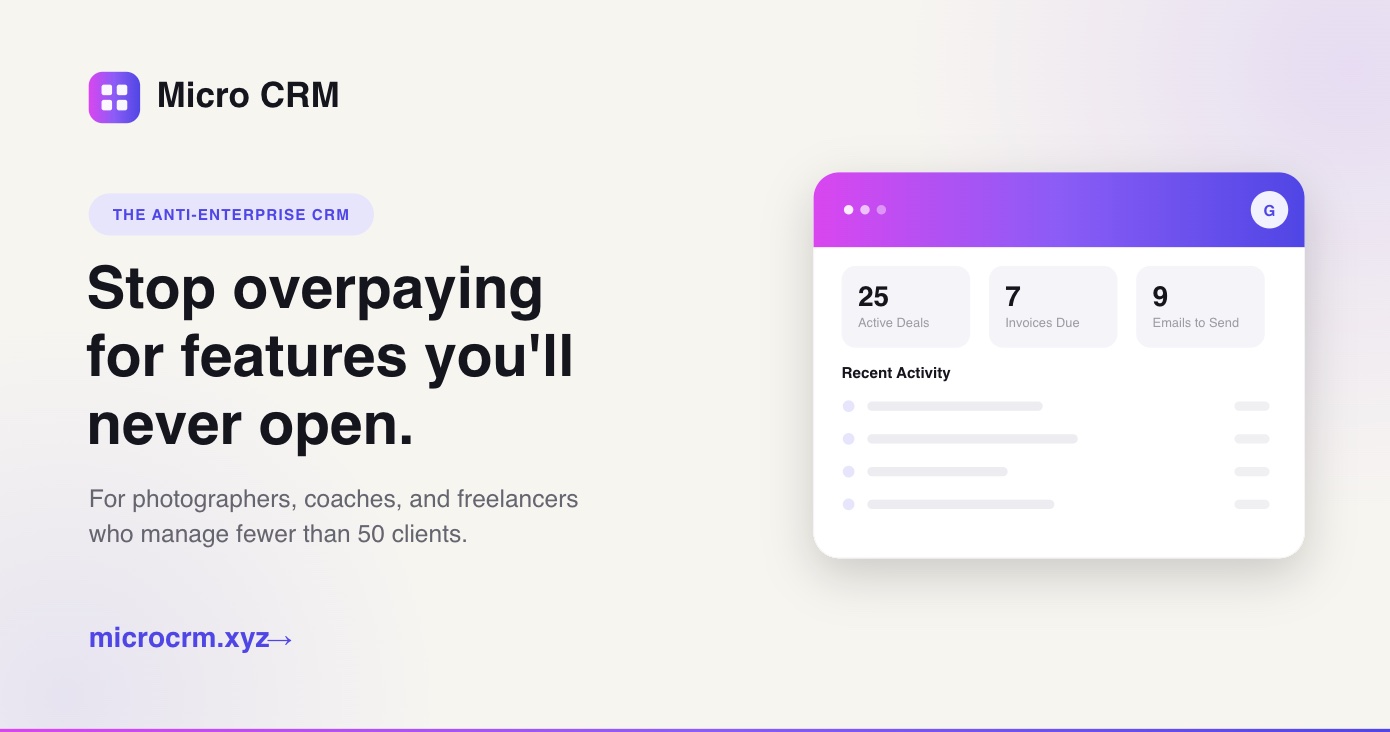
Table of Contents
- The Spreadsheet Trap Most Freelancers Start In
- What a Client Management App Actually Does
- Core Features That Matter for Freelancers and Small Businesses
- Client Management App vs Spreadsheets vs Enterprise CRMs
- How to Choose the Right Client Management App
- Migrating From Spreadsheets Without Losing Your Mind
- Simplifying Your Stack and Getting Started
The Spreadsheet Trap Most Freelancers Start In
On Tuesday morning, a freelance designer opens a Google Sheet in Chrome to check which prospects need proposals. Three email tabs are already running. A calendar invitation overlaps with a Slack message from a subcontractor, and a sticky note says to invoice a client from last Thursday.
The client information is spread across at least seven places: the spreadsheet, email inbox, calendar, Slack, proposal documents, accounting software, and handwritten notes. None of those tools is bad. The problem is that each stores only part of the relationship, while the freelancer has to remember how the pieces fit together.
A spreadsheet can show a project status, but it won't reliably remind you why a lead is stalled. An inbox contains the conversation, but not necessarily the invoice status. A calendar shows the meeting, but not the unpaid proposal connected to it. A sticky note depends entirely on being noticed at the right time.
Operational rule: If you need memory to connect the tools, the workflow is already fragile.
The cost is measured in attention before it appears on a profit-and-loss statement. A freelancer may lose roughly four hours a week stitching context together, but the more serious damage is silent: follow-ups slip, invoices arrive late, and promising opportunities disappear without a clear failure point.
A client management app creates a single source of truth. Instead of asking where a detail lives, you open the client record and see the contact, deal stage, notes, billing activity, and next action together. That consolidation matters even more as CRM adoption becomes mainstream among small businesses, with 2026 summaries reporting adoption around 71% to 74% among small businesses according to CRM adoption statistics for small businesses.
What a Client Management App Actually Does
A client management app is lightweight operational software for managing the relationship from first inquiry through payment and continued follow-up. It combines a searchable contact record with deal tracking, invoicing, scheduled reminders, and often email and calendar functions in one workspace accessible across devices.
That makes it different from a contact manager. An address book stores names, phone numbers, and email addresses. It doesn't tell you whether a prospect received the proposal, whether a project is ready to bill, or when you promised to follow up.
A spreadsheet workaround goes further, but it makes you build the operating system yourself. You create columns for pipeline stages, formulas for totals, filters for overdue work, and manual reminders for every next step. The file can work for a while, but every new exception creates another rule someone has to maintain.
The four jobs the app must handle
Capture inquiries. Add a new lead with the relevant contact details and the context of the request before it disappears into an inbox.
Move opportunities through a pipeline. Use clear stages such as inquiry, proposal, approved, active, and complete. A visual Kanban board makes stalled work visible without requiring a report.
Connect billing to the deal. Create and send an invoice from the same client context, then track whether payment is pending or complete.
Schedule the next action. Set a reminder or automated email sequence so follow-up depends on a workflow, not on remembering a promise made during a call.
The category prioritizes speed, clarity, and daily adoption over enterprise customization. For a solo consultant or small creative studio, a tool that opens quickly and answers “what needs attention today?” is more useful than a platform that requires extensive configuration before anyone can use it.
Core Features That Matter for Freelancers and Small Businesses
Choose features by the daily problem they remove, not by the length of the product page. If a tool does not reduce duplicate entry, missed follow-ups, invoice delays, or uncertainty about deal status, leave it out of the day-one setup.
Start with the essentials
A unified contact record should keep a person's email, phone number, company details, notes, and interaction history together. That ends the routine of searching old email threads before every call and gives anyone handling the account the same context.
A visual pipeline should show proposals and active projects by stage. Moving a deal from proposal to approved is easier to maintain than updating several spreadsheet columns, particularly when work continues between meetings. The board should make stalled opportunities visible without requiring a separate report.
Invoice work belongs beside the client and deal record. SMBs spend an average of 14.4 hours per month manually processing invoices, while 27% report that creating and sending an invoice takes more than a week, according to SMB invoicing research. Invoice creation, PDF generation, email delivery, and payment status should stay in one workflow, rather than creating another administrative queue.
Follow-up automation addresses a different leak. A survey reported that 92% of sales managers say their teams lose qualified leads each month because follow-ups are delayed, inconsistent, or forgotten, as described in Zapier's dropped-leads survey. For a freelancer, a reliable reminder after a proposal is often more valuable than an impressive dashboard.
Feature Tiers for Freelancers and Small Teams
| Feature | Friction Point It Solves | Worth It From |
|---|---|---|
| Contact record and search | Scattered details and duplicate data entry | Day one |
| Kanban deal pipeline | Unclear proposal and project status | Day one |
| Invoicing and payment status | Late bills and manual invoice tracking | Day one |
| Email templates and follow-ups | Forgotten outreach | Day one |
| Tags and saved views | Repeating the same filtering work | As recurring workflows develop |
| Basic revenue and activity reporting | Limited visibility into business health | When decisions need regular review |
| Calendar and email integrations | Switching between scheduling and client records | When the existing stack creates duplication |
| Territory management and custom object builders | Enterprise governance requirements | Rarely at freelance scale |
For a practical example of this workflow in a freelancer-focused setup, read this CRM guidance for freelancers.
Add the second tier only after recurring work justifies it. Tags can separate retainers from one-off projects, saved views can isolate overdue invoices, and basic reporting can show which deals or services need attention. Complex role hierarchies, AI-driven lead scoring, territory management, and custom object builders usually add administration without helping a small operator close work or collect payment.
If you want to test whether this workflow fits your daily routine, you can start with a free account at MicroCRM.
Client Management App vs Spreadsheets vs Enterprise CRMs
Most freelancers choose among three approaches. They keep a spreadsheet, adopt a purpose-built client management app, or buy into a large CRM such as Salesforce or HubSpot.
The spreadsheet is familiar and flexible. It's also a blank canvas, so the owner must define stages, formulas, reminders, and conventions. A purpose-built app costs less in attention because those workflows already exist. An enterprise CRM offers deeper customization and reporting, but its configuration burden can become the new problem.
| Option | Monthly Cost | Setup Time | Learning Curve | Best Fit |
|---|---|---|---|---|
| Spreadsheet setup | Often no separate software cost | Immediate file creation, ongoing configuration | Low at first, rising with complexity | Simple lists and occasional tracking |
| Purpose-built client management app | Free plans or transparent paid plans vary by product | Same-day start for focused tools | Low | Freelancers and small teams with modest client volumes |
| Enterprise CRM | Pricing and add-ons vary by platform and plan | Requires process design and configuration | High | Larger sales teams needing governance and reporting |
Cost isn't only the subscription. A spreadsheet consumes time through reconciliation. An enterprise CRM consumes time through setup, training, maintenance, and fields nobody uses. A lightweight tool can justify itself when it prevents a missed invoice or replaces repeated manual follow-up work.
The global CRM software market is projected to grow from USD 112.91 billion in 2025 to USD 320.99 billion by 2034, with a projected 12.40% compound annual growth rate from 2026 to 2034, based on CRM market estimates. That expansion reflects broad demand, but it doesn't mean every small business needs enterprise software.
Enterprise overhead becomes easier to justify when several simultaneous users need shared reporting, permissions, formal handoffs, and sales-team forecasting. For a freelancer managing fewer than fifty active contacts, those capabilities often create more administration than value. CRM alternatives for small businesses can help you compare lighter approaches before committing.
How to Choose the Right Client Management App
Choose from your workflow outward, not from a vendor's feature page. Start with three facts: your current active client count, your billing model, and the tools already handling email, calendars, payments, and accounting.
Use the following checklist and score each option based on whether it removes a real daily obstacle.
Contact and deal storage
Can you search a client quickly and see the connected opportunity, notes, and status? If contact details sit in one tool and deal context sits in another, you'll keep rebuilding the same history.
Micro CRM provides contact management, search, tags, interaction history, and a visual deal pipeline. This covers the basic record and the commercial context without requiring a custom data model.
Pipeline visibility
A pipeline should answer three questions immediately: what is new, what is waiting, and what is moving toward completion. Kanban stages are usually enough for a small service business, especially when each stage reflects a real client milestone.
Micro CRM includes a visual Kanban pipeline with drag-and-drop stages and deal visibility. Don't add stages for information you won't act on.
Invoicing and payment status
Review the invoice workflow from creation through sending and payment tracking. A tool that only stores a client name but still makes you prepare every invoice elsewhere hasn't consolidated the work.
Micro CRM supports professional invoice creation, PDF generation, email sending, multi-currency invoicing, and payment status tracking. This directly addresses the manual burden documented in the SMB invoicing report, which should be cited only once in the decision process.
Follow-up reminders
Look for email templates, variables, scheduled reminders, and automated sequences. The point isn't to automate every conversation. It's to stop routine follow-up from competing with client delivery.
Micro CRM includes an email composer, templates, variable placeholders, and automated follow-up sequences. For security-sensitive implementations, managed identity matters. AWS Cognito's data protection documentation describes encryption at rest, searchable encryption for key profile attributes, and TLS requirements for network transport.
Mobile access and integrations
Check whether you can update a deal after a meeting and whether the app fits your existing email, calendar, payment, and accounting tools. Integration breadth is useful only when it eliminates duplicate entry rather than adding another maintenance project.
Pricing transparency
A free plan should let you test the daily workflow, not merely view a demo. Micro CRM offers Free, Starter, Pro, and a limited-time Lifetime Deal, with limits varying by plan for contacts, deals, email, and sequences. It also offers account pausing with data preserved and no billing, which is useful for seasonal businesses.

For a fuller decision framework, use this guide to choosing a CRM. If you manage under one hundred active clients, bill using fewer than three billing approaches, and need to start the same day, a lightweight tool is the sensible choice. Defer heavier software until your users, reporting requirements, or process complexity genuinely exceed it.
Migrating From Spreadsheets Without Losing Your Mind
Don't import every row just because you can. The common migration mistake is bringing over years of incomplete notes, duplicate contacts, and dead opportunities, then deciding the new app is cluttered before the workflow has had a fair test.
Use a two-week migration that protects current client responsiveness.
Days one through three, audit and clean. Export the spreadsheet, create a backup, remove duplicate contacts, normalize names and email addresses, and identify missing ownership or status fields.
Days four through six, import the working set. Start with active clients, outstanding invoices, and upcoming deadlines. Add the cleaned contacts, then assign pipeline stages that match the way you sell and deliver work.
Days seven through nine, automate one sequence. Choose stalled leads or proposal follow-ups. Build the smallest useful reminder sequence, review its wording, and test it with an internal record before using it with a real prospect.
Days ten through twelve, run both systems in parallel. Continue checking the spreadsheet while entering new activity in the app. Compare active deals, invoice status, and deadlines each day.
Days thirteen and fourteen, retire the sheet. Archive the old file, establish a weekly review, and make the new app the place where every new client action gets recorded.

Defer historical notes and archived deals until the active workflow works. A clean partial import beats a complete but unusable database. Consistency matters more than volume, because the app only protects follow-ups and billing when you keep it current.
Watch the migration process in practice:
Simplifying Your Stack and Getting Started
A freelancer doesn't need five disconnected tools to manage a client relationship. One workspace for contacts, deals, invoices, email follow-ups, and scheduling reduces tab switching and makes the next action visible.
The fear of migration is reasonable. Client history, payment records, and calendar links feel too important to risk. A phased import solves that problem: bring in active clients first, validate the workflow, and move archived projects only after the daily process is stable.

Start with the free tier, import one spreadsheet column at a time, and let built-in reminders replace the manual calendar blocks you created to compensate for a missing system. Complexity is the enemy of consistency. A focused tool you open every day beats a feature-rich platform you avoid after the second week.
MicroCRM brings contacts, pipeline tracking, invoicing, email sequences, appointment scheduling, and reporting into one interface. Create the account, import your first ten active clients, and let the first automated reminder demonstrate the value before you migrate anything else.
Manage clients, deals, and invoices in one platform with Micro CRM's focused workspace for contacts, pipeline tracking, invoicing, email follow-ups, and scheduling. Visit Micro CRM to start for free, with no credit card required.