
Free CRM Software: Your 2026 Guide to Smart Picks
You probably know the pattern already. Client names live in a spreadsheet, follow-ups sit buried in your inbox, and invoices get rebuilt from scratch because the last version is somewhere on your desktop. That's not a discipline problem. It's a workflow problem, and free CRM software is usually the first practical fix.
If you're still juggling sticky notes and half-finished email threads, this guide will save you time. It covers what a free CRM can do, where the limits are, and how to choose a tool that helps you work instead of creating another admin job.
Table of Contents
- Why Freelancers and Small Teams Need a Better System
- What Free CRM Software Actually Is
- Essential Features to Expect from a Free Plan
- Real Limitations of Free CRM Plans
- How to Evaluate and Choose the Right Free CRM
- Why MicroCRM Is the Smart Starting Point
- Getting Started with Your Free CRM Today
Why Freelancers and Small Teams Need a Better System
A freelance designer opens her laptop on Monday and finds three client threads marked unread, two invoices needing revision, and a lead she meant to follow up with last week. She doesn't need more effort. She needs a single place where the client, the deal, the invoice, and the next action all live together.
That's the main reason people start looking for free CRM software. It isn't about buying “more software.” It's about stopping the constant switching between spreadsheets, inboxes, and calendar tabs. A unified workspace cuts the number of times you have to ask yourself, “Where did I put that?”
The basic business case is already mainstream. Industry statistics compiled in 2026 show that 91% of companies with 11 or more employees use CRM software, and 74% of U.S. businesses report having a CRM system in place, which tells you this is standard operating infrastructure, not a fancy extra. The same set says CRM delivers an average return of $8.71 for every $1 invested, and 97% of CRM-using businesses met or exceeded their sales goals in the past year, which helps explain why even small teams often start with a free tier before they pay for scale. See the CRM market context in these 2026 CRM statistics.
For freelancers and small agencies, the point is simpler than the statistics. A clean system protects your time, your follow-up cadence, and your cash flow. If you want a practical example of that shift, this guide on CRM for freelancers shows why the spreadsheet model breaks down fast.
Practical rule: if you handle more than a handful of active clients, your system should show you who they are, what stage they're in, and what happens next without opening three different apps.
What Free CRM Software Actually Is

A free CRM is a customer management system you can start using without paying upfront. In plain English, it gives you one organized place for contacts, deals, follow-ups, and basic reporting, instead of making you patch together spreadsheets and inbox searches. Think of it as a filing cabinet with a pipeline view, not a pile of sticky notes.
The useful version of free CRM software is narrow on purpose. Independent guides consistently describe the core value as centralizing contact and deal management, task reminders, and lightweight reporting in one place rather than spreading work across disconnected tools, which is exactly why these systems feel so much calmer than Excel when you're handling live client work. Gestisoft's free CRM overview makes that essentials-first model very clear.
Who it fits
Free CRM software makes sense for freelancers, independent designers, coaches, consultants, and small agencies with a modest client load. If your day revolves around client conversations, proposals, follow-ups, and scheduled calls, a simple CRM keeps the process visible. If you're running a larger sales operation with heavier automation needs, free plans usually won't be enough.
The market is built around that trade-off. In 2026, major free plans typically cap usage at very small team sizes, with examples like 2 users and 1,000 contacts on one platform or 3 users and 5,000 records on another, so the free tier is clearly aimed at early-stage teams. Review coverage also points to common allowances such as 2,000 marketing emails or 5,000 branded emails, along with deal pipelines, scheduling, and task tracking. That's why the best mental model is simple, a free CRM is a starter operating system, not an enterprise suite. See the plan patterns in this free CRM market review.
A free CRM should reduce admin work on day one. If it needs a long setup session before it's useful, it's already costing you time.
Essential Features to Expect from a Free Plan

A free plan should cover the basics without making you work around the tool. If it doesn't, it's not a CRM for a freelancer or small agency, it's a demo with a login.
The minimum viable set
The core feature set is consistent across solid free CRM systems. Independent reviews point to contact management, deal or pipeline tracking, task and calendar support, email integration, and basic reporting as the floor. NetSuite's CRM requirements overview backs that up by framing the minimum useful CRM around contact records, pipeline stages, reminders, and email activity in one workspace.
Here's why each one matters in daily work:
- Contact management: You need search, notes, and interaction history so you can open one record and know what happened last time.
- Visual pipelines: A Kanban board shows the next move. Dragging a deal forward is faster than editing a spreadsheet status cell.
- Tasks and reminders: Follow-up work disappears fast unless the CRM keeps it visible.
- Email integration: Logging conversations from inside the CRM prevents information from getting trapped in your inbox.
- Basic reporting: You need a simple view of deals, revenue, and activity, not a dashboard full of metrics you'll never check.
The point is not feature count. The point is reducing context switching. A contact record that shows the last email, the next meeting, and the current deal stage saves more time than a long menu of tools you don't use. That's why a lightweight system can outperform a flashy one for a small client list.
Good CRM design for micro-businesses: capture the touchpoint once, show it everywhere it matters, and keep the reporting short enough that you'll actually read it.
Real Limitations of Free CRM Plans

Free CRM plans are useful, but they're not magic. The best way to avoid regret is to accept the limits before you build your workflow around them.
Where free plans hit the wall
The common constraints are predictable. Free tiers are usually capped at 2 to 5 users, roughly 500 to 5,000 records, and storage somewhere between 200MB and 5GB. Independent guidance also says advanced automation is often missing, including multi-step workflows and automatic task creation, while free tiers commonly leave advanced reporting and customization behind. See the plan-limit patterns in this free CRM selection guide.
That matters in real operations. Attachment-heavy invoicing, PDFs, and image files can burn through storage quickly, and once that happens, the free tier stops feeling free. The same problem shows up when a small team adds a third user and discovers the free seat cap isn't flexible.
HubSpot's free CRM is a clear example of the trade-off. It's described as having a 1,000-contact cap, a 2-user limit, and no automated workflows, while Zoho's free edition supports up to 3 users and includes leads, deals, contacts, tasks, events, and some Zoho integrations. Those examples prove the point: “free” is usually a controlled starter package, not a scaled system. See the comparison in this HubSpot and Zoho free CRM review.
For a small business, the risk isn't just losing a feature. It's losing continuity when the plan gets outgrown. If you care about what happens to your records when you switch tools, read customer data protection and CRM continuity before you commit.
How to Evaluate and Choose the Right Free CRM
Start with your daily workflow, not the product page. Free CRM tools usually look generous until you try to run real work through them every day.
Use a short checklist
Choose the tool that makes your actual work easier. Test setup time, daily speed, and what happens if you need to leave before you think about advanced extras.
- Setup speed: Can you import contacts and see a usable pipeline in minutes, or does the first setup turn into a long project?
- Learning curve: Will your team use it without training sessions or constant hand-holding?
- Export and portability: Can you get your data out cleanly if you switch tools?
- Plan continuity: What happens when you pause, downgrade, or outgrow the free tier?
- Workflow fit: Does it match the way you already sell, follow up, and invoice, or does it force a new process?
The contrarian truth is simple. For a micro-business, the best free CRM often has the fewest features. Every extra module adds setup work, maintenance work, and more chances for the team to ignore the system. A stripped-down tool usually wins because someone will open it every day.
Choose friction over flash. A simple CRM that your team uses consistently beats a feature-heavy platform you keep postponing because setup feels like a second job. If you want a fast test run, visit MicroCRM and see whether a smaller tool fits your workflow better than an all-in-one stack.
Don't optimize for what the software can theoretically do. Optimize for what you'll keep using after the first busy week.
Why MicroCRM Is the Smart Starting Point
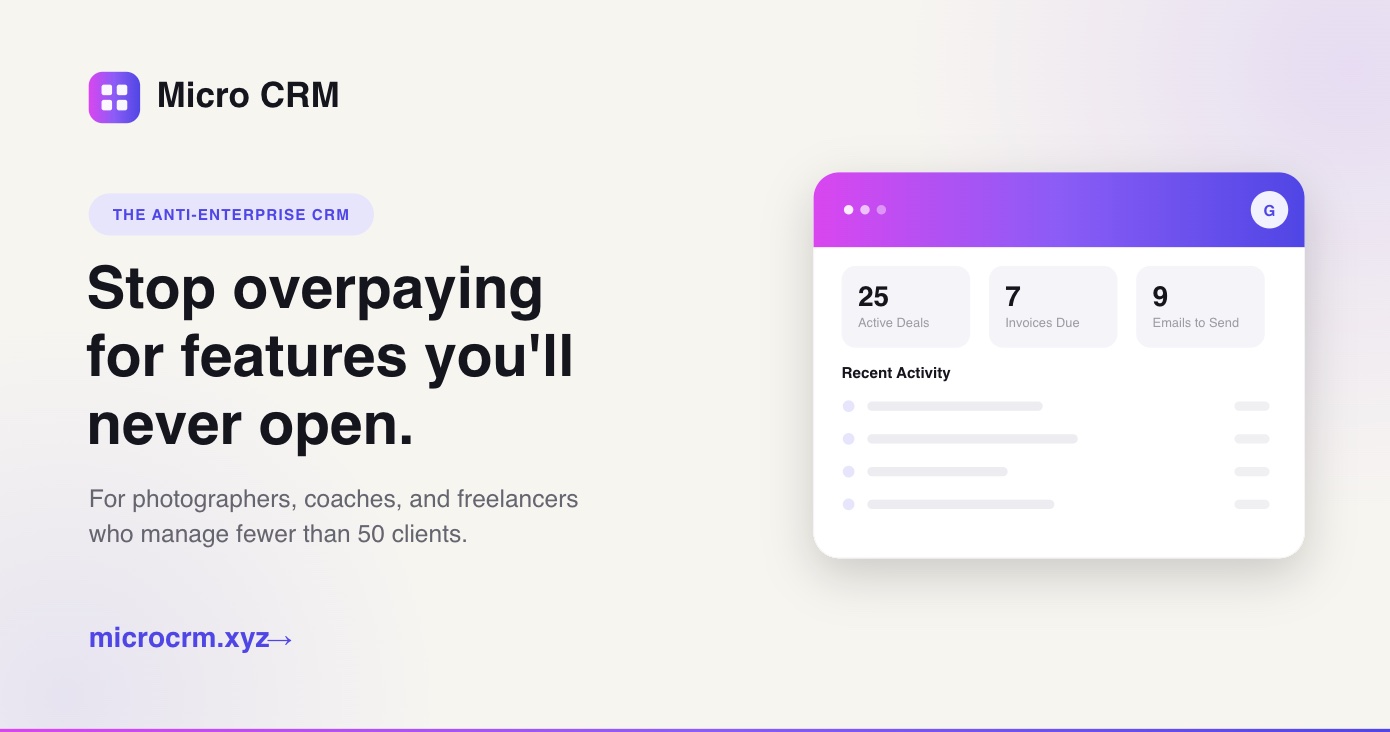
A freelancer does not need a CRM that feels like a software project. A small agency does not need one that asks for days of setup before it becomes useful. MicroCRM fits that reality by keeping clients, deals, invoicing, and follow-ups in one place without piling on extra layers you will spend time configuring and maintaining.
What the simple approach buys you
Speed is the main reason to start here. You can sign up quickly, use the free plan right away, and avoid setup calls or long documentation sessions. The product keeps the core workflow inside one interface with a Kanban pipeline, integrated invoicing, automated emails and follow-ups, and an appointment calendar, so you spend less time switching tools and more time running client work.
That matters because every extra module creates more work before the CRM starts paying off. MicroCRM is organized around users handling fewer than 50 clients, which fits the way many freelancers operate. The account pause option also helps, since it lets you preserve data without paying if you need to step away for a while.
The larger lesson is simple. Free CRM plans reward simplicity at the start and punish overbuilding later. A compact system is easier to adopt, easier to keep updated, and easier to open every morning. If you want a faster setup and fewer decisions, start with Micro CRM, then compare that workflow against your current spreadsheet setup.
Getting Started with Your Free CRM Today
Import your current contacts first. Don't start by building the perfect setup, start by moving your active clients out of scattered files and into one place.
Create your first pipeline next, then add the stages you already use in real life, such as inquiry, proposal, booked, invoiced, and paid. After that, load a few email templates so follow-ups don't depend on memory. Schedule one next action for each live client, even if it's just a check-in or a payment reminder.
A simple first-day sequence
- Start small: Put in your top 10 active clients before anything else.
- Add your next actions: Every record should show what happens next.
- Use templates early: Save the email you send most often.
- Keep invoices close: If billing matters, connect it to the same workflow.
- Review daily: Five minutes daily prevents missed follow-ups.
The goal is momentum, not perfection. A good free CRM should feel useful on day one, not after a weekend of setup. If it helps you manage clients, deals, and invoices in one place, it's doing the job.
Start with the system that keeps things simple. Manage clients, deals, and invoices without wasting time on complex CRMs, and if you want a direct path to that workflow, open Micro CRM and start for free. No credit card required.