
Really Simple Systems vs Micro CRM: Which Wins in 2026?
Most advice about CRMs is lazy: people tell freelancers to “just pick something simple,” then shove them into software built for a sales department, a RevOps team, and a consultant with a procurement checklist. That's how you end up with client data in spreadsheets, follow-ups buried in your inbox, and invoices scattered across three apps.
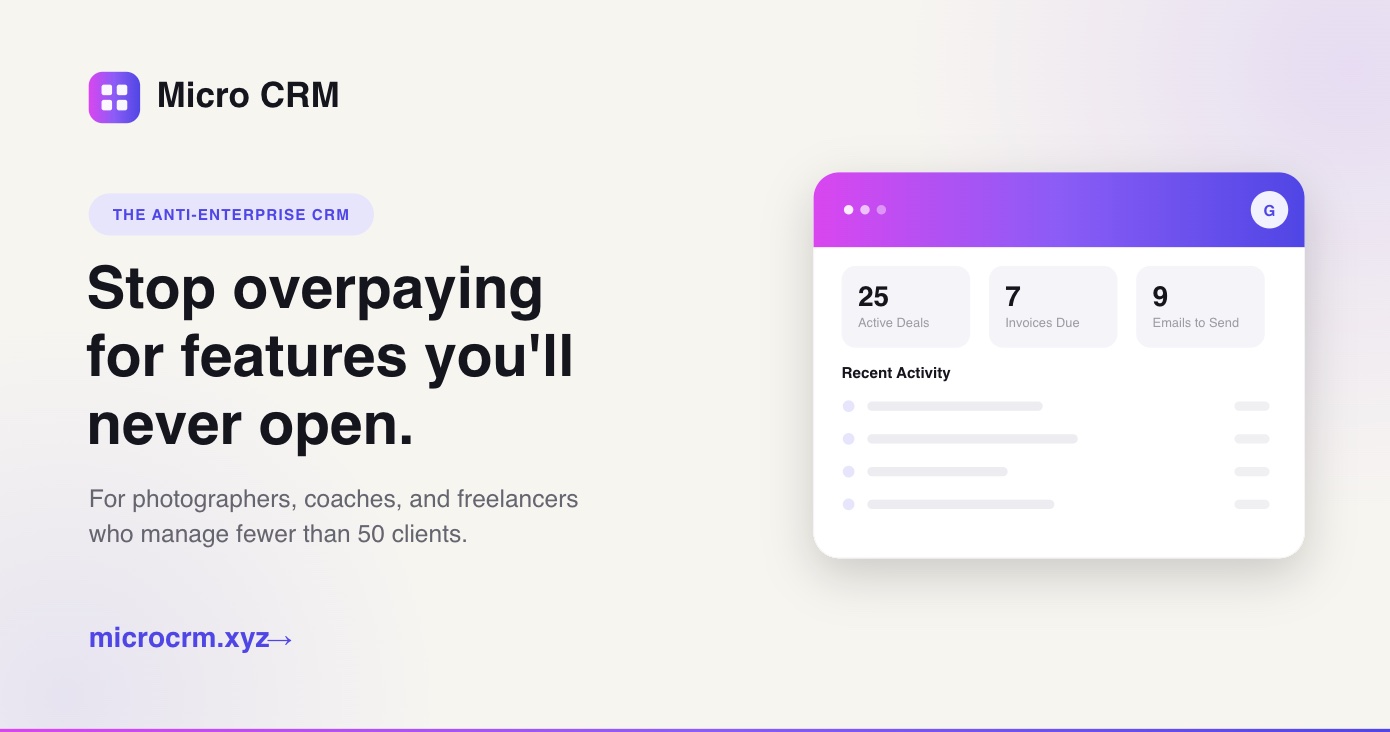
Really Simple Systems and Micro CRM are not interchangeable just because both are simple on paper. One has grown into a broader SMB CRM under Spotler, with API access, quota management, MailSync, and multi-device support that fits a more mature sales process. The other is built for operators who want contacts, deals, invoicing, follow-ups, and scheduling in one low-friction workspace, without carrying enterprise baggage.
| Dimension | Really Simple Systems | Micro CRM |
|---|---|---|
| Positioning | SMB CRM with broader sales and service depth | Freelancer-focused system for small client bases |
| Target user | Small to mid-sized teams | Solo freelancers and micro-businesses |
| Core feature focus | Sales, marketing, service, reporting, MailSync | Contacts, deals, invoicing, email sequences, calendar |
| Setup style | Quick setup with broader configuration | Minimal setup, immediate use |
| Best fit | Teams that want growth headroom | Operators under 50 clients who want focus |
| Trade-off | More breadth, more structure | Less overhead, fewer distractions |
The choice isn't “which one is simpler.” It's whether you want breadth with room to grow, or focus with almost no learning curve. That maturity-stage question matters more than brand name, because a tool that fits a five-person sales team can be the wrong choice for a freelancer managing 18 clients and invoicing from the same dashboard.
Table of Contents
- Why Simple CRMs Are Not All the Same
- Really Simple Systems vs Micro CRM at a Glance
- Pricing, Free Plans, and Plan Fit
- Onboarding and Day-to-Day Usability
- Security and Data Protection
- Limits That Actually Matter to Freelancers
- Real-World Use Cases for Each CRM
- Migrating From One CRM to the Other
Why Simple CRMs Are Not All the Same
The word simple gets abused in CRM marketing. A stripped-down interface doesn't automatically mean a stripped-down operating model, and that difference matters the moment you outgrow a contact list in Excel. Really Simple Systems proves the point, because its history shows a tool that started early, launched publicly in January 2006 after being founded in 2004, and then kept adding layers over time, including a free plan in October 2010, email marketing in August 2012, and a cross-platform version in July 2013 for desktops, laptops, tablets, and smartphones. Really Simple Systems history
Breadth follows maturity
That timeline tells you what the product became. It's not a bare-bones utility anymore, it's a broader SMB CRM with API access, funnel reporting, task assignment, quotation handling, territory and quota management, and MailSync that pulls email correspondence into one timeline. The current brand is Spotler CRM, because Spotler said the Really Simple Systems name was rebranded in 2024. Spotler CRM rebrand notice
Micro CRM sits on the other side of that divide. It's for freelancers and micro-businesses who need one workspace for contacts, deals, invoicing, emails, and scheduling, not a platform that starts acting like an account-management suite. That's why the choice isn't about raw feature count. It's about the stage of the business and how much structure you need.
Practical rule: if your CRM needs territory rules, quota management, and team-level email visibility, you've already moved beyond micro-business territory.
Why the maturity stage changes the fit
A freelancer managing 12 repeat clients needs a different system from a sales-led agency with handoffs, reporting, and multiple inboxes. Really Simple Systems makes sense when your process is formal enough that shared timelines, pipeline reporting, and role-based work start paying off. Micro CRM makes more sense when your day is still about doing the work, sending the invoice, and making sure nobody gets forgotten.
That's also why the old “just choose the easiest CRM” advice fails. A tool can be easy to click through and still be wrong for your workflow, because it solves for the wrong scale. If you want a lightweight system with one purpose, pick for focus. If you want a platform with room to formalize, pick for breadth.
Really Simple Systems vs Micro CRM at a Glance

The cleanest way to compare these tools is by asking what happens on a normal workday. Really Simple Systems gives you broader CRM coverage, which matters once a team is sharing pipeline ownership and reporting. Micro CRM is narrower by design, which matters when you want to move fast without paying a complexity tax. You can see that difference in the public product profiles and in the documented support path for the newer Spotler CRM identity. Spotler CRM support guide
Really Simple Systems vs Micro CRM Quick Comparison
| Dimension | Really Simple Systems | Micro CRM |
|---|---|---|
| Positioning | General-purpose SMB CRM | Freelancer-focused system |
| Target user | Small to mid-sized teams | Solo freelancers |
| Primary feature modules | Sales, marketing, service | Contacts, deals, simple automations |
| Supported languages | Multi-language ecosystem through broader SMB rollout | English and Italian in the publisher's product profile |
| Signature differentiator | Broad functionality, MailSync, quota management | Minimalist workflow, zero learning curve |
The rows matter because they map to how work happens. MailSync is valuable when several people need to see the same client history. Integrated invoicing and a calendar matter the moment you're chasing payment, booking calls, and managing a small roster of clients without bouncing between tabs. That's a different operating model, not just a different feature list.
If you're deciding quickly, use this filter: if your CRM has to support shared visibility, structured reporting, and scaling sales operations, Really Simple Systems is the stronger fit. If your CRM has to keep invoices, reminders, and client follow-ups in the same place as your contacts, Micro CRM is the cleaner match. For a closer look at that workflow-first approach, start with the Micro CRM homepage.
What the table hides
The biggest hidden difference is cognitive load. Really Simple Systems gives you more knobs to turn, which is good when you have people, process, and handoffs. Micro CRM removes most of the knobs, which is good when you don't want to spend your afternoon deciding how to configure a CRM instead of using it.
That's why “at a glance” comparisons can be misleading. Two products can both look simple in screenshots and still serve different maturity stages. One is a small-business CRM that has grown up. The other is a focused system that stays close to the daily work of a freelancer or micro-agency.
Pricing, Free Plans, and Plan Fit
Pricing only matters if it matches how you work. Really Simple Systems lays out its tiers clearly enough to judge the trade-offs without guesswork. The Free plan is $0 for 2 users and 100 company records, Starter is $15/user with 1,000 company records and 1 GB document storage, Professional is $33/user with 5,000 records and 5 GB storage, and Enterprise is $50/user with unlimited records and storage. Really Simple Systems pricing
What those tiers actually mean
Those limits show the kind of buyer the product serves. The free tier works as a real trial for a very small operation, but 100 company records leaves little room if you are actively prospecting, nurturing leads, and keeping long client histories. Starter and Professional make more sense once your sales process is organized and you need more storage and reporting room. Unlimited records and storage only appear at Enterprise, which is the point where broader SMB software usually adds its heavier structure.
Micro CRM keeps its plan structure tight on purpose. It offers Free, Starter, Pro, and a limited-time Lifetime Deal, and the free plan requires no credit card. For a pricing-first breakdown of a smaller workflow, the Micro CRM pricing guide makes the plan logic easy to see. The exact limits vary by plan, but the product is built for people managing fewer than 50 clients, which is the planning frame here, not feature sprawl.
Decision rule: if you expect to stay under 50 clients and you want invoicing and follow-ups inside one app, choose for workflow fit, not the longest feature list.
Matching plan to buyer type
A solo freelancer with a tight client roster should care about friction first. A two-person studio with recurring work needs a tool that does not force separate billing and reminder systems. A five-person sales team will care more about roles, reporting, and shared visibility than about how fast it can send a single invoice. That is where Really Simple Systems starts to make sense.
A smaller workflow needs a different test. If your business is still centered on one operator and a small set of repeat clients, a stripped-down system avoids paying for structure you will not use. Micro CRM fits that stage better because it stays close to the daily work instead of adding layers you have to maintain.
The mistake is buying for a future org chart you do not have yet. If your process is already formalizing and you need more records, more structure, and more shared visibility, Really Simple Systems gives you the clearer upgrade path. If you are still under 50 clients and you want a CRM that behaves like a workbench instead of a platform project, stay focused and keep the stack light.
Onboarding and Day-to-Day Usability
Setup speed shows the trade-off fast. Really Simple Systems gives you a usable starting point without much ceremony, and its getting started flow makes it clear how to create a new Task, Activity, or Opportunity from the “+ Add” icon. That kind of first-step clarity helps teams that want structure without a long implementation cycle.
What fast setup feels like
Micro CRM is built for immediate use. You sign up, add contacts, create a deal, and move work across a Kanban board without a setup call or a long checklist. That matters for freelancers because they do not need a software project, they need a client system that gets out of the way. A stripped-back CRM works because first use feels obvious, not because it advertises more features.
Device support matters once the work starts moving between desk and phone. Really Simple Systems supports web, iOS, Android, and desktop use, so people who split time between laptop and mobile can keep records in one place. That suits operators who update contacts in the office, on the road, or between meetings. Device support overview
Friction is the product
Setup speed reveals the distinction, one CRM tolerates process overhead, the other removes it. Really Simple Systems accepts a bit more configuration because it is built to support broader sales operations. Micro CRM strips out most of that friction because it is built for immediate use.
Use the first 15 minutes to judge the product, not the sales page. If you cannot log a contact, a deal, and a follow-up without hunting through menus, the tool is already too heavy for a solo workflow.
For a freelancer, the best onboarding test is plain. How fast can you go from signup to the first live deal, invoice, and follow-up? If that answer involves training videos or a long admin session, you are buying more software than you need. If you want a sharper yardstick for what simple systems should and should not do, this guide on customer data protection is the right companion piece.
Security and Data Protection
Simplicity does not equal safety. A lightweight CRM can still expose a large amount of client information if storage, access control, or file handling is weak. A breach report covered by Security Affairs on the breach report said the Really Simple Systems provider exposed millions of clients' files, which is the clearest warning that “small tool” does not mean “low risk.”
What buyers should check
This is the checklist I use with small-business clients before they trust any CRM with invoices, notes, and client history:
- Data exposure risk: Collect less if you can, because every stored file or attachment widens the blast radius.
- Password and access control: Check whether the system supports strong authentication and granular permissions.
- Backups and recovery: Ask how data is restored after deletion or a breach.
- Integrations: Audit every connection, because each one adds another place where data can move or leak.
- Retention and compliance: Make sure the vendor's policies are clear enough for your client base and geography.
That checklist matters because “simple” products often skip governance language in their marketing. Buyers then assume there is less to worry about, which is the wrong assumption. The core question is whether the CRM is simple on top and controlled underneath.
Why Micro CRM's posture matters
Micro CRM documents a more explicit security setup, with data hosted on AWS, encryption at rest and in transit, and authentication through Amazon Cognito. It also includes an account pause option that preserves data without billing, which is a practical sign that the product treats continuity seriously. That does not make security a checkbox, but it does show the system is built around managed infrastructure rather than casual file handling.
If you are comparing any small CRM, read the data-handling story before you read the feature story. I would rather see fewer features and a clearer security posture than the reverse. For a deeper buyer checklist, the Micro CRM customer data protection note is worth using as a benchmark against any vendor you are considering.
Limits That Actually Matter to Freelancers
Freelancers do not hit CRM limits the way sales teams do. They hit them through contact growth, invoice volume, follow-up habits, and how often they need to open a client record in a week. Really Simple Systems makes its thresholds visible through record caps, with 100 records on Free, 1,000 on Starter, 5,000 on Professional, and unlimited only on Enterprise at $50 per user, as outlined in the pricing breakdown above.
The bottlenecks that show up first
For a solo operator, the first pain point is usually not pipeline depth. It is whether the CRM forces workarounds for contact storage, document handling, or repeated follow-up. Once you start exporting contacts to keep the system usable, the “simple” promise disappears fast. Once you need separate apps for invoicing or scheduling, the whole point of a unified workspace starts to break down.
Micro CRM's limits scale by plan, but the product is clearly built for people managing fewer than 50 clients. That is the useful signal. It means the software is shaped around a modest but active client base, not around broad sales infrastructure.
Where the tools stop feeling simple
- Too many contacts: If you have to prune records just to stay inside a plan, the CRM is too small for your workflow.
- Too many handoffs: If you keep switching between email, billing, and calendars, the tool is too fragmented.
- Too much reporting overhead: If you need dashboards just to understand what happened this week, the system is probably overbuilt for your use case.
- Too many permissions needs: If access roles matter, you are leaving micro-business territory and heading toward a broader SMB platform.
The right fit is the one whose limits match your daily rhythm. If you are still under 50 clients and want everything in one place, a compact system makes sense. If you are already managing a larger record base with formal process, Really Simple Systems starts to justify itself.
Real-World Use Cases for Each CRM
A freelance photographer does not need the same CRM as a small sales agency. The photographer needs a place to track inquiries, deposits, shoot dates, invoices, and reminders. In that workflow, Micro CRM fits because the calendar and invoicing belong in the same workspace as the deal itself. Really Simple Systems would still work, but it gives less day-to-day value if billing and scheduling are central to the business.
Three working days, three different choices
An independent designer or two-person studio is a closer call. They often juggle retainers, repeat deliverables, and a small Kanban pipeline, so either product can hold the process together. The difference is that integrated invoicing and email sequences in Micro CRM cut out more context switching, which matters when the same person is also doing the actual client work.
A small sales-led agency with a few hundred active contacts is where Really Simple Systems starts earning its weight. MailSync keeps interaction history visible, territory management supports ownership, and the broader dashboards matter once multiple people touch the same account. That's not overkill, it's the right amount of structure for a team that has outgrown a freelancer tool.
My blunt take: if the CRM is mainly where you log conversations and send invoices, stay lightweight. If it's where team ownership, reporting, and shared history live, buy the broader platform.
Verdict by persona
- Freelance photographer: Micro CRM.
- Independent designer or small studio: Micro CRM, unless team reporting is already getting serious.
- Sales-led agency with shared ownership: Really Simple Systems.
That's the maturity-stage split in plain English. The wrong move is buying breadth for a business that still needs focus. The right move is buying enough structure to match the way your team already works, not the way you hope it will work someday.
Migrating From One CRM to the Other
Migration gets messy when people try to do it during a busy sales week. Don't do that. Export the data, clean it, import it, and verify the first few records before the team depends on the new system. CSV is still the safest format for contacts and deals, and the work is mapping custom fields so nothing important disappears in the move.
A clean 30-day switch
Start with exports from the old system, then prepare the destination import file. Match field names carefully, especially tags, deal stages, and any custom notes you rely on for context. After import, test a few records and check that the notes, activities, and pipeline stages look right in the new CRM.
Then handle the workflow pieces people forget. Redirect email templates and follow-up sequences, update calendar integrations, and confirm who needs access to what. In the Spotler CRM setup, the product now sits under the Spotler CRM name, so older help articles and export paths may still use the legacy brand, as noted earlier regarding the Spotler rebrand.
Three mistakes to avoid
- Migrating mid-campaign. If an active sales week is underway, wait.
- Skipping field mapping. Custom fields are where client context goes to die.
- Forgetting invoice templates. If your billing workflow changes and nobody updates the template, clients notice immediately.
The first 30 days should have three checkpoints. First logged deal in the new system, first invoice generated from the new tool, and first automated sequence sent without manual cleanup. If all three work, the migration is real.
The decision is simple. A solo freelancer or micro-business with under 50 clients should choose the lighter system that keeps contacts, deals, invoices, and follow-ups in one place. A growing team of 5 to 20 with territory, reporting, and shared process needs should choose Really Simple Systems because it carries the broader structure that stage of business requires. If you are bigger than that and need heavier compliance or API work, stop shopping in this category and look for a more serious platform. That is the trade-off, focus for a small operator, or feature breadth for a business growing past freelancer tools.
Micro CRM is built for operators who want to manage clients, deals, and invoices without turning CRM admin into a part-time job. If your business still lives on a short list of clients and a lot of context switching, that is the fit worth testing first. Visit Micro CRM, start free, and see whether a focused workspace is enough to replace the spreadsheet chaos.