
CRM Software Free: Top 10 Picks for 2026
Tired of spreadsheets, scattered inbox threads, and a separate invoicing app that never quite matches your client list? That's the daily mess a lot of freelancers and small teams live in, and it's exactly why CRM software free has become such a useful starting point. The CRM market grew from $14 billion in 2010 to $69 billion in 2020, a rise of about 393%, and a 2026 forecast projected it would reach $129 billion by 2028 at 12% annual growth (Flowlu CRM statistics). In a market that has gone mainstream, free tiers are often the easiest way to move from chaos to a real client system without paying enterprise prices right away.
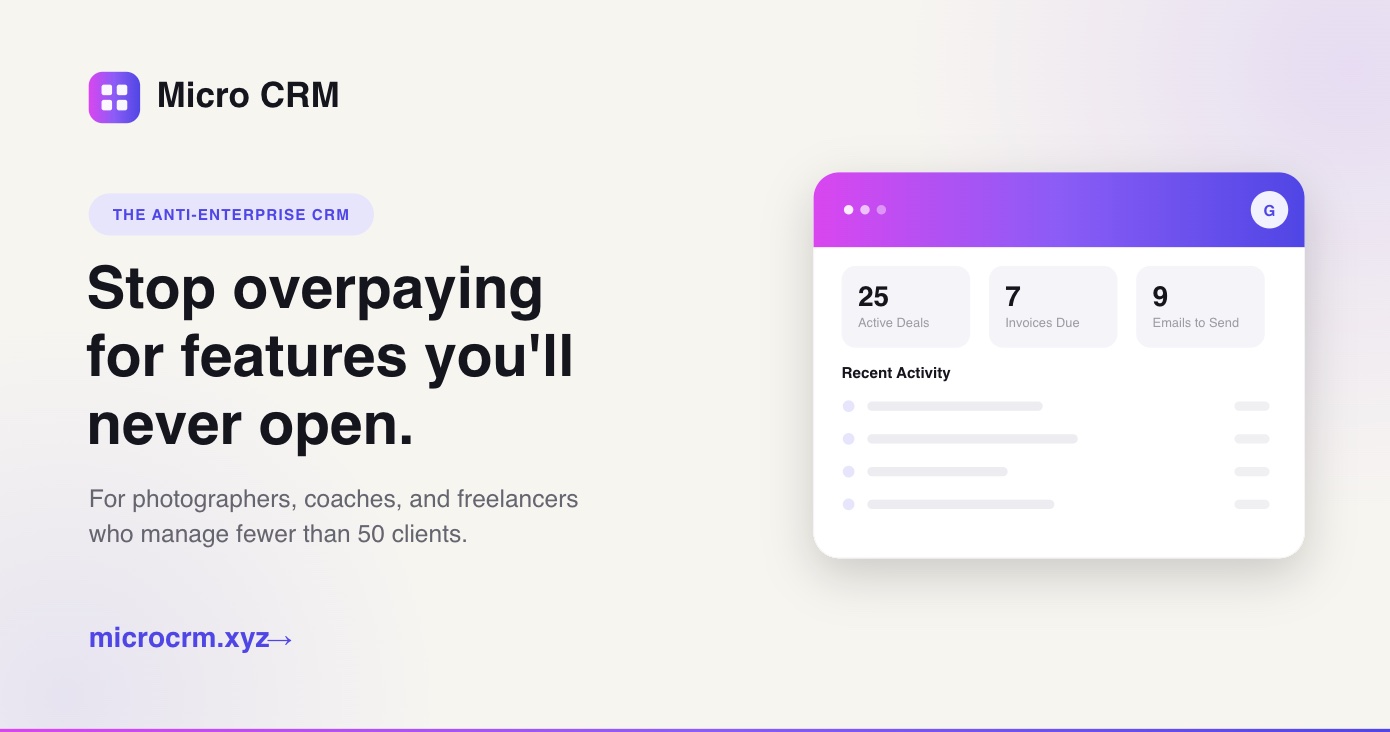
A practical free CRM does a few things well. It keeps contacts in one place, shows deals in a visual pipeline, and makes follow-ups harder to miss. Some tools do much more than that, while others stay deliberately simple. The question isn't which platform sounds impressive, it's which one stays useful before the free plan turns into a trap.
Table of Contents
- 1. Quick Comparison 10 Best Free CRM Platforms
- 2. Micro CRM The Simple CRM for Freelancers
- 3. HubSpot CRM The All-in-One Growth Platform
- 4. Zoho CRM Free Edition For the Zoho Ecosystem
- 5. Freshsales Freshworks Sales-Focused and User-Friendly
- 6. Bitrix24 The All-in-One Workspace
- 7. EngageBay Affordable HubSpot Alternative
- 8. SuiteCRM The Open-Source Powerhouse
- 9. Odoo CRM Modular and Scalable
- 10. Flowlu CRM and Project Management Combined
- 11. Bigin by Zoho Lightweight and Pipeline-Centric
- Top 11 Free CRMs, Feature Comparison
- From Chaos to Control Make Your Choice
1. Quick Comparison 10 Best Free CRM Platforms
If you're comparing crm software free options, the question is how long the free tier can carry your actual workflow before it starts creating extra admin. Seat caps, record limits, storage ceilings, and missing automation usually show up later, after the setup work is already done. That matters whether you're a freelancer handling a few active clients or a small team trying to keep sales follow-up from slipping.
Practical rule: if the free plan cannot handle your normal client load without manual workarounds, the hidden cost shows up in time, not money.
Micro CRM is built for that smaller operating model. It focuses on contact management, deals, invoicing, and follow-ups in a single workflow, so you spend less time stitching tools together and more time moving work forward. HubSpot, Zoho CRM, Freshsales, Bitrix24, EngageBay, SuiteCRM, Odoo CRM, Flowlu, and Bigin all solve different problems, but their free tiers run into limits at different stages, and those limits matter more than the word free on the pricing page.
For a side-by-side look at those trade-offs, see the MicroCRM comparison guide. If you want a fuller picture of how Micro CRM fits freelancer workflows, this guide to Micro CRM for freelancers shows the practical setup choices in more detail.
2. Micro CRM The Simple CRM for Freelancers
Micro CRM makes sense if your current system is a mix of spreadsheets, email folders, and memory. The product is built around a lightweight workflow, so you can manage contacts, deals, invoicing, and follow-ups without setting up a giant CRM project first. That approach fits the day-to-day reality of freelancers and micro-businesses better than a feature pile you'll never fully configure.
The practical appeal is obvious. Free CRM products are attractive because CRM users report an average return of $8.71 for every $1 spent on sales CRM software and 86% higher odds of exceeding sales goals versus non-users (CRM.org CRM statistics). For a solo operator, that kind of upside only matters if the tool is simple enough to use every day, and Micro CRM leans into that with a visual pipeline, invoicing, a calendar, and email follow-ups in one place.

Why the free plan fits small operators
The free plan is designed for light but real client work. It includes 50 contacts, 1 pipeline, 5 invoices per month, 100 emails per month, and 1 sequence, which is enough for many freelancers to stay organized without immediately hitting a wall. The free plan also requires no credit card, which removes the usual trial-style friction.
That matters because the smallest businesses often adopt CRM more slowly than larger teams. A 2026 synthesis puts adoption at roughly 30 to 45% for firms with fewer than 10 employees and 15 to 25% among solo founders, with free tiers often used as a basic contact database rather than a full workflow system (Nordics CRM stats 2026). Micro CRM is positioned for that exact group, people who need a simple system that feels useful on day one.
Manage clients, deals, and invoices in one platform, without rebuilding your process around software.
Best fit and honest limits
Micro CRM works best for freelance photographers, independent designers, consultants, coaches, and small agencies under 50 clients. It's a strong fit when you need quick deal tracking, appointment scheduling, and client follow-up more than deep enterprise automation. The Kanban-style pipeline keeps the sales process visible, and the invoicing side reduces the need to jump between apps.
The limitations are just as clear. If you need a large app marketplace, advanced multi-stage automation, or deep enterprise integrations, this isn't the right match. That's not a flaw so much as the point. Micro CRM is built to stay small, fast, and focused, and for the right user, that's the advantage.
Website: Micro CRM
3. HubSpot CRM The All-in-One Growth Platform
HubSpot is the obvious choice when you want a polished free CRM that can grow into a much larger system later. It's broader than most free tools because the free tier sits inside a full marketing, sales, and service ecosystem. That makes it attractive to startups that already know they'll need forms, scheduling, chat, and email tools later.
There's a reason so many teams start here. A 2024 summary reported that 73% of businesses would use CRM software in 2024, and another found 91% of organizations with 11 or more employees already used CRM systems (Flowlu CRM statistics). HubSpot benefits from that mainstream adoption because it feels familiar, organized, and easy to hand off to a growing team.
Where HubSpot feels strong
The free plan offers strong features for contact management, deal tracking, email marketing, live chat, and a meeting scheduler. It's also easy to onboard, which is a real advantage when you don't want to spend a week teaching the team where everything lives. For a startup with a long runway, that polish can beat raw simplicity.
Where the free plan starts to bite
The trade-off is brand visibility and expansion pressure. HubSpot branding shows up on forms, emails, and chat, and the system can become expensive quickly once you start adding paid features or scaling contact volume. The free tier is generous, but it's not the same thing as unrestricted freedom.
Who should pick it
HubSpot suits small businesses that want a clean path from free CRM to marketing automation. It's less compelling for solo users who just need contacts, pipeline, and invoices, because the ecosystem can feel like too much before you're ready for it. If your goal is to build inside a larger platform, it's a smart start. If your goal is to stay lean, it may be more CRM than you need.
Website: HubSpot
4. Zoho CRM Free Edition For the Zoho Ecosystem
Zoho CRM's free edition is one of the better choices for tiny teams that want a real CRM, not a toy. The free tier supports up to 3 users and includes the core modules for leads, contacts, accounts, and deals (Zoho free CRM). That makes it a good starting point for a small team that expects to stay organized without paying on day one.
The reason people stick with Zoho is the ecosystem. If you expect to add finance, HR, projects, or other business apps later, Zoho gives you a route to do that without switching vendors. That kind of continuity matters more than a flashy interface when you're trying to avoid another migration six months from now.
The practical upside
Zoho CRM can save time because it supports workflows, reporting, and mobile access without forcing you into a huge platform rebuild. The structure is useful for teams that want a bit more process than a spreadsheet can offer, but not the overhead of a complex enterprise system. A 2024 industry summary also said CRM can save employees 5 to 10 hours per week and shorten the average sales cycle by 8 to 14 days (CRM.org CRM statistics), which is the kind of operational gain small teams look for in tools like Zoho.
The trade-offs you'll feel fast
Zoho can feel dated and a little busier than newer products. Advanced analytics and mass email are paywalled, so the free plan gets you started rather than fully equipped. If you like configuration and expect to scale across multiple business functions, that's fine. If you want a frictionless daily workspace, it may feel heavier than it should.
Best use case
Zoho CRM is best for small teams that expect to grow into a broader software stack. It's also a sensible choice if your client work already lives in the Zoho universe. For freelancers who want a single clean screen for contacts, deals, and invoices, Micro CRM is more direct. For teams that value an ecosystem first, Zoho holds up well.
Website: Zoho CRM
5. Freshsales Freshworks Sales-Focused and User-Friendly
Freshsales works well for people who want the CRM to behave like a sales tool first. It's cleaner than many budget platforms and easier to learn than the denser all-in-one systems. If your day revolves around leads, follow-ups, and deal movement, that focus helps.
A 2024 industry summary found that 49% of businesses using CRM reported a customer acquisition cost reduction of 11 to 20% (CRM.org CRM statistics). Freshsales is built for the kind of process discipline that can support that outcome, especially when you want a visual pipeline and a tool that doesn't fight you on basic sales work.
Why sales teams like it
The interface is modern, and the visual pipeline makes it easy to see what needs attention. Contact, account, and deal management are central, and the mobile experience is good enough for field work or quick updates between calls. It feels like a CRM designed for actual selling, not just storing names.
Where the free plan is tight
The free plan is limited to 100 contacts, so it gets restrictive fast if you're actively prospecting or serving many clients. Reporting and automation also live behind paid plans. That means Freshsales is better for small pipelines than for teams that need a lot of custom follow-up logic.
Who it fits
Freshsales is a practical choice for solo sellers, small sales teams, and service businesses that work a manageable list of prospects. It's less appealing if you need invoicing, broad project management, or a client delivery workflow. For those users, a tool like Micro CRM or Flowlu tends to fit better.
Best free CRM for small business workflows
Website: Freshsales
6. Bitrix24 The All-in-One Workspace
Bitrix24 is the free CRM for people who keep asking for one system that can do everything. It combines CRM with project management, team chat, video calls, document storage, and even a website builder. That scope is useful if you want to reduce app sprawl and don't mind a steeper learning curve.
The free plan is unusually generous on paper. It supports unlimited users and unlimited contacts, which makes it one of the most flexible entry points in the category (Flowlu CRM statistics). For growing teams, that removes a common early blocker.
What works well
Bitrix24 is strongest when a business wants CRM and collaboration under one roof. The platform can handle the basics of sales management while also giving teams a place to communicate and organize work. That can be a real help for remote groups that don't want to stitch together several tools.
Where it gets expensive in practice
The interface can overwhelm first-time users. The breadth is impressive, but the first week often feels like setup work rather than productivity. Advanced CRM features and automations are still locked behind paid tiers, so the free plan solves breadth more than depth.
Best fit
Bitrix24 makes sense for teams that want a central operations hub and are willing to invest time in setup. It's not the fastest choice for a freelancer who just needs client tracking and invoicing. If the goal is a simple, low-friction daily tool, Bitrix24 can feel like too much machine for too little work.
Website: Bitrix24
7. EngageBay Affordable HubSpot Alternative
EngageBay is worth a look if you want a taste of all-in-one CRM without HubSpot's heavier growth path. The free plan covers CRM, email marketing, landing pages, helpdesk, and live chat. That's a strong package for a tiny team trying to centralize customer-facing work.
The catch is the limit. The free plan is capped at 250 contacts and 1,000 branded emails per month (Zapier free CRM roundup). That's enough to test an integrated workflow, but not enough for a team that expects volume.
Why some teams still like it
EngageBay gives you marketing, sales, and service in one place. That makes it easy to test how an integrated stack feels before paying for it. For small businesses that want one system for support and sales, that can be useful.
Where the free tier is tight
The user interface isn't as polished as the best-known competitors, and the contact cap is easy to hit. Once you do, the free plan stops being a long-term solution and starts being a preview. That's fine if you're evaluating, not fine if you want to stay free for a while.
Who should consider it
EngageBay is a reasonable choice for solos and very small teams that want an all-in-one feel and don't mind a tighter limit. If your business depends on clean client follow-up, invoicing, and a small number of active accounts, Micro CRM is the more focused option. If you want a broader marketing-and-support stack, EngageBay is more ambitious.
Website: EngageBay
8. SuiteCRM The Open-Source Powerhouse
SuiteCRM is for teams that care more about control than convenience. It's open source, self-hosted, and completely free in the sense that you own the software stack yourself. That comes with real power, but also real responsibility.
The attraction is full ownership. You get unlimited users, unlimited contacts, and the ability to customize heavily, which makes it appealing for businesses with technical resources. The trade-off is obvious, though, installation, maintenance, and security are on you.
What makes it different
SuiteCRM is not trying to be the easiest CRM on the market. It's trying to be the most adaptable one for teams that can support it. If your business has specific workflows or strict data-handling requirements, that control matters.
Where it breaks for many small businesses
If you're a freelancer or micro-agency, the self-hosting burden can outweigh the savings. The interface also feels less modern than cloud tools, so daily use may be slower than you'd like. A free CRM should save time, and SuiteCRM only does that if you already have the technical muscle to keep it running.
Best use case
SuiteCRM is a strong fit for organizations with in-house admin or development support. It's not a casual choice for a solo consultant who wants to get organized this afternoon. For that user, a hosted tool with simpler setup is usually the better move.
Website: SuiteCRM
9. Odoo CRM Modular and Scalable
Odoo's free approach is attractive because it lets you start with CRM and expand later. The CRM app is clean, visual, and built around a Kanban workflow, which makes it easy to track deals at a glance. The structure is especially appealing if you like modular software and expect to add billing, sales, or eCommerce later.
Odoo's main strength is scalability. You can begin with one app and then grow into a wider business system when you're ready. That makes it useful for founders who know they'll outgrow a single-purpose CRM eventually.
Where Odoo works well
The Kanban pipeline and activity tracking are the parts users notice first. They're simple enough to use quickly, but flexible enough to support a real sales process. That balance is helpful if you don't want the rigid feel of a heavy enterprise suite.
The free-plan catch
Once you move beyond the single-app setup, the free story changes. The modular model is powerful, but it can also push you into configuration overhead and eventually a paid plan. If you're only after a straightforward client hub, that may be more structure than you need.
Best fit
Odoo suits businesses that want room to grow inside one ecosystem. It's especially useful if you already think in terms of systems, not just contacts. If you need something tighter and more purpose-built for freelancers, Micro CRM keeps the focus on client work instead of platform sprawl.
Website: Odoo CRM
10. Flowlu CRM and Project Management Combined
Flowlu is useful when the sale and the delivery live in the same workflow. It combines CRM with project management, invoicing, and a knowledge base, so you can move from lead to project without bouncing across multiple apps. That makes it a good fit for consultants, small agencies, and freelancers who deliver work after the deal closes.
The free plan supports 2 users, which is small but workable for very lean teams (Flowlu CRM statistics). For the right business, the value is not seat count, it's the fact that the workflow stays connected.
What stands out
The combination of contact management, project tracking, and invoicing is the core appeal. If your work starts with a proposal and ends with delivery, Flowlu helps keep the whole lifecycle visible. That reduces the chance of losing context after a sale.
What to watch for
The interface can feel dense because so much is packed in. The free plan also has limited automation, so it's less attractive if you want the CRM to run lots of follow-up logic for you. It's a strong operational hub, but not the lightest one.
Best use case
Flowlu fits businesses that need both client management and project execution. It's a smarter pick than a pure CRM if you bill for the work that comes after the deal. For users who mainly need fast contact capture, a visual pipeline, and invoices, Micro CRM stays simpler.
Website: Flowlu
11. Bigin by Zoho Lightweight and Pipeline-Centric
Bigin is Zoho's simpler answer to the problem of CRM overload. It trims away the bulk of full Zoho CRM and gives you a pipeline-centric system that's easier to start with. If the bigger Zoho suite feels like too much, Bigin is the cleaner on-ramp.
The free plan is limited to a single user and 500 records, so it's clearly aimed at individuals rather than teams (Zapier free CRM roundup). That sounds restrictive, but for a solo founder it can be enough to organize deal flow without clutter.
Why it works for solo users
Bigin is easy to set up and easy to understand. The visual pipelines keep the sales process simple, and activity tracking covers the basics without overwhelming you with extra modules. If you want a direct, visual way to move opportunities forward, it gets the job done.
Where it falls short
The single-user limit is a hard stop for teams. Reporting and advanced CRM functionality are also thin compared with bigger platforms. That means Bigin is best seen as a starter tool for one person, not a long-term team operating system.
Best fit
Bigin is a good match for freelancers who want a Zoho-branded CRM without the complexity of full Zoho CRM. If you want that same simplicity plus invoicing and follow-up in one interface, Micro CRM is the more complete fit for micro-businesses.
Website: Bigin by Zoho
Top 11 Free CRMs, Feature Comparison
| Product | Core features & USP ✨ | UX / Quality ★ | Target audience 👥 | Pricing / Value 💰 |
|---|---|---|---|---|
| Guide: 10 Best Free CRM Platforms | ✨ Summary of free-plan limits & highlights; flags Micro CRM | ★★★☆☆ | 👥 Researchers shortlisting CRMs | 💰 Free (article) |
| 🏆 Micro CRM | ✨ Contacts, Kanban deals, invoicing (PDF), email sequences, calendar, minimal setup | ★★★★☆ | 👥 Freelancers & micro-businesses (<50 clients) | 💰 Free / Starter / Pro / Lifetime, generous free limits |
| HubSpot CRM | ✨ Contact & deal tracking, email, meetings; seamless upgrade path to Hubs | ★★★★☆ | 👥 Small businesses planning to scale | 💰 Free tier; paid add-ons can be costly |
| Zoho CRM – Free Edition | ✨ Leads/contacts/deals, basic workflows; integrates with Zoho suite | ★★★☆☆ | 👥 Small teams (up to 3 users) in Zoho ecosystem | 💰 Free (3 users); affordable upgrades |
| Freshsales (Freshworks) | ✨ Visual pipeline, built-in phone/email, tasks & mobile apps | ★★★★☆ | 👥 Small sales teams & individual reps | 💰 Free (100 contacts limit); paid for advanced features |
| Bitrix24 | ✨ CRM + projects, chat, video, website builder, all-in-one workspace | ★★★☆☆ | 👥 Teams wanting consolidated collaboration tools | 💰 Free unlimited users/contacts; paid for premium features |
| EngageBay | ✨ CRM + email marketing, landing pages & helpdesk in one suite | ★★★☆☆ | 👥 Solos & small teams on a budget | 💰 Free (250 contacts); affordable paid tiers |
| SuiteCRM | ✨ Open-source, full customization, advanced automation when self-hosted | ★★★★☆ | 👥 Organizations with technical resources & data control needs | 💰 Free software; self-hosting & maintenance costs apply |
| Odoo CRM | ✨ Kanban CRM with modular apps (invoicing, eCommerce) for scaling | ★★★★☆ | 👥 Growing businesses seeking modular expansion | 💰 Free (one app); adding apps moves to paid plans |
| Flowlu | ✨ CRM + project management + invoicing, bridges sales to delivery | ★★★☆☆ | 👥 Small agencies, consultants managing projects & CRM | 💰 Free (2 users); paid for more users/features |
| Bigin by Zoho | ✨ Lightweight, pipeline-first CRM with fast setup | ★★★★☆ | 👥 Individuals & solo sellers wanting simple pipelines | 💰 Free (1 user, 500 records); paid tiers for teams |
From Chaos to Control Make Your Choice
Choosing a free CRM is really about choosing which kind of friction you can live with. Some tools give you massive breadth but ask for patience, setup time, and a willingness to work around limits. Others stay small and focused, which is exactly what many freelancers and micro-businesses need.
The biggest mistake is picking a tool because it looks powerful in the abstract. The better question is whether it helps you follow up, track deals, and stay organized without turning into another system you have to babysit. For smaller teams, the best free CRM is often the one that makes daily work faster, not the one with the longest feature list.
That's why Micro CRM stands out in this category. It keeps the workflow tight, with contact management, a Kanban pipeline, invoicing, follow-ups, and scheduling in one place, so you can manage clients without enterprise overhead. If your business is still lean and you want a free plan that feels built for real client work, it's worth starting there.
Manage clients, deals, and invoices in one platform.
Start for free. No credit card required.
Micro CRM is built for freelancers and small businesses that want a simple way to handle clients, deals, invoices, and follow-ups without adding complexity. If you're comparing crm software free options and want a tool that stays practical as you grow, visit Micro CRM and try the free plan for your own workflow.