
Best CRM Tools for Freelancers and Small Businesses
Are spreadsheets, sticky notes, and half-finished follow-up emails still running your client work? If you're a freelancer or small business owner, that mess usually shows up in the same way, missed callbacks, duplicate contact info, invoices that take too long to send, and a pipeline you only remember to check when a deal goes quiet. A simple CRM can fix that without forcing you into enterprise software you'll never fully use. Micro CRM is built for that lighter, faster workflow, with contacts, deals, invoicing, automated emails, and scheduling in one place, so you can stop switching between tools and just manage the work.
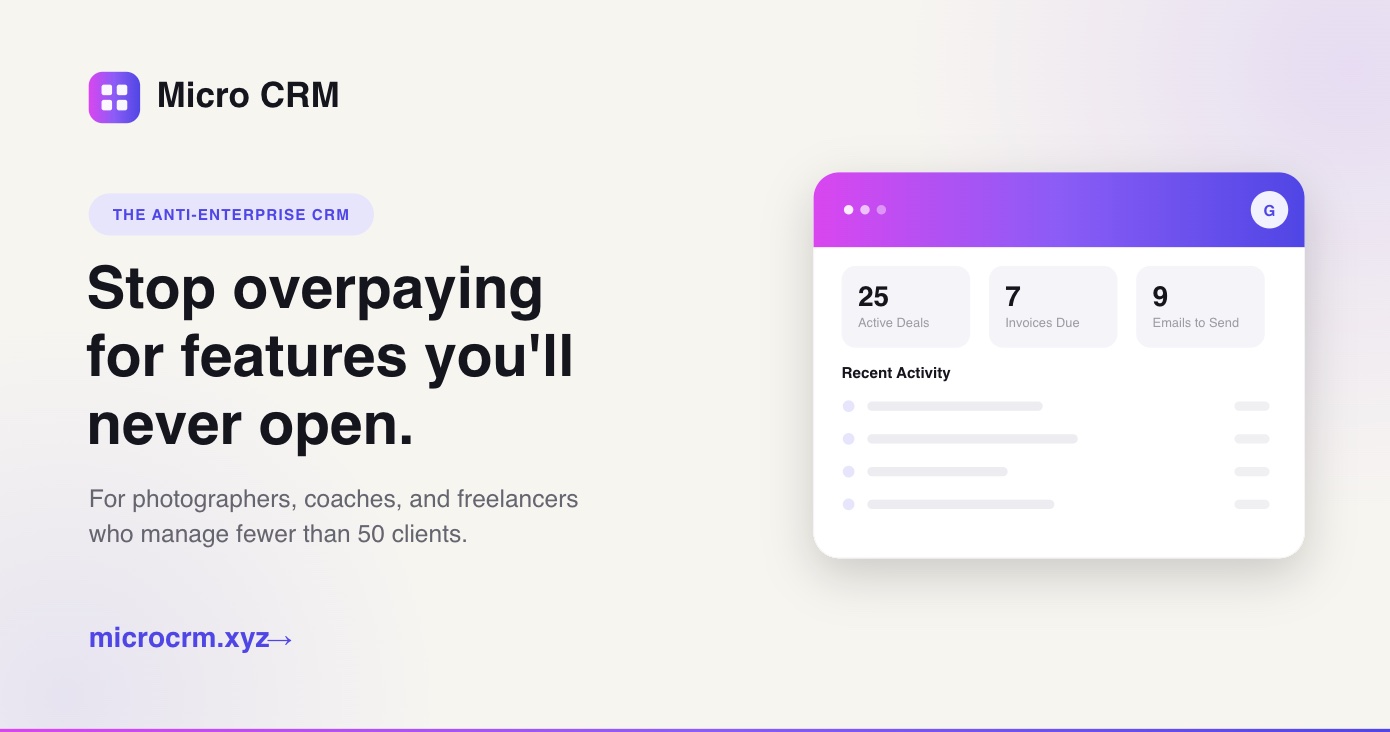
Table of Contents
- 1. Micro CRM
- 2. HubSpot CRM Sales Hub
- 3. Pipedrive
- 4. Zoho CRM
- 5. Freshsales Freshworks
- 6. Copper
- 7. Capsule CRM
- 8. Less Annoying CRM
- 9. HoneyBook
- 10. Bonsai
- Top 10 CRM Tools Comparison
- Find Your Perfect CRM and Get Organized
1. Micro CRM
Micro CRM makes sense when you want the basics to work fast, not a long setup project. It's built for freelancers, solo operators, and small agencies that need contacts, deals, invoicing, email follow-ups, and scheduling in one lightweight system, without extra modules getting in the way. That matters because CRM adoption is already mainstream in larger businesses, but very small firms still have room to win by moving from spreadsheets to a dedicated system, especially when the bigger barrier is perceived overkill and cost rather than lack of need, as the market adoption data shows in CRM usage benchmarks and small-business adoption patterns.

The advantage is speed. You can sign up in 30 seconds, add a client, and send an invoice almost immediately. For a photographer chasing deposits, a designer managing revisions, or a consultant sending a proposal and follow-up sequence, that kind of friction reduction is the difference between using your CRM daily and abandoning it after a week.
Practical rule: if your team has fewer than about 50 clients in active motion, a simple workflow usually beats a powerful one you keep postponing.
What it does well
- Contacts and history in one place: You can keep every client note, tag, and interaction together, which is cleaner than hunting through spreadsheets and email threads.
- Kanban pipeline that's easy to read: Deal stages are visible at a glance, so you know what's open, what's stalled, and what needs a follow-up.
- Invoicing without extra tools: PDF invoices and multi-currency support are built in, which cuts out yet another app from your stack.
- Automated emails and follow-ups: Templates, variables, and sequences help you stay consistent without manual reminders.
- Calendar scheduling: You can book appointments without the usual back-and-forth.
Micro CRM also keeps the pricing straightforward. The free plan includes 50 contacts, 5 active deals, 5 invoices a month, 100 emails a month, and 1 sequence, while the paid tiers scale up from there. It's hosted on AWS with encryption at rest and in transit, and uses Amazon Cognito for authentication, which gives it a more serious security foundation than many lightweight tools.
Choose Micro CRM if you want the cleanest path from lead to invoice, and you'd rather spend time serving clients than configuring software. Visit the Micro CRM website if your current process lives in spreadsheets, inbox folders, and memory.
2. HubSpot CRM Sales Hub
HubSpot is the option people reach for when they want to start free and keep room to grow. Its free CRM has strong contact and deal management, native scheduling, quotes, invoicing, dashboards, and a broad app ecosystem, which is why it shows up so often in CRM roundups. The trade-off is obvious once you grow past the basics, pricing and package complexity can snowball quickly, so it works best if you expect to expand into more marketing and sales tooling later.

For freelancers, HubSpot is strongest when you want a polished free tier and a familiar interface. It's less attractive if all you need is a simple pipeline and a few invoices, because you may end up paying for capabilities you never touch. That's where a baseline simple CRM like Micro CRM pricing is easier to judge against, since you can compare actual day-to-day usefulness instead of a long list of extras.
Best fit and trade-offs
HubSpot is a better fit if you run a small agency, plan to hire, or want to connect a lot of other tools. It's also a practical choice if your clients come in through forms, campaigns, or a larger website operation, because the ecosystem around it is deep.
- Choose HubSpot if you want a free entry point with a long runway.
- Skip HubSpot if you need a lean, fixed-cost system with minimal admin.
- Watch the upgrade path: the further you go, the more important it becomes to track what each seat and hub is costing you.
Directly compared with Micro CRM, HubSpot is broader and more expandable, but it's also easier to overbuy. If your main problem is messy client tracking, not running a full sales and marketing stack, the simpler system is usually the faster win.
Website: HubSpot
3. Pipedrive
Pipedrive is the CRM people like when they care most about the pipeline itself. Its drag-and-drop board is easy to understand, activity management is strong, and the day-to-day experience is built around keeping deals moving. That makes it a good fit for solo operators and small teams who sell through a visible sequence of touchpoints rather than a sprawling marketing stack.

The upside is clarity. You always know what's next, and that reduces the chance that a warm lead goes cold just because nobody owned the follow-up. The downside is that Pipedrive often pushes useful extras into add-ons, so the price can rise once you want deeper lead gen, richer reporting, or more than the core sales flow.
Choose this if your sales work is visual
Pipedrive works best when the deal stage is the whole story. If you're a freelancer who sends estimates, follows up, closes, invoices, and then moves on, the interface can feel natural right away.
If your CRM only needs to answer “what should I do next?”, Pipedrive is stronger than tools that try to do everything.
Compared with Micro CRM, Pipedrive is the more sales-native option, but it's also more likely to pull you into add-on territory. Micro CRM is better when you want the pipeline plus invoicing and follow-ups without buying into a larger sales system.
Internal comparison reading: Micro CRM versus other CRM options
Website: Pipedrive
4. Zoho CRM
Zoho CRM is the budget-conscious choice for people who want breadth. It can handle contacts, deals, workflows, automation, inventory, quotes, and invoices in higher tiers, and it plugs into the wider Zoho suite if you expect your business systems to expand. That breadth is useful, but it comes with a denser interface and more configuration than most lightweight tools.
For a freelancer, Zoho can feel like buying a workshop when you only need a clean desk. If you're building a business that will eventually need more than a simple client tracker, that extra depth can pay off. If you just want to manage a modest client list and send invoices without a setup phase, it's probably more than you need.
Where Zoho makes sense
Zoho is strongest when you want one vendor across multiple functions. It's a logical pick for agencies that may add email marketing, reporting, or support tools later, because the ecosystem can keep more of your stack under one roof.
- Good for: businesses that expect more process, more users, and more data later.
- Less ideal for: solo workers who want the lightest possible setup.
- Key trade-off: configuration power versus day-one simplicity.
Compared with Micro CRM, Zoho gives you more system depth, but it asks for more attention in return. If your priority is low admin and a faster path to value, Micro CRM stays easier to live with.
Website: Zoho CRM
5. Freshsales Freshworks
Freshsales is a strong fit if you want CRM, email, phone, and chat in one app. It's built for teams that want the core communication tools close to the pipeline, and it adds AI-assisted deal management on top. For small businesses, that can reduce tool switching and help you keep client communication in one place.

The downside is naming and packaging. Freshsales and Freshsales Suite can blur together if you're trying to compare plans quickly, and some of the stronger features live higher up the ladder. That doesn't make it bad, it just means you need to check the plan boundaries before you commit.
Good for communication-heavy workflows
If you spend a lot of time emailing, calling, and following up on the same leads, Freshsales keeps that work close to the deal record. That's useful for small agencies, coaches, and consultants who depend on quick response times.
A simple CRM like Micro CRM still feels easier if your main need is basic client management, invoicing, and follow-up automation. Freshsales wins when you want more communication tools inside the CRM, but it's not as stripped down.
Website: Freshsales
6. Copper
Copper is the obvious pick for Google Workspace users who don't want to leave Gmail and Calendar all day. It lives close to your inbox, captures conversations and contacts, and reduces context switching for teams already standardized on Google. That design makes it feel natural if your sales process already runs through email.
The trade-off is scope. Copper is tightly integrated with Google, but it doesn't try to be the broadest all-in-one platform. That's a strength if you like focus, and a weakness if you expect built-in marketing or broader ops features.
Best for inbox-first work
Copper is strongest when your business is built around Gmail, Google Calendar, and quick client responses. If your leads, scheduling, and document sharing already happen in Google's ecosystem, it feels efficient fast.
The best CRM is the one your team opens without thinking. For Google-first teams, Copper does that job well.
Against Micro CRM, Copper wins on Google-native convenience. Micro CRM wins if you want your CRM to handle contacts, deals, invoices, and follow-ups without depending on one ecosystem to feel complete.
Website: Copper
7. Capsule CRM
Capsule is one of the cleanest options for small teams that want a calmer interface. It keeps contact history, visual pipelines, tasks, and light project tracking in one place, so it's a practical middle ground between a barebones contact list and a heavyweight sales platform. The predictable pricing approach also helps if you hate surprise costs.
Where Capsule stands out is usability. It doesn't feel overloaded, and that makes it easier to stick with day to day. The limitation is that it's lighter on built-in marketing features and deeper automation, so it's better for straightforward client work than for complex multi-step sales operations.
Use it when simplicity matters more than breadth
Capsule fits teams that want clean defaults and a short learning curve. It's a sensible choice for micro agencies and service businesses that mainly need to see who's active, what's due, and what comes next.
Micro CRM is still the sharper fit if invoices and follow-ups are central to your workflow, because Capsule's strength is organization more than end-to-end billing. That distinction matters if you're trying to cut app sprawl.
Website: Capsule CRM
8. Less Annoying CRM
Less Annoying CRM does exactly what its name promises. It's built for very small businesses that want one plan, one price, and a short learning curve. Contacts, pipelines, calendar, tasks, and basic email sync are all there, along with live support that small teams tend to appreciate.
The reason people stick with it is predictability. You don't have to decode a pricing maze or guess whether a feature belongs to another tier. The reason some people outgrow it is equally clear, it doesn't go deep on automation or analytics.
Best when support and clarity matter most
This is a good fit if you're moving off spreadsheets and want the least stressful transition possible. It's especially appealing if you're not trying to build a complex sales machine, just a dependable place to track clients and next steps.
Compared with Micro CRM, Less Annoying CRM is similarly focused on simplicity, but Micro CRM goes further for freelancers who need invoicing and automated follow-up in the same workspace. If that's your daily pain point, the extra workflow integration matters.
Website: Less Annoying CRM
9. HoneyBook
HoneyBook is closer to a clientflow platform than a classic CRM, and that's why so many creatives like it. It combines lead capture, proposals, contracts, invoicing, scheduling, and payments, so you can move someone from inquiry to paid engagement in one system. That's a strong fit for photographers, designers, and other service providers who want to reduce tool sprawl.
It's less about classic B2B pipeline management and more about client onboarding. If your process is proposal-first and payment-first, it feels efficient. If you're trying to manage colder sales leads or a more traditional pipeline, it may not map as neatly to your work.
Best for proposal to payment workflows
HoneyBook is a natural choice when the client journey is the product. You send the proposal, get the contract signed, collect payment, and keep the process moving without bouncing between apps.
For freelancers who mostly need contacts, deals, and invoices without extra ceremony, Micro CRM is simpler and easier to learn. HoneyBook is stronger when the business flow itself is the product experience.
Website: HoneyBook
10. Bonsai
Bonsai is the all-in-one freelancer suite for people who want CRM, proposals, contracts, time tracking, invoicing, payments, and client portals under one roof. It's especially appealing if you want the whole lead-to-invoice path wrapped in a polished package. That makes it a strong operational tool for solo service businesses.
The downside is that the CRM itself is lighter than a dedicated sales platform. Bonsai does a lot well, but if your main priority is detailed pipeline management or more structured sales tracking, the CRM part may feel secondary to the rest of the suite.
Best for end-to-end freelancer administration
If your work includes projects, billing, and client deliverables, Bonsai keeps the workflow cohesive. That can save time, especially when you're trying to avoid separate tools for contracts, invoices, and tracking.
Choose the suite when the admin is the business. Choose the lighter CRM when client tracking is the business.
Against Micro CRM, Bonsai is broader, while Micro CRM is sharper. If you want a simple CRM for freelancers that doesn't bury the essential client workflow inside a larger operating system, Micro CRM is easier to adopt.
Internal freelancer reading: Micro CRM for freelancers
Website: Bonsai
Top 10 CRM Tools Comparison
| Product | Core features ✨ | UX & Quality ★ | Price & Value 💰 | Target audience 👥 |
|---|---|---|---|---|
| 🏆 Micro CRM | Kanban deals, invoices (PDF & multi‑currency), email templates & sequences, calendar, snapshot reports, AWS security ✨ | ★★★★☆ Zero learning curve, instant onboarding | 💰 Free; Starter $14/mo (annual); Pro $29/mo; Lifetime $299 one‑time | 👥 Freelancers, creatives, coaches, solo consultants, micro‑agencies (<~50 clients) |
| HubSpot CRM (Sales Hub) | Contacts, deals, email tracking, scheduler, quotes, large integrations ✨ | ★★★★☆ Polished UI, scalable | 💰 Free core; paid tiers & per‑seat costs grow | 👥 SMBs planning to scale, sales & marketing teams |
| Pipedrive | Visual Kanban pipeline, activity management, email sync, basic automations ✨ | ★★★★☆ Very intuitive for daily pipeline work | 💰 Tiered per user; add‑ons for lead gen | 👥 Small sales teams, solo sellers focused on pipelines |
| Zoho CRM | Full CRM with workflows, invoices/CPQ (paid), deep customization ✨ | ★★★☆☆ Powerful but denser configuration | 💰 Competitive per‑user tiers; broad app ecosystem | 👥 Growing teams needing extensibility and apps |
| Freshsales (Freshworks) | Built‑in email/phone/chat, visual pipelines, AI insights (Freddy), workflows ✨ | ★★★★☆ Clean UI, helpful automation & AI | 💰 Good entry value; Suite option increases cost | 👥 Teams wanting integrated comms + AI assistance |
| Copper | Deep Gmail & Calendar integration, pipeline, email templates ✨ | ★★★☆☆ Minimal context switching inside Google | 💰 Per‑user pricing; best ROI for Google Workspace | 👥 Google Workspace teams and small SMEs |
| Capsule CRM | Contact history, visual pipelines, Tracks/projects, reporting ✨ | ★★★★☆ Simple, predictable UX for micro teams | 💰 Predictable per‑user pricing | 👥 Small businesses seeking an easy, reliable CRM |
| Less Annoying CRM | Contacts, pipelines, calendar, tasks, basic email sync ✨ | ★★★★☆ Ultra‑simple, praised live support | 💰 Single predictable plan (30‑day trial) | 👥 Very small businesses, solopreneurs |
| HoneyBook | Lead capture, proposals & e‑sign, invoicing, scheduling, client automations ✨ | ★★★★☆ Built for creatives & client flows | 💰 All‑in‑one for service pros; pricing varies | 👥 Creatives, event pros, service providers |
| Bonsai | CRM linked to proposals/contracts, invoicing, time tracking, client portals ✨ | ★★★★☆ Polished end‑to‑end freelancer workflow | 💰 Freelancer plans; payment processing fees apply | 👥 Freelancers & consultants needing contracts + billing |
Find Your Perfect CRM and Get Organized
The best CRM tools are the ones your business keeps using. If you need a broad platform with room to scale, HubSpot, Zoho, or Freshsales can make sense. If you want a more focused workflow, Pipedrive, Copper, Capsule, Less Annoying CRM, HoneyBook, and Bonsai each solve a different version of the same problem, keeping client work from slipping through the cracks.
For freelancers and very small businesses, the decision usually comes down to friction. The more setup, configuration, and feature noise a CRM adds, the easier it is to ignore. A simpler system like Micro CRM is useful because it keeps the important parts together, contacts, deals, invoices, follow-ups, and scheduling, without making you manage software instead of clients.
That's the key comparison to keep in mind. Some tools are better for growth, some for ecosystem fit, and some for end-to-end client workflows, but the right one is the one you'll open every day. If your current process still depends on spreadsheets, reminders, and memory, it's time to switch to something built for the work you do.
Micro CRM gives freelancers a simple place to manage clients, deals, invoices, and follow-ups without paying for a complex stack. If you want a cleaner system that's quick to set up and easy to keep using, take a look at Micro CRM and start for free.