
10 Best Simple CRM Free Tools for Freelancers in 2026
Stop juggling spreadsheets, sticky notes, and inbox searches. If client details live in three places, follow-ups slip, invoices get buried, and you end up doing the same admin twice. A simple CRM free tool solves that by putting contacts, deals, and reminders in one place, without dragging you into enterprise software you'll never fully use. For freelancers and small businesses, that means less tab switching and more time spent on billable work. MicroCRM fits that use case well because it's built around fast setup, a clean workflow, and the basics most solo operators need.
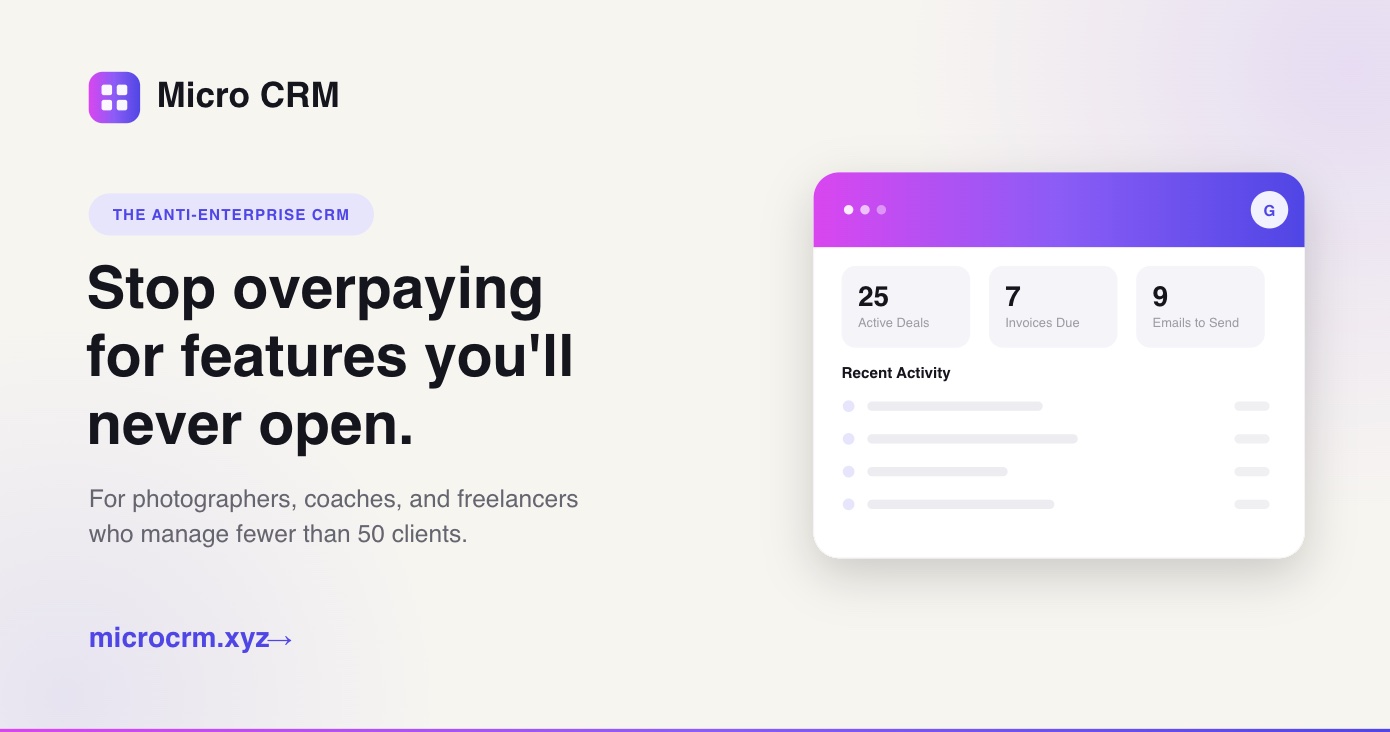
Table of Contents
- 1. MicroCRM
- 2. HubSpot CRM
- 3. Zoho CRM Free Edition
- 4. Bigin by Zoho CRM
- 5. Freshsales Freshworks CRM
- 6. Capsule CRM
- 7. Bitrix24
- 8. EngageBay
- 9. Flowlu
- 10. Vtiger CRM One Pilot
- Top 10 Free Simple CRMs Comparison
- How to Choose and Implement Your Simple Free CRM
1. MicroCRM
MicroCRM is the kind of tool I reach for when I want the CRM to stay out of the way. It keeps contacts, a Kanban pipeline, invoicing, email follow-ups, and a calendar in one lightweight interface, which is usually what freelancers need when they are tired of connecting separate apps. The platform also offers a free plan with no credit card required, so it is easy to test before you commit.
The first session is where the practical value becomes clear. A free CRM works best when it covers the basics, contact management, deal tracking, and simple reporting, without forcing you through heavy setup or enterprise-style controls (OfficeClip CRM statistics). That is the appeal of a focused tool. If you are managing client work, quotes, and billing at the same time, you need a short path from lead to invoice, not another system with too many layers.
What makes it strong for freelance work
MicroCRM fits the way small service businesses usually work. It is not trying to be a marketing suite first, it is built to help you manage client relationships with less friction. The Kanban pipeline is easy to read, the invoice flow is built in, and the email automation helps you avoid relying on memory for follow-ups.
Practical rule: if you cannot create a contact, move a deal, and send an invoice without reading a manual, the CRM is too heavy for most solo businesses.
The tradeoffs that matter
The limitation is part of the design. MicroCRM does not try to compete with the larger automation layers you get in bigger platforms, and that is a reasonable trade-off if you are a freelancer rather than a sales operations team. The result is less complexity, but also fewer advanced controls. That trade-off matters because weak lead handling still wastes time and leaves opportunities slipping through the cracks, so the ultimate goal is consistent use, not feature sprawl.
A focused tool can reduce that leakage if you keep it updated.
Quick setup that actually feels quick
The setup path is straightforward. Sign up with an email, create your first contact, and build a pipeline stage, then start logging work. That matters more than feature count because CRM adoption often fails after signup, not before it. A lighter system like MicroCRM is easier to keep active day to day, which is the whole point of using a CRM instead of another spreadsheet.
Website: MicroCRM
2. HubSpot CRM
HubSpot CRM is a strong default if you want a polished interface and a clear path to grow later. It keeps contacts, companies, deals, tasks, and timeline activity in one place, and the layout is easy to learn without a long setup grind. HubSpot's free CRM is positioned for teams of up to 2 users, and the free tier ties together contacts, sales activity, communication history, deal pipelines, import, and reporting in one system.
For freelancers, that mix helps and gets in the way at the same time. The setup is quick, you can connect your inbox, and you can start logging activity without building much from scratch. The downside is that the free plan is built to pull you into the broader HubSpot ecosystem, not to stay stripped down forever. That is workable if you expect to add marketing or service tools later, but it is more than you need if your only job is keeping client work organized.
Where it works and where it gets in the way
HubSpot does well when clean records and a mature ecosystem matter more than minimalism. Free forms, meeting links, email tools, and marketplace integrations make it easy to get started without stitching together separate apps. The tradeoff is that the free plan leaves out the deeper automation and reporting that make a CRM earn its keep once your client list and follow-up load grow.
If you want a broader view of how HubSpot compares with other no-cost tools, the best free CRM options guide is a useful internal starting point. HubSpot is often the reference point, but that does not make it the right fit for every solo workflow.
It suits freelancers who expect to outgrow a simple setup and want a platform that can expand with them. If you already know you will need more tools later, the free plan gives you a sensible place to begin. If you want a lean CRM that stays lean, HubSpot can feel like the first step into a much larger system.
Website: HubSpot CRM
3. Zoho CRM Free Edition
Zoho CRM's free edition is one of the more generous options for a very small operation. The free plan supports up to 3 users and includes leads, contacts, accounts, deals, tasks, and events, which gives a freelancer or tiny team enough structure to move off spreadsheets without losing track of the basics. Zoho also has a long track record as a suite company, so the free CRM can sit inside a larger system later.
The upside is easy to see. Three-user access works for a freelancer with a partner, a small studio, or a coach who wants an assistant in the same workspace. The trade-off is just as clear. Zoho's interface can feel busy, especially if you are not using most of the modules, and the free plan leaves out some of the reporting and automation people expect once they start relying on a CRM every day.
The small-team sweet spot
Zoho works best when you want structure and do not want to pay for it yet. You get enough contact and deal management to track conversations properly, and you get a mobile presence that helps with updates on the go. If your business is still small enough that you can keep your sales process simple, the free edition can carry real operational weight.
The catch is setup time. You will likely spend a little while hiding the clutter and shaping the workspace to your actual workflow. That is not a deal-breaker, but it is a real difference from a more stripped-down tool. For readers comparing feature sets, the CRM comparison guide is worth keeping open in another tab.
A freelancer who wants a free CRM to stay organized without rebuilding the whole sales process around it can get useful mileage here. The plan gives enough room for basic client tracking, but the extra interface weight means it works best for people willing to spend time tuning the setup instead of expecting instant simplicity.
Website: Zoho CRM Free Edition
4. Bigin by Zoho CRM
Bigin is the easier Zoho product to recommend when the main CRM feels too heavy. It keeps the experience centered on the pipeline, which fits solo operators who mainly need to see leads move from one stage to the next. The free plan is limited, but the interface stays clean and the mental load stays low.
That simplicity matters for freelancers and other micro-business owners who delay CRM adoption because the setup looks like extra admin. CRM usage is still much lower in smaller business segments than in larger SMBs, with synthesized 2026 benchmarks putting firms with fewer than 10 employees at roughly 30 to 45% CRM usage and SMBs with 10 to 100 employees at 60 to 75% (Nordics CRM stats 2026). The gap points to a real market problem. The issue is not more features, it is easier adoption. Bigin is built around that idea by putting the pipeline at the center of the product.
Why it feels easier than full Zoho CRM
The layout is direct. You get stages, activities, contacts, and company records without a flood of extra modules, so the first setup pass is usually simpler than with full Zoho CRM. For freelancers, that matters because most client workflows are straightforward. A lead comes in, a conversation happens, a proposal goes out, the deal moves, and follow-up stays visible without extra configuration.
A smaller footprint also makes it easier to keep the workspace readable. If you do not need a broad CRM system yet, Bigin gives you enough structure to track work without asking you to redesign your whole sales process. That is a significant advantage for solo operators who want order more than complexity.
The hard limit to watch
Bigin is intentionally narrow. If you need strong marketing automation, wider analytics, or a multi-channel sales stack, you will run into the ceiling quickly. That limitation is acceptable when your goal is a simple tool that gets used, but it is still the trade-off for low friction.
The practical question is whether the free plan matches your actual routine. A pipeline-first CRM only works if you open it regularly, update stages accurately, and use it as part of client follow-up. If the dashboard gets ignored after the first week, the simplicity did not help enough.
Website: Bigin by Zoho CRM
5. Freshsales Freshworks CRM
Freshsales sits in a practical middle ground. It gives a solo freelancer or a small client-facing team a cleaner path than many bloated CRMs, while still leaving room to grow into a more complete sales setup later. The free plan supports up to 3 users and centers on contacts, accounts, deals, and tasks, which is enough to keep a basic pipeline honest without turning the first setup into a project (Freshsales pricing).
I find Freshsales useful for people who want a modern interface without paying with extra setup work. The mobile app helps if you are moving between meetings, client calls, and desk time. The core flow is easy to follow, but the free tier leaves out the parts that usually matter once you start depending on a CRM every day, especially phone, chat, and deeper reporting. Those capabilities exist in the broader Freshworks stack, but they are tied to higher tiers.
Good fit for lead tracking, not for overbuilding
Freshsales makes sense if you mainly need to track inbound leads and a handful of active deals. The interface helps you stay organized, and it does not force you to design a full sales process before you have even used the product. For freelancers, that means you can start with a working pipeline and refine the workflow as your client load becomes clearer.
The tradeoff is packaging clarity. Freshworks splits its products and tiers across several plans, so comparing what is free, what is included, and what sits behind an upgrade can take more attention than it should. That is not a usability flaw inside the app, but it does affect planning if you want to avoid buying into a tool that looks simple until the limits show up.
Website: Freshsales
6. Capsule CRM
Capsule is one of the cleanest simple CRM free options if your priority is contact management without extra clutter. The free plan includes 250 contacts, 1 sales pipeline, and up to 2 users, which is a narrow but workable setup for a freelancer with a small client list (Capsule CRM). The appeal shows up as soon as you log in. There is very little visual noise, and that alone can make it easier to keep the CRM in daily use.
The product feels built for people who want the lightest possible CRM overhead. Contacts and organizations are easy to organize, the pipeline is simple to follow, and the calendar and task views keep follow-ups visible. The tradeoff is equally clear. The contact cap is low if you are actively collecting leads or keeping a long prospect list, so a growing business can reach the limit faster than expected.
Best for people who want the least possible friction
Capsule works well when you do not need many extras. You want a clean place to store contacts, review history, and move a few deals forward. That is enough for many consultants, designers, and solo service businesses that do not run heavy outreach campaigns.
It also suits freelancers who prefer a CRM that stays out of the way. A simple layout reduces setup time and makes it easier to keep records current, which matters more than flashy features if you are juggling client work, admin, and prospect follow-up in the same day.
Where it stops being enough
Capsule does not provide much built-in marketing support. If you need campaigns, support tools, or richer automation, you will need to add those elsewhere. For some freelancers, that is a reasonable tradeoff. For others, it turns Capsule into a stepping stone instead of the final system.
It also depends on discipline. A simple CRM only helps if you use it every day, and Capsule gives you enough structure to do that without forcing a larger workflow on you. The downside is that once your process gets more complex, you may outgrow the free tier before you outgrow the need for organization.
Website: Capsule CRM
7. Bitrix24
A freelancer who wants one place for contacts, deal tracking, internal chat, and project work will usually notice Bitrix24 quickly. The free plan is broad, with unlimited users and 5GB online storage, plus core CRM functions, tasks, projects, chat, and other workspace tools (Bitrix24). That mix makes it attractive for small businesses that care more about centralizing work than keeping the interface minimal.
The main benefit is consolidation. Contacts, deals, team chat, and project work can live in the same system, which helps small agencies and service teams avoid stitching together separate tools for every job. The tradeoff shows up fast in daily use. The interface can feel crowded, and the CRM layer is easy to miss when the rest of the workspace is competing for attention.
Strong on breadth, weaker on calm
Bitrix24 works well if the goal is to reduce the number of tools you pay for. It asks for more attention than a simple CRM, because it behaves more like a business operating system than a focused contact manager.
That flexibility can save time for a small team, but it can also wear you down. If you are a freelancer who only needs a client list and a pipeline, the platform may feel heavier than the job requires. If you run a small business that needs internal chat, tasks, and CRM together, the same setup can be practical because it keeps daily work in one place.
Setup matters here more than the sales page suggests. I've found that a free CRM only stays useful when it is easy to keep current, so the first step is to decide which parts you will use, then ignore the rest. If you want a cleaner comparison before deciding, the best free CRM for small business guide is a useful reference point, because Bitrix24 sits near the all-in-one end of that spectrum.
Website: Bitrix24
8. EngageBay
EngageBay stands out because it tries to cover more than sales tracking from the start. The free plan includes 250 contacts and 1,000 branded emails per month, along with basic email marketing, forms, live chat, and help desk features. (EngageBay) For a freelancer or small team that wants sales, outreach, and support in one place, that mix can reduce tool sprawl without forcing an immediate paid upgrade.
Its appeal is scope. Many free CRM plans stop at contacts and deals, with maybe a light email add-on. EngageBay also brings in customer support tools, which matters if you want inquiries and follow-up handled inside the same workspace. The tradeoff is usability. The interface is usable, but it does not feel as polished as some larger platforms, and the contact cap becomes a constraint once your list starts growing.
Useful when your CRM has to touch marketing
A small agency, solo founder, or early-stage startup can use EngageBay to connect lead capture with follow-up without spending upfront. It gives you more surface area than a basic free CRM, so you can test whether your lead flow, email nurturing, and sales process fit together before paying for a larger stack.
That extra breadth only helps if you will use it. If you just need a client list and a pipeline, the marketing and support modules can add clutter instead of clarity.
Where it can feel restrictive
The contact ceiling is the main limit. Once your list grows, you have to decide whether the added tools are worth the upgrade or whether a simpler free CRM will stay easier to manage. For freelancers, that decision often comes down to how much of the workflow happens before the sale and how much happens after it.
Website: EngageBay
9. Flowlu
Flowlu fits service businesses that need more than a CRM, but do not want a full operations suite. The free plan supports 2 users, 1GB storage, and a single pipeline, and it ties CRM to projects, tasks, and invoicing in one workspace. For freelancers who bill after delivery, that setup can keep the sales handoff and the money side in the same place.
I like Flowlu for client lifecycle work. A lead can become a project, the project can become an invoice, and the same system keeps follow-ups visible along the way. That reduces the risk of losing context between sales and billing, which is a common problem for solo operators and small agencies.
Strong for project-based billing
Flowlu makes sense if your CRM and invoicing need to live together. You can track opportunities, manage work, and produce invoices without bouncing between tools. That is useful when you want a light business management layer rather than a pure sales stack.
It also suits freelancers who sell a service, deliver the work, then invoice from the same record. That flow is cleaner than stitching together a separate CRM, task app, and billing tool. The tradeoff is that you are accepting a broader system, so the setup takes more care than a very simple contact tracker.
The ceiling is real
Flowlu's automation and integration depth trails larger suites, so it will not feel like a deep enterprise CRM. It works best when the process is straightforward and the team is small. If you need a wider app ecosystem, the limits show up fast.
The free plan also stays tight by design. Once your workflow gets more complex, the single pipeline and storage limit force choices about what stays in the system and what gets pushed elsewhere. For freelancers, that is the main test, whether the convenience of one workspace is worth the narrower ceiling.
Website: Flowlu
10. Vtiger CRM One Pilot
A freelancer who wants a more traditional CRM, and is willing to spend a little time learning the layout, may find Vtiger's One Pilot a practical fit. The free edition supports 3 users and 1,000 contacts, and it includes basic contact, deal, and case management. The pilot model does not expire, so you can build and test a real workflow without rushing through a trial window. Vtiger
That matters if you are validating a CRM process for a tiny team and want to see how it holds up over time before paying. Vtiger is not as minimal as Capsule, and it does not feel as modern as some newer tools, but it gives you a more serious structure to work with. The tradeoff is clear. You get more system behavior to manage, and that means the setup takes more attention than a very simple contact tracker.
Good when you want stability, not novelty
Vtiger suits users who prefer a conventional CRM layout with distinct modules and activity tracking. You can organize contacts, deals, and cases in a way that feels familiar if you have used older CRM systems before. That kind of structure can reduce setup guesswork and make it easier to keep your process consistent as your needs grow.
The paid path is also straightforward if your workflow expands later. That helps if you do not want to rebuild everything from scratch after outgrowing the free plan. The tradeoff is that the interface expects you to do more upfront setup than lighter tools on this list, so the benefit only shows up if you use that structure.
Why the free pilot matters
A free edition that does not expire gives you room to evaluate the system properly. You can test real client work, follow-ups, and pipeline behavior over time instead of trying to judge everything in a short trial. That makes the free pilot useful for freelancers who want to see whether a CRM fits their actual habits, not just their first impression.
The downside is just as real. If your goal is the simplest possible setup, Vtiger may feel heavier than you need. It makes more sense when you want a stable CRM foundation and are comfortable trading some simplicity for a more organized workflow.
Website: Vtiger CRM One Pilot
Top 10 Free Simple CRMs Comparison
| Product | Core features | UX / Quality (★) | Value & Price (💰) | Target audience (👥) | Unique selling points (✨ / 🏆) |
|---|---|---|---|---|---|
| MicroCRM | Contacts, Kanban pipeline, invoicing (PDF, multi‑currency), email templates & sequences, calendar, reports | ★★★★☆, minimal, super fast onboarding | 💰 Free (50 contacts); Starter/Pro; limited‑time Lifetime deal | 👥 Freelancers, consultants, micro‑businesses (<50 clients) | ✨ Integrated invoicing + email sequences; pauseable account; AWS security 🏆 |
| HubSpot CRM | Contacts, deals, tasks, meeting scheduler, forms, basic email, large integrations | ★★★★☆, polished, scalable | 💰 Free tier; paid hubs can be expensive | 👥 Small businesses planning to scale | ✨ Free meeting scheduler & vast app marketplace; clear upgrade path 🏆 |
| Zoho CRM (Free) | Leads/contacts/accounts/deals, tasks, basic pipelines, mobile app | ★★★☆☆, powerful but busy interface | 💰 Free for up to 3 users; many advanced features paid | 👥 Small teams (≤3 users) | ✨ Generous 3‑user free plan; strong Zoho ecosystem |
| Bigin (Zoho) | Visual pipelines, contacts, call/email logging, simple webforms | ★★★★☆, pipeline‑centric, very easy to learn | 💰 Free (1 user, 500 records); paid tiers for growth | 👥 Solo entrepreneurs, freelancers | ✨ Clean pipeline UX; very fast setup 🏆 |
| Freshsales (Freshworks) | Contacts/accounts/deals, pipeline views, email integration, mobile app | ★★★★☆, modern, intuitive UI | 💰 Free (up to 3 users); AI/telephony on paid plans | 👥 Small sales teams eyeing growth | ✨ Clear upgrade path to AI and telephony features |
| Capsule CRM | Contacts & organizations, one pipeline, tasks, history | ★★★★☆, extremely clean, minimal | 💰 Free (250 contacts, 2 users); paid to scale | 👥 Freelancers & solo business owners | ✨ Ultra‑simple contact management; very short learning curve |
| Bitrix24 | Contacts, deals, pipelines, forms, chat, tasks, drive, projects | ★★★☆☆, very broad, can feel overwhelming | 💰 Free (unlimited users, 5GB); paid flat‑price plans for more features | 👥 Small businesses wanting tool consolidation | ✨ All‑in‑one workspace; unmatched free breadth 🏆 |
| EngageBay | Contacts, deals, basic email marketing, landing forms, live chat, helpdesk | ★★★☆☆, functional, less polished | 💰 Free (250 contacts, 1,000 emails/mo); low‑cost paid plans | 👥 Budget startups & small businesses | ✨ Live chat + helpdesk on free plan; strong multi‑module value |
| Flowlu | CRM pipelines, invoicing, projects, tasks, simple finance tools | ★★★★☆, logical for projects + CRM | 💰 Free (2 users, 1GB); paid for more users/storage | 👥 Service businesses, small agencies | ✨ Tight CRM ↔ invoicing ↔ project integration |
| Vtiger CRM (One Pilot) | Contacts, leads, deals, activity management, basic dashboards | ★★★☆☆, classic CRM UX, steeper learning curve | 💰 Free Pilot (3 users, 1,000 contacts); paid One editions to expand | 👥 Small teams preferring traditional CRM | ✨ Permanent free pilot for validation; long‑standing vendor |
How to Choose and Implement Your Simple Free CRM
What Does Simple Really Mean
Simple doesn't just mean fewer features. It means you can add a contact, create a deal, and track the next step without hunting through menus. That's a key test for a simple CRM free tool, especially for freelancers who don't have time for onboarding drama.
A simple CRM should feel intuitive on day one. If you need a setup call or a long internal training session to log basic client activity, the tool is already too heavy for the job. The best options on this list keep the core actions visible and obvious.
Watch the Limits Before You Commit
Free always comes with limits, and the limits matter more than the marketing. Pay attention to users, contacts, features, and usage caps before you commit. A plan with the wrong ceiling can force a migration at exactly the moment your business gets busy.
For freelancers, the safest choice is the plan that matches your current workload, plus a little room for the next several months. If you're already close to the limit on contacts or emails, you're not choosing a free CRM, you're choosing a short temporary stop.
Clean Your Data Before You Import
If you're moving from Excel or Google Sheets, clean the list first. Standardize names, remove duplicates, and delete stale contacts before the import. That small step matters because spreadsheet workflows are still common, and Salesforce's SMB research shows 62% of SMBs use email and 53% use spreadsheets to track customer information (Salesforce SMB trends report).
Practical rule: a messy import turns a CRM into a messier spreadsheet. A clean import turns it into a system.
Test the First Week, Not the Feature List
After signup, test five things quickly. Add a few contacts, create one deal, log one activity, send a test email if the plan supports it, and open the mobile app. That first-week test tells you more about long-term usefulness than a long checklist of features.
That's also where many CRMs fail. Adoption research suggests 40% to 60% daily usage is average, 70%+ daily active usage is a strong ROI threshold, and 90% to 95% adoption is best in class for a managed rollout (VantagePoint CRM adoption benchmark). If a tool is too clumsy to use every day, the free price won't save it.
Manage Your Business, Not Your Software
A good CRM should make your day quieter. It should centralize client history, keep follow-ups visible, and help you move from lead to invoice without extra admin. That's the practical win, and it's why tools like MicroCRM are worth a serious look when you want essentials without bloat.
If you're still bouncing between spreadsheets and email, pick one free CRM and test it this week. Start with your real contacts, your real deals, and your real invoice flow, then see whether the tool feels like a relief or another burden.
MicroCRM gives freelancers a simple way to manage clients, deals, invoices, and follow-ups without getting buried in software overhead. If you want one lightweight system that fits the way small businesses operate, visit MicroCRM and start for free, no credit card required.